When the Beatles Came to Bangladesh — and Bangladesh Came to the Beatles
I want you to picture something. It's August 1, 1971. Madison Square Garden, both afternoon and evening shows, roughly 40,000 tickets sold across two concerts. The air inside is thick and warm — no modern HVAC miracle, just bodies packed into a legendary arena. George Harrison walks out under the stage lights for the first time since the Beatles stopped touring in 1966. Five years of silence from the stage, and he breaks it for a country that most of the audience, honestly, could not have found on a map the week before.
But did Harrison know what he started?
The Concert for Bangladesh, pulled together because Ravi Shankar — Harrison's sitar guru and close friend — phoned him in desperation, raised $250,000 that single night. Over the years, the triple live album and the concert film pushed the total to roughly $12 million for UNICEF relief efforts supporting displaced Bangladeshis during the Liberation War. It was the first major benefit concert in rock history. Before Live Aid. Before Farm Aid. Before every stadium fundraiser that followed. And it carried Bangladesh's name.
Here's the thing. While Harrison was performing "While My Guitar Gently Weeps" on that New York stage to raise money for a country being born through bloodshed, young musicians in Dhaka were already hunched over their own guitars trying to figure out those exact chord shapes. The story runs in two directions at once, and that's what makes it worth telling.
The British Invasion Reaches Dhaka
The Beatles arrived in Bangladesh before Bangladesh even existed. Think about that for a second.
Throughout the 1960s, the Gramophone Company of Pakistan shipped LPs and 45-rpm singles into East Pakistan — Cliff Richard and the Shadows, Elvis, the Rolling Stones, the Beach Boys. These weren't available in big record shops with neon signs. They circulated hand to hand among college students in Dhaka and Chittagong, passed around dormitory rooms at Dhaka University, played on borrowed turntables at somebody's cousin's flat. A teenager would drop the needle on "A Hard Day's Night" and hear an electric guitar tone that sounded like the future. You don't forget a sound like that.
Windy Side of Care formed in Dhaka in 1964 — one of the earliest known bands in the region. They were Elvis and Cliff Richard guys at the core, but what they actually played was a wild stew of psychedelic rock, hard rock, blues, and Bengali classical music cranked up loud enough that, as the story goes, their grandfather flatly told them to turn it down. They never had a hit record. They never toured beyond local gigs.
But they mattered. They proved something crucial: Bangladeshi musicians weren't just absorbing Western rock passively. They were already messing with it, already pulling in ragas and folk scales, already asking, "What does this sound like if we do it our way?"
That question — what does Western rock sound like filtered through Bengali ears? — would drive the next sixty years of music.
The 1970s: A Nation Finds Its Rock Voice
Bangladesh declared independence in 1971. Same year as the Concert for Bangladesh at Madison Square Garden. Not a coincidence in spirit, even if the timelines were running on parallel tracks. The Liberation War broke open something in the culture. A generation of young musicians came out the other side understanding — in their bones, not just intellectually — that music could say things no speech or newspaper editorial ever could.
Let me jump ahead for a moment before coming back. In 2018, when Ayub Bachchu died of a heart attack, hundreds of thousands of Bangladeshis mourned. I'll get to him properly later. But his story starts here, in the 1970s, in the chaos and possibility that followed independence. Because the 1970s produced the mentors who would create Bachchu.
Azam Khan founded Uccharon in 1973 and became, almost immediately, Bangladesh's first genuine rock star. Khan had fought in the Liberation War — he'd seen things that don't fit into song lyrics, though he tried. He'd take the stage at the Hotel Intercontinental ballroom in Dhaka or at rally grounds in Chittagong, plugging a Fender Stratocaster into whatever amp he could find, and play with a rawness that made polite society deeply uncomfortable. "Ore Saleka, Ore Maleka" was a song about poverty and displacement sung with a sneer. "Rail Liner Bostite" was about people sleeping on train platforms because they had nowhere else to go. He wore his hair long. He didn't care what your parents thought.
Not everyone loved him. Honestly, a lot of people didn't. Conservative voices in Dhaka's cultural establishment saw him as vulgar, as too Western, as a bad influence. But the kids turning up to his shows? They heard something that sounded like truth.
Meanwhile, the Akhand Brothers — Lucky and Happy — were doing something gentler and equally important. Their melodic pop-rock treated Bengali melody with reverence while wrapping it in electric guitar, bass, and drums. "Abar Elo Je Shondha" (1972) had a sweetness that made you ache. "Ke Bashi Bajai Re" (1974) proved that a Bengali tune didn't have to be flattened or Westernized to fit a rock arrangement — it could sit right in the center and shine. Happy Akhand became a behind-the-scenes giant, mentoring younger musicians, passing along everything he knew about arranging and songwriting. One of those younger musicians was a teenager named Ayub Bachchu.
By the mid-1970s, Dhaka and Chittagong had between twenty and thirty active bands performing in clubs, hotel ballrooms, and makeshift concert grounds. You could hear the British Invasion in every chord change and guitar tone. But the words were Bangla, and the feeling was local. The accent was unmistakable.
The 1980s and 1990s: The Golden Era
Three bands. If you want to understand the 1980s in Bangladeshi rock, start with three names: Souls, Miles, and Feedback.
Souls dropped Bangladesh's first-ever band album, Super Souls, in 1980. Their track "Mon Shudhu Mon Chuyeche" became a massive hit — played on Radio Bangladesh, hummed by rickshaw pullers, known by people who had never touched a guitar in their lives. And that matters because it proved something the music industry needed to see: Bangladeshi audiences would actually buy domestic rock music. Not as a novelty. Not as a subcultural curiosity. As pop music they loved.
Miles, founded in 1978 by Happy Akhand, took Bengali melodies and Western pop-rock and wove them together so seamlessly that the seams vanished. Their catalog is one of the most beloved in Bangladeshi music. Full stop. Feedback came at it from a jazzier angle — more complex harmonies, a more cerebral approach — and carved out a loyal following among listeners who wanted something a bit more adventurous.
What did any of this have to do with the Beatles specifically? Not the riffs. Not the haircuts. It was the model. Four people in a room, writing their own material, playing their own instruments, saying something that matters — wrapped in melody you can't get out of your head. That philosophy, which the Beatles crystallized through Revolver and Sgt. Pepper's Lonely Hearts Club Band, taught rock musicians on every continent that there was no ceiling. You could be experimental and accessible. Sincere and complex. The studio itself could be an instrument. Souls and Miles and Feedback absorbed that lesson even if they never played a single Beatles cover.
Then the 1990s blew the doors open.
Warfaze had formed back in 1984, drawing from Led Zeppelin, Deep Purple, and Iron Maiden to build a Bangladeshi heavy metal tradition from scratch. By the 1990s they were producing some of the most technically impressive rock in South Asia. Artcell, founded in 1999, pushed even further — their album Oniket Prantor (2006) is a progressive metal landmark that folds Bengali folk motifs into time-signature-shifting compositions no Western band could have dreamed up. Pull up Artcell's "Oniket Prantor" on YouTube today and you'll find it sitting at over 50 million views. Fifty million. For a prog-metal track from Bangladesh sung entirely in Bangla. Let that number sink in.
Aurthohin brought doom metal and hard rock with Bengali poetry layered on top — imagine Black Sabbath raised on Rabindranath Tagore. LRB, led by Ayub Bachchu from 1991 until his death in 2018, became the cultural earthquake. Bachchu was a self-taught guitarist with an ear so sharp that musicians half a generation older deferred to him. He could play blues, he could play hard rock, he could play acoustic ballads that made entire audiences fall silent. As one fan once put it in an online tribute: "Only for LRB, people of all generations have been involved in the rock scene." His passing was mourned as a national loss, covered by every newspaper, felt by people who hadn't listened to a rock song in years.
The Concert for Bangladesh: A Legacy That Never Left
Let me circle back to George Harrison and that Madison Square Garden stage.
Harrison organized the Concert for Bangladesh because Shankar asked him to — it really was that simple at first. But Shankar's connection to Harrison ran deep. He'd been teaching Harrison sitar since the mid-1960s, and that friendship didn't just change Harrison's playing; it reshaped the Beatles. "Norwegian Wood." "Within You Without You." "Love You To." Indian classical music seeped into the most famous band on earth through that single relationship. When Bangladesh was burning in 1971, Harrison didn't respond as a celebrity doing charity. He responded as someone with skin in the game, someone whose musical identity had been rewired by a tradition rooted in the subcontinent.
The lineup that night was absurd. Harrison. Ringo Starr. Bob Dylan — who hadn't performed live in years and showed up anyway. Eric Clapton. Billy Preston. Leon Russell. Badfinger. Ravi Shankar himself opened the show with a raga that most of the rock audience had never heard anything like. More money for humanitarian relief than any prior rock event. The invention of a format — the benefit mega-concert — that would reshape how musicians engage with global crises for decades.
And it carried Bangladesh's name. A country that was, at that exact moment, fighting to exist.
In Bangladesh, the concert is remembered with something more complicated than simple gratitude. There's pride in it — the idea that the greatest rock musicians in the world stood on a stage and said this country matters. There's also a quiet awareness that Bangladesh's own musicians were never passive beneficiaries in a one-way cultural exchange. The Concert for Bangladesh didn't introduce rock to Dhaka. Rock was already in Dhaka. What the concert did was make the connection visible — the moment Western rock and Bengali music looked each other in the eye and recognized something shared.
The Beatles' Indirect Children: Contemporary Bangladesh
Fast forward to now, and the Beatles' fingerprints are everywhere in Bangladeshi music — just not where you'd expect.
Shironamhin might be the best example. One of the most respected contemporary bands in the country, they fold traditional instruments — the sarod, the esraj — into rock arrangements that pulse with a warmth studio-only production can't fake. Harrison would have recognized what they were doing instantly. He spent years learning to play instruments from a tradition that Shironamhin grew up inside. The cultural distance that Harrison had to travel, Shironamhin's musicians simply didn't. Their fusion sounds effortless because it is — it's their heritage played through Marshall amplifiers.
Nemesis brought a harder, more aggressive edge into the 2010s. Arbovirus layered wit and social commentary over punk-inflected rock. Chirkutt blended folk, electronica, and rock in ways that resist easy categorization — their live shows feel like a party and a religious experience happening simultaneously. Joler Gaan, the folk-fusion group that French President Macron made a point of visiting during his 2023 trip to Dhaka, draws directly from Baul and Lalon traditions — mystical Bengali folk music that predates the Beatles by centuries. On the surface, nothing to do with rock and roll. But underneath? There's the Beatles' central demonstration: you can take old, rooted, sacred music and run it through electric instruments without destroying the thing that made it sacred in the first place.
Not everyone agrees about the Beatles' influence, by the way. I've talked to younger musicians in Dhaka who shrug when you mention Harrison or Lennon. "We listen to Radiohead," one guitarist told me. "We listen to Tool. We listen to Bangla bands who came before us." And that's fair. Maybe the Beatles' influence is now so deeply baked into the DNA of global rock music that crediting them specifically feels like crediting the person who invented the wheel every time you drive a car.
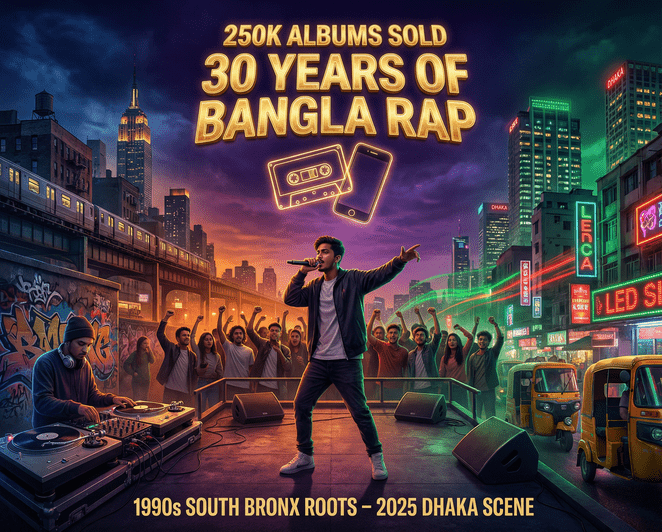
The Bangladeshi rock scene in 2025 faces real, unglamorous problems. Music piracy hasn't gone away. Streaming revenues, adjusted for local purchasing power, are painfully thin — a song with a million Spotify streams might earn a band less than the cost of a decent mixing session at Dhaka's Studio 58 or Audiolab. The live music infrastructure is uneven: a few good venues in Dhaka, fewer in Chittagong, almost nothing in smaller cities. Bands still struggle with the basics — reliable electricity at outdoor gigs, sound engineers who know what they're doing, promoters who actually pay.
But the music keeps coming. It hasn't stopped since the 1960s. From the first Gramophone Company LP that landed in a college student's hands in East Pakistan, through Azam Khan's snarling Stratocaster, through Souls and Miles filling concert halls, through LRB making an entire country fall in love with rock, through Artcell racking up 50 million YouTube views on a progressive metal masterpiece — the thread is continuous and it is unbroken.
Why This Connection Matters
Music history usually gets told as a story about influence radiating outward from a handful of centers — London, Memphis, New York, Los Angeles — to everywhere else. The rest of the world receives. The centers transmit.
The Beatles and Bangladesh break that story.
Bangladesh received rock and roll in the 1960s and did exactly what every living culture does with a borrowed form: it made the form its own. Bengali classical scales reshaped the chord progressions. Baul philosophy rewired the lyrics. The specific gravity of Bangla — the way the language sits in the mouth, the way its syllables fall — changed the vocal melodies. What came out the other side was music that belongs to Bangladesh in a way that cannot be reproduced in a London or New York studio, no matter how talented the musicians.
And the flow went the other direction too. Harrison learned from Ravi Shankar — whose musical tradition is rooted in the same soil as Bangladeshi music — and that learning changed the Beatles forever. Then, when Bangladesh needed the world to pay attention, Harrison organized a concert that invented the template for how rock musicians respond to humanitarian crises. The exchange was never one-way. It never is when music is involved.
Maybe that's the deepest thing the Beatles left in Bangladesh. Not a chord progression. Not a guitar tone. Not a hairstyle. Just the proof — lived and recorded and still echoing — that music crosses borders in both directions, and that what returns from the crossing is always, always richer than what went out.
win-tk.org is a wintk publication. This article was produced by our editorial team for entertainment and cultural commentary purposes.