How Common Are Fake News Websites in Bangladesh?
Bangladesh's digital media landscape includes thousands of registered online news portals — the exact count runs into the thousands, many at the district and upazila level — alongside an unknown number of unregistered sites, lookalike domains, and Facebook pages presenting themselves as news outlets without any editorial infrastructure behind them. The misinformation environment is significant: the Tech Global Institute documented coordinated disinformation campaigns on social media connected to Bangladesh's political transition in late 2024, Facebook bot networks linked to political actors were identified by The Daily Star in August 2024, and multiple international press freedom organisations have documented the circulation of false information during the July 2024 uprising and subsequent flood seasons.
The challenge for an ordinary Bangladeshi reader is that fake news websites and low-credibility portals are designed to look credible. They use professional-looking layouts, they copy the visual design conventions of established outlets, and they choose names that closely resemble trusted publications. A reader encountering an unfamiliar news site via a Facebook share or WhatsApp forward has no immediate way of knowing whether it is an established outlet with editorial standards or a site created recently for the purpose of spreading a specific false narrative. The trust indicators in this guide are designed to help readers make that determination quickly and practically.
What Are the 7 Trust Indicators of a Legitimate News Website?
A legitimate news website will typically demonstrate most or all of the following seven characteristics. The more of these a site demonstrates, the more it can be considered reliable. The fewer it demonstrates, the more scrutiny its content deserves before being shared.
1. Named editor-in-chief and editorial team. Every legitimate news outlet has a named editor-in-chief whose identity can be verified. The editorial team — reporters, sub-editors, section editors — are typically listed on an About or Team page. The editor's name appears in editorial statements, corrections notices, and in media industry databases. If you cannot find the name of the editor-in-chief of a news website after searching their About page, their Contact page, and the masthead of the site, treat its content with significant caution.
2. A functional and detailed About page. Legitimate news outlets have substantive About pages that explain the outlet's history, ownership, editorial mission, and funding model. A vague About page saying only "We publish news about Bangladesh" with no additional information is a warning sign. A missing About page is a serious red flag. What to look for: founding date, named founders, editorial philosophy, and disclosure of ownership structure.
3. A physical address and verifiable contact information. Legitimate news outlets have a verifiable physical address — at minimum a city and district — and contact information that works: an email address that receives responses, a phone number, or both. Anonymous contact forms with no identifying information attached are insufficient. Outlets that have been registered with BTRC as online news portals will have submitted contact information as part of registration.
4. Consistent publication history. A legitimate news outlet has published content consistently over a period of months or years. You can verify this by checking the site's archive or by using the Wayback Machine (web.archive.org) to see when the site first appeared and how its content has evolved. A site created two weeks ago that claims to be an established news portal is almost certainly not one. Check the oldest content available on the site — legitimate outlets accumulate years of published material.
5. Articles with named bylines linked to verifiable journalists. Every reported news article on a legitimate outlet should carry the byline of the journalist who wrote it. That journalist's name should be searchable — on the outlet's own journalist profile pages, on LinkedIn, in other publications' archives, or in press databases. If every article on a site says "Staff Reporter" with no individual bylines, that is not how legitimate news outlets operate at scale.
6. A corrections and editorial standards policy. Legitimate news outlets acknowledge errors. Their corrections policy — whether a dedicated page, a standard note at the bottom of corrected articles, or a published editorial standards document — demonstrates accountability. Searching a site's corrections page (or the absence of one) is one of the fastest credibility checks available.
7. Membership in or recognition by journalism bodies. Legitimate outlets in Bangladesh may be members of the Editors' Council (Sampodak Parishad), registered under the relevant government press registration process, or recognised by the IFCN-affiliated fact-checking network. Some may be members of the Online News Publishers Association (ONAB). These affiliations are not guarantees of quality — but their presence is a positive indicator, and their complete absence in an outlet that claims to be a major publication is a warning sign.
How to Check If a Website Is Registered in Bangladesh
Bangladesh's online news portal registration system is administered by the Information and Broadcasting Ministry and related authorities. Legitimate online news portals operating in Bangladesh are expected to register through the relevant government process. However, the registration database is not always easily publicly searchable, and the presence or absence of formal registration is not a definitive indicator of credibility — many legitimate small outlets are unregistered, and some unscrupulous actors have registered sites.
The Bangladesh Telecommunication Regulatory Commission (BTRC) is the primary regulatory body for internet services and digital content in Bangladesh. Its website (btrc.gov.bd) maintains registers of licensed operators and service providers. For specific concerns about a website — particularly if you suspect it is operating illegally or spreading harmful content — BTRC's complaint mechanism is the appropriate channel.
A more practically useful check is the domain registration look-up. Using any WHOIS service (whois.com, lookup.icann.org, or who.is), enter the website's domain name to see: when the domain was registered; who registered it (or whether the registrant has used privacy protection to hide their identity); where the domain was registered; and when the registration expires. This does not reveal the quality of a site's journalism, but it reveals something important: when the site was created. A domain registered in the last few weeks or months for a publication that claims to have been covering Bangladesh news for years is a significant inconsistency that warrants further scrutiny.
Domain Age and WHOIS — What They Reveal About a News Site
Domain age is one of the most useful quick checks for evaluating an unfamiliar news website. Here is what different scenarios typically indicate.
Domain registered more than 5 years ago: The site has been operating long enough to have accumulated a track record. This is not a guarantee of quality — a site can be low-credibility for five years — but it rules out the specific pattern of fresh sites created to spread a specific false narrative around a current event.
Domain registered 1–5 years ago: Neutral. Many legitimate outlets have launched in this period. Apply the other trust indicators to assess credibility.
Domain registered in the last 12 months, especially the last 3 months: Treat with significant caution. New sites can be legitimate — every outlet starts somewhere — but a newly registered domain making major claims or publishing political content around a current controversy should be verified against multiple other trust indicators before being trusted.
Registrant identity hidden (privacy protection): Many legitimate sites use domain privacy protection, so this alone is not a red flag. But a recently created site with hidden registrant identity, no About page, and no named editorial team — all three together — is a strong indicator of a site not worth trusting.
You can also use the Wayback Machine (web.archive.org) to check a site's archival history. Enter the URL and the Wayback Machine shows you the earliest archived version of the site and how it has changed over time. A site claiming to be an established publication but with no Wayback Machine archive before last month has not been around as long as it claims.
Social Proof — How to Check If Real Journalists Work for a News Outlet
The journalist byline check is one of the most reliable trust indicators available for verifying a news outlet's credibility. Legitimate outlets employ real journalists whose professional identities are verifiable. Fake or low-credibility outlets typically avoid named bylines because named bylines create accountability.
How to verify a journalist's identity: Take the byline name from the article and search it on Google, LinkedIn, and Facebook. A journalist with a legitimate professional identity will typically have: a LinkedIn profile listing their employer and work history; a history of articles published at the same outlet and potentially at previous publications; mentions in other news stories (for journalists who have been interviewed or quoted); and possibly social media accounts where they interact as journalists.
If a search for the byline name produces no results — no LinkedIn, no previous articles, no professional presence of any kind — the byline is likely fabricated. This is a common practice in low-credibility content farms: articles are attributed to "journalists" whose names produce no search results because they do not exist as working journalists.
Cross-reference with journalism databases: The Dhaka-based journalist community is relatively small and interconnected. Names of journalists at established outlets appear in journalism association databases, press club membership lists, and awards records. The Bangladesh Editors' Council (Sampodak Parishad), the Bangladesh Federal Union of Journalists (BFUJ), and the Dhaka Union of Journalists (DUJ) maintain membership structures that create verifiable records of working journalists. An outlet claiming to employ senior journalists whose names appear in none of these records is worth questioning.
For a broader guide to evaluating news sources — including the complete 5-sign and 5-red-flag frameworks — see our WINTK fact-checking and editorial standards guide. For the legal context around online content in Bangladesh, including what the Cyber Security Ordinance means for online publishers and readers, see our Bangladesh Cyber Security Act 2026 guide.
What to Do If You Find a Fake News Website
If you have identified a website that you believe is spreading false news, impersonating a legitimate outlet, or operating deceptively, the following channels are available for reporting.
BTRC (Bangladesh Telecommunication Regulatory Commission): BTRC maintains a complaint system at btrc.gov.bd for reporting harmful or illegal online content. Reports about websites spreading misinformation, operating without registration, or impersonating legitimate media can be submitted through this channel. BTRC has the technical and legal authority to direct the blocking of specific websites and URLs in Bangladesh.
Rumor Scanner (rumorscanner.com): Bangladesh's primary dedicated fact-checking organisation. If you have encountered a specific false claim — rather than a general concern about a website — Rumor Scanner is the appropriate channel. Submit the claim through their website and their team will investigate and publish a fact-check if they determine the claim warrants one. Rumor Scanner is IFCN-certified and publishes in both English and Bengali.
Bangladesh Cyber Crime Unit: The Bangladesh Police Cyber Crime Unit handles complaints about online criminal activity, including fraud, identity theft, and defamation. If a fake news website is specifically targeting individuals with false accusations or is engaged in fraud using a journalism cover, a complaint to the Cyber Crime Unit is appropriate. Their online complaint portal is accessible through the Bangladesh Police website (police.gov.bd).
Google Safe Browsing: If a website is hosting malware, phishing content, or deceptive forms alongside fake news, it can be reported to Google Safe Browsing at safebrowsing.google.com/safebrowsing/report_phish/. Google will investigate and may add the site to its list of dangerous websites, which automatically warns users before they visit.
Facebook and social media platforms: If fake news content is spreading through a Facebook page or group, the individual posts can be reported using Facebook's built-in reporting mechanism (the three dots on any post → Report Post). Facebook has a specific category for false news. Similarly, WhatsApp messages can be forwarded to the Rumor Scanner WhatsApp number for fact-checking. On YouTube, misleading content can be reported through the flag function below any video.
For the specific context of TikTok and youth-targeted misinformation, see our TikTok challenges and youth safety guide for Bangladesh, which covers how misleading content spreads specifically on TikTok and what young users can do.
Fake News Website Trust Checklist
Trust CheckWhat Legitimate Sites HaveWhat Fake Sites Often Lack Editor identityNamed editor-in-chief, verifiableNo named editor anywhere on site About pageDetailed: history, ownership, missionVague or absent Contact informationPhysical address, working email/phoneAnonymous form only, no address Publication historyYears of archived contentOnly recent articles, no archive Journalist bylinesNamed, verifiable journalists"Staff Reporter" only, no searchable bylines Corrections policyPublished corrections when errors occurNo corrections ever published Domain age (WHOIS)Multi-year registration historyDomain created weeks or months ago Wayback Machine archiveYears of archived pagesFirst archived version is recent Journalist search resultsNamed journalists appear in searchByline names return zero search results Journalism body membershipListed in industry associationsNo association membership verifiableFrequently Asked Questions
How do I know if a news website in Bangladesh is fake?
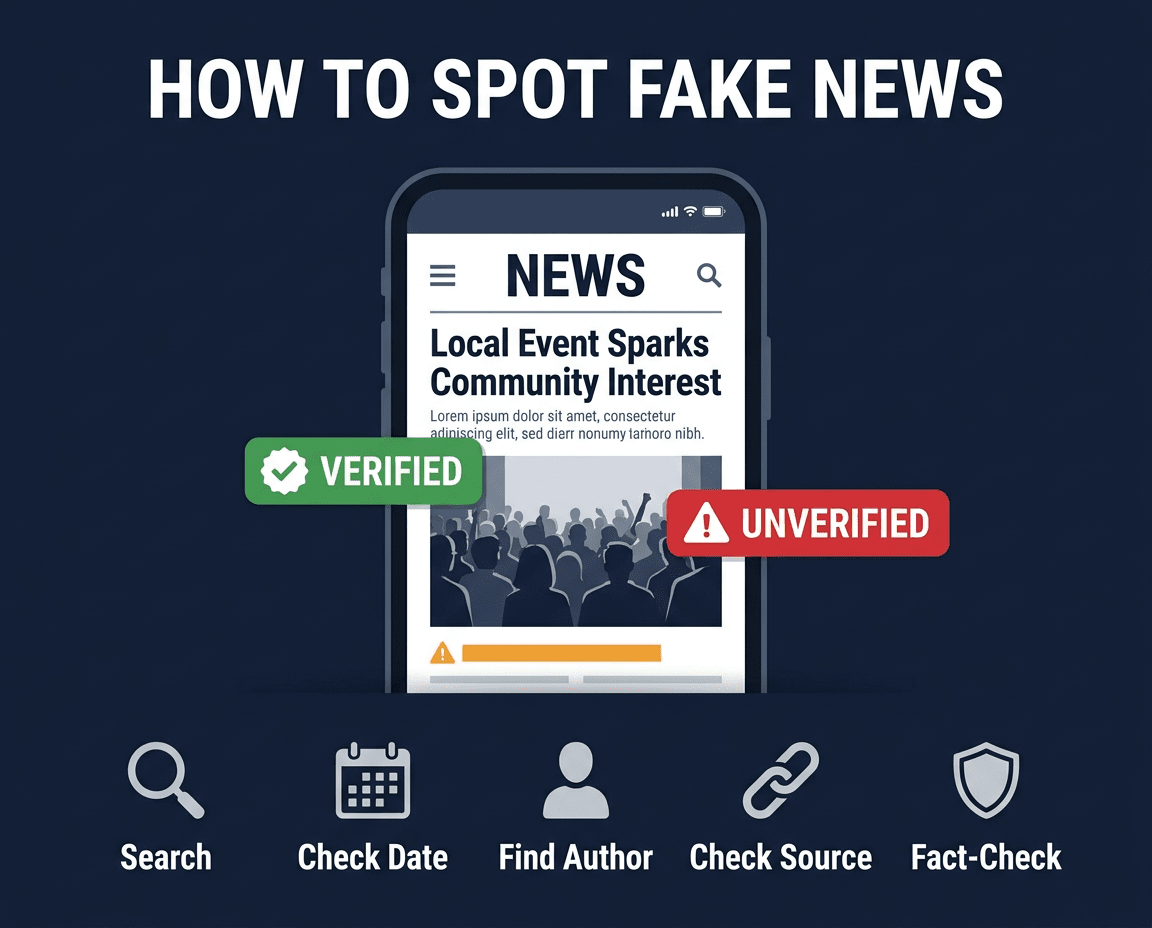
Check seven trust indicators: named editor-in-chief, detailed About page, verifiable contact information, years of publication history, named journalist bylines that appear in search results, a corrections policy, and a domain age confirmed by WHOIS lookup. Legitimate outlets demonstrate most of these; fake sites typically lack several.
How do I check when a website was created?
Use any WHOIS lookup tool — whois.com, who.is, or lookup.icann.org — and enter the website's domain name. The result shows when the domain was registered. Also check web.archive.org (Wayback Machine) to see when the site first appeared in archived web snapshots. A site claiming to be established but registered recently is a strong red flag.
Where do I report a fake news website in Bangladesh?
Report to BTRC (btrc.gov.bd) for illegal or harmful content. Submit specific false claims to Rumor Scanner (rumorscanner.com) for fact-checking. For criminal activity, file a complaint with the Bangladesh Police Cyber Crime Unit (police.gov.bd). Report misleading content directly to Facebook, YouTube, or TikTok through each platform's reporting mechanism.
How do I verify if a journalist is real?
Search the byline name on Google and LinkedIn. A real journalist will have a verifiable professional history — previous articles, social media presence, or mention in journalism databases. A byline that returns no search results at all is almost certainly fabricated.
Are lookalike domain names a common fake news tactic in Bangladesh?
Yes. Lookalike domains — URLs that closely resemble established outlets but differ slightly — are a common misinformation vector. Always check the full URL carefully. "thedailystar24.com" is not The Daily Star (thedailystar.net). "Prothomoalo.com" is not Prothom Alo (prothomalo.com). When in doubt, navigate directly to the outlet's known URL rather than clicking a shared link.