Why Media Literacy Matters in Bangladesh Right Now
Bangladesh has 82.8 million internet users, 60 million Facebook accounts, and a digital media landscape where thousands of news portals compete for attention — many with no clear editorial standards, no named journalists, and no accountability mechanism if they publish false information. The consequences of this environment are not abstract. During the July 2024 uprising, false casualty figures, fabricated government statements, and manipulated images circulated on WhatsApp and Facebook ahead of verified reporting — shaping public behaviour during a moment of genuine political crisis. During Cyclone Remal's landfall in May 2024, misinformation about safe routes and shelter locations spread through the same channels. The Bangladesh Telecommunication Regulatory Commission and multiple civil society organisations have documented hundreds of misinformation incidents per month during peak political periods.
Media literacy — the ability to evaluate, question, and verify information before sharing it — is not a technical skill reserved for journalists. It is a practical necessity for anyone who uses Facebook, WhatsApp, YouTube, or any news app in Bangladesh. This guide explains how to evaluate online news sources, identify red flags that indicate unreliable content, and use free tools to verify claims before sharing them.
What Are the 5 Signs a News Source Is Reliable?
A reliable news source — whether a major outlet or a small independent site — will typically demonstrate most or all of the following characteristics. No single characteristic is definitive on its own; the combination matters.
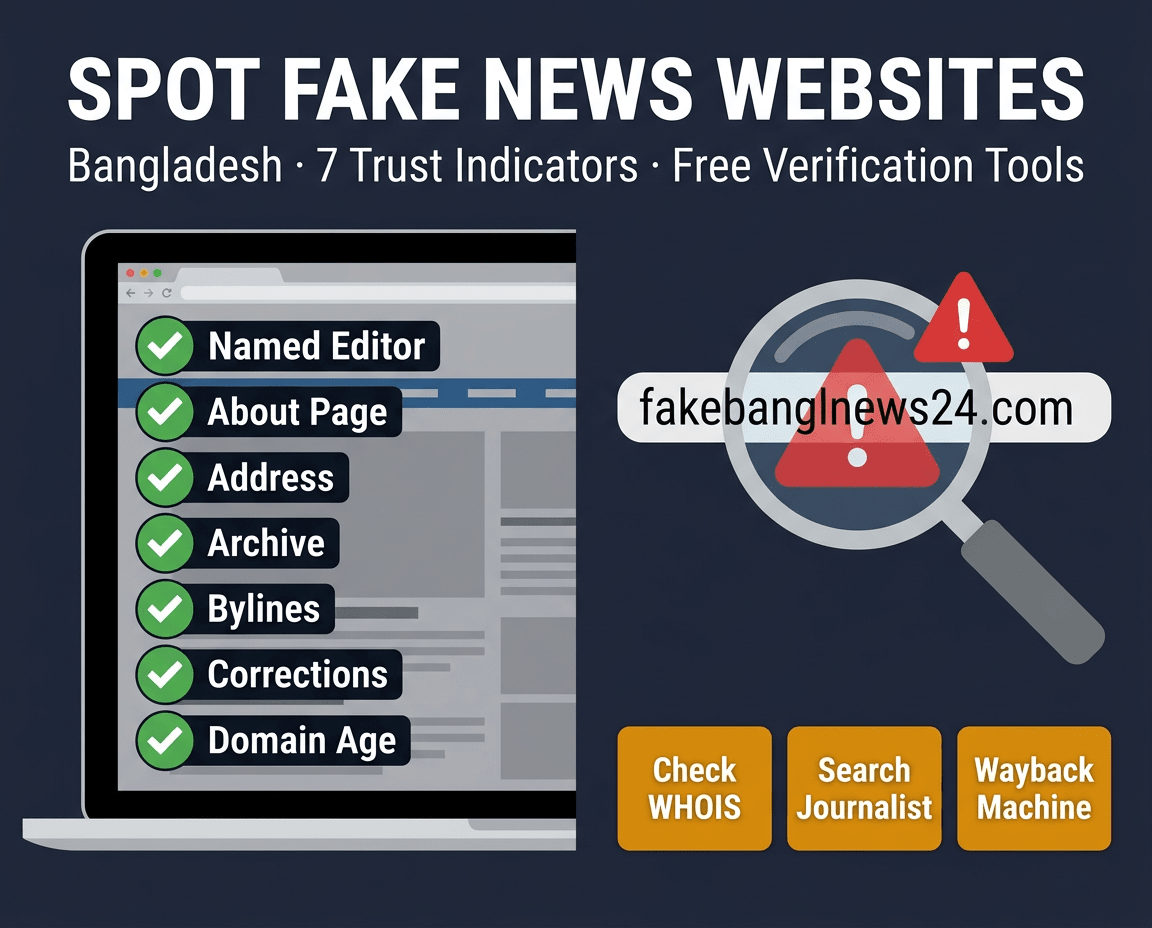
1. Named journalists and editors. Reliable news outlets publish articles with named authors. The editor of the outlet is publicly identified. If an article has no byline, no named journalist, and no identified editor-in-chief, that is a significant credibility gap. It does not make the article automatically false — some wire service content is published without specific bylines — but it removes the accountability mechanism that named journalism creates. Journalists who put their name on a story have professional and legal exposure that anonymous publishers do not.
2. Transparent ownership and funding. Who owns the outlet? Is the ownership structure publicly disclosed? Reliable publications disclose who funds them — whether that is advertising revenue, subscription fees, or a parent company. If you cannot find any information about who owns or operates a news website, treat its content with additional scrutiny. In Bangladesh, many reputable outlets — The Daily Star, Prothom Alo, bdnews24, Dhaka Tribune — publish ownership and editorial information on their About pages. Many low-credibility sites do not.
3. Dated and sourced reporting. Every factual claim in a reliable news article should be traceable to a source — a government announcement, a named official, a document, an on-record interview. Reliable outlets include the date of publication prominently. If an article makes specific statistical claims without sourcing them, or if the publication date is absent or buried, both are warning signs. Check whether key claims link to or cite primary sources.
4. Corrections policy. Every news outlet makes mistakes. What distinguishes reliable outlets from unreliable ones is how they handle errors. Reliable outlets publish corrections — typically at the bottom of the original article or in a dedicated corrections section — acknowledging what was wrong and what the accurate information is. If you cannot find any evidence that an outlet has ever corrected a story, this does not mean they have never made errors; it likely means they do not acknowledge errors when they make them.
5. Consistent coverage with an identifiable editorial position. A reliable outlet covers events consistently over time, has a recognisable tone and editorial position, and can be evaluated against its own track record. New websites created recently and claiming to have broken major stories should be treated more cautiously than established outlets with a documented history. Check when the domain was registered — tools like WHOIS lookup show when a website was created, which can reveal whether a site claiming to be an established publication is in fact very recently created.
What Are the 5 Red Flags That Indicate Fake News?
The following characteristics do not always mean a piece of content is false — but they are strong indicators that require verification before sharing.
1. Extreme headline that triggers strong emotion. Content engineered to generate outrage, fear, or excitement tends to spread faster than calm factual reporting. If a headline makes you angry, frightened, or triumphant before you have read the article, that emotional response is a signal to slow down and verify. This is particularly true of headlines that involve political figures, religious communities, or national security. The emotional escalation pattern is a technique deliberately used by misinformation producers to bypass critical thinking.
2. No date or a recycled date. One of the most common misinformation techniques in Bangladesh's social media environment is sharing old news as if it is current — cyclone warnings from 2022, election results from previous years, violence incidents from other countries. Always check the publication date. If a story is being circulated on Facebook or WhatsApp without any date, or with a date that looks recently added, verify the original publication date before assuming it is current news.
3. No named author or outlet. Screenshots of text claiming to be from news sources — without a visible URL or outlet name — are impossible to verify and frequently fabricated. Text overlaid on images claiming to quote news articles, government announcements, or officials are among the most common misinformation formats on Bangladeshi social media. Before believing a text-image claim, search for the original source.
4. The story appears only on one outlet. Significant news events are covered by multiple outlets. If a claim that appears to be major — a political leader's statement, a casualty figure, a government decision — appears only on a single small website and is not referenced by The Daily Star, Prothom Alo, bdnews24, or equivalent outlets, that is a strong signal to verify independently before accepting or sharing it.
5. The URL looks similar to a real outlet but is slightly different. Lookalike domains — websites whose names closely resemble legitimate outlets — are a common misinformation vector. "dailystar24.com" is not The Daily Star (thedailystar.net). "Prothomoalo.com" is not Prothom Alo (prothomalo.com). Always check the URL carefully when reading or sharing news, particularly if the article arrived via a social media share rather than through the outlet's own app or direct link.
Free Fact-Checking Tools for Bangladeshi Readers
Several free tools are available to Bangladeshi readers for verifying claims before sharing them. None of these tools is infallible, but used together they significantly improve a reader's ability to identify false or misleading content.
Rumor Scanner (rumorscanner.com): Bangladesh's most prominent dedicated fact-checking organisation. Rumor Scanner publishes fact-checks on viral claims circulating on Bangladeshi social media — both in English and Bengali. It is IFCN (International Fact-Checking Network) signatory, meaning it adheres to the global standards for fact-checking transparency including open methodology, non-partisanship, and corrections policy. If a viral claim or image is widely circulating in Bangladesh, checking Rumor Scanner first is often the fastest path to a verified answer.
AFP Fact Check Bangladesh (factcheck.afp.com/afp-bangladesh): AFP's dedicated Bangladesh fact-check desk publishes regular fact-checks in Bengali and English on claims circulating in Bangladesh's social media environment. AFP's global newsgathering infrastructure gives it capacity to verify claims involving international sources and cross-border content that purely local outlets may lack the access to check.
Google Fact Check Explorer (toolbox.google.com/factcheck/explorer): A free tool that allows you to search for fact-checks published by IFCN-certified fact-checkers globally on any topic or claim. Enter a keyword, name, or claim and the tool returns relevant fact-check articles. Particularly useful for checking whether a claim circulating in Bangladesh has already been fact-checked by an accredited organisation.
Google Reverse Image Search: If you receive an image or video still on social media that makes a factual claim, right-click the image (on desktop) or press and hold on mobile, then select "Search image" or use Google Images (images.google.com). Reverse image search shows you where else the image appears online, which frequently reveals whether a viral image has been repurposed from a different event, year, or country. Many cyclone, flood, violence, and accident images that circulate on Bangladeshi social media as current news are recycled from earlier events — reverse image search catches this quickly.
TinEye (tineye.com): A dedicated reverse image search engine that specifically tracks where images have appeared online over time. TinEye is particularly useful for establishing the first appearance of an image — useful when checking whether a viral image predates the event it is being used to illustrate.
InVID/WeVerify (invid-project.eu): A free browser plugin and web tool specifically designed for verifying videos shared on social media. WeVerify can extract keyframes from videos, perform reverse image searches on those frames, check metadata, and identify whether a video has been repurposed from an earlier time or place. Particularly useful for verifying video content from conflict, protest, or disaster events — all of which circulate heavily on Bangladesh's social media platforms during significant events.
How to Verify Images and Videos Shared on Social Media
Image and video verification is one of the most practically important media literacy skills for Bangladeshi social media users, because manipulated visual content — decontextualised photos, repurposed videos, AI-generated images — is among the most effective misinformation formats. The following process can be applied to any suspicious visual content you receive.
Step 1 — Look at the metadata. Where possible, check the metadata of an image. On smartphones, the "Details" or "Info" section of a photo shows when it was taken and sometimes the GPS location. A photo claiming to show a recent event but with a metadata date from two years ago is almost certainly recycled content. On desktop, right-clicking an image and selecting "Properties" shows creation date.
Step 2 — Reverse image search. Use Google Images, TinEye, or Yandex Images (yandex.com/images) to search for the image. Yandex reverse image search is particularly effective for finding earlier versions of manipulated images. If the image appears in a context that contradicts the claim being made about it, you have identified decontextualisation.
Step 3 — Check the video for clues. Watch the full video carefully before assessing it. Note visible text (signs, licence plates, uniforms), environmental clues (vegetation, architecture, dress), and audio language. These details can often locate a video geographically and temporally. Use WeVerify or InVID to extract keyframes and reverse-search them.
Step 4 — Search for the specific claim. Search for the key claim in the content using Google, checking the "News" tab. If the claim is significant and true, it will typically appear in multiple news sources. If only unverified social media posts appear, that is a warning sign. Search in both English and Bengali for Bangladesh-specific claims.
Step 5 — If still uncertain, do not share. The default should be not sharing unverified content. The cost of withholding unverified content is low. The cost of spreading misinformation — particularly during crisis events — can be severe. If you cannot verify a claim but think it may be important, share it with explicit caveats: "Unverified — cannot confirm this is accurate."
Trusted News Sources in Bangladesh — Editorial Standards Comparison
The following is an honest comparison of the editorial standards of Bangladesh's major news platforms — not a commercial ranking. All editorial assessments are based on publicly observable factors: ownership disclosure, named editorial leadership, corrections practices, and documented commitment to source-based reporting.
The Daily Star (thedailystar.net) — Named editor-in-chief, publicly disclosed ownership, documented corrections practice, IFCN-adjacent fact-checking partnerships. English-language. Bangladesh's most internationally cited news outlet. Standard: HIGH.
Prothom Alo (prothomalo.com) — Named editorial leadership, largest Bengali-language daily by circulation, documented editorial standards. Bengali-language. Strong investigative capacity. Standard: HIGH.
bdnews24.com — Bangladesh's oldest digital-native outlet, named editorial team, English and Bengali. Strong breaking news track record. Standard: HIGH.
Dhaka Tribune (dhakatribune.com) — Named editorial team, 2013-founded digital-first English outlet. Data journalism capacity. Standard: HIGH.
TBS News / The Business Standard Bangladesh (tbsnews.net) — Named editorial team, strong economic and business coverage. English-language. Standard: HIGH.
Banglanews24, Samakal, Kalerkantho, Jugantor — All have named editorial leadership and documented histories. Standard varies by section and story type: MEDIUM-HIGH.
District and upazila-level portals (generic) — Highly variable. Many operate without named editorial leadership, corrections practices, or verifiable ownership. Standard: VARIABLE — verify case by case.
For context on how misinformation spreads specifically through Facebook in Bangladesh, see our coverage of Facebook's impact on Bangladesh's social media landscape. For the legal framework that governs online speech and how it has changed, see our Bangladesh Cyber Security Ordinance 2026 guide. And for WINTK's own approach to fact-checking and editorial verification, see our WINTK fact-checking and editorial standards guide.
Media Literacy Checklist — Quick Reference
CheckWhat to Look ForRed Flag AuthorNamed journalist with bylineNo byline, anonymous or AI-generated OutletEstablished publication with About pageNo About page, recently created domain, lookalike URL DateClear publication date at top of articleNo date, or date buried / missing SourcesNamed officials, documents, cited dataVague "sources say", no attribution HeadlineDescribes the story factuallyExtreme emotional language, capitalised outrage ImagesCaptioned with context and sourceNo caption, recycled from different event CorroborationMultiple outlets covering the same claimOnly one small/unknown outlet has the story CorrectionsEvidence of published corrections when wrongNo corrections history found OwnershipTransparent owner/funder disclosedNo ownership information available Fact-checkChecked against Rumor Scanner, AFP, GoogleContradicted by IFCN-certified fact-checkerFrequently Asked Questions
How do I check if a news source is reliable in Bangladesh?
Look for five things: a named journalist and editor, transparent ownership, dated and sourced reporting, a corrections policy, and a consistent track record. Major outlets including The Daily Star, Prothom Alo, bdnews24, and Dhaka Tribune meet these standards. Sites with no bylines, no About pages, and recently registered domains should be treated with caution.
What is the best free fact-checking tool for Bangladesh?
Rumor Scanner (rumorscanner.com) is Bangladesh's dedicated fact-checking site, operating in English and Bengali with IFCN certification. AFP Fact Check Bangladesh covers viral claims in both languages. Google Fact Check Explorer allows you to search all IFCN-certified fact-checks globally on any topic.
How do I check if an image on social media is real?
Right-click the image on desktop (or press and hold on mobile) and select "Search image" to run a reverse image search through Google. Also use TinEye (tineye.com) to check if the image appeared earlier in a different context. Many viral images in Bangladesh are recycled from older events or other countries — reverse image search catches this quickly.
What are the signs of fake news on Facebook and WhatsApp in Bangladesh?
Five common red flags: extreme emotion-triggering headline; no date or recycled date; no named outlet or author; the story appears only on one unfamiliar site; or the URL closely resembles a known outlet but is slightly different (e.g. "thedailystar24.com" instead of "thedailystar.net").
What should I do if I am not sure whether a news story is true?
Do not share it until you have verified it. Check Rumor Scanner, AFP Fact Check, and Google Fact Check Explorer. Run a reverse image search if the story includes images. Search for the claim in the News tab of Google. If you still cannot verify it, share with an explicit caveat — or do not share at all. The default should always be not sharing unverified content.