The Starman Who Crossed Every Border
David Bowie died on January 10, 2016, two days after releasing what would become his farewell record, Blackstar. He was 69. Within hours, musicians from London to Lagos were posting tributes. But the grief was just as raw in Dhaka, in Mumbai, in Lahore — cities where Bowie never performed, where his records arrived late and often second-hand, and where his influence nonetheless ran deep through generations of artists who found in him something they could not find anywhere else: permission to be strange.
That permission, more than any single song or album, is Bowie's most enduring export. And in South Asia — a region whose music cultures are among the oldest and most complex on earth — it landed with unusual force.
A Career Built on Reinvention
To understand Bowie's global reach, it helps to understand just how radical his approach was even by Western standards. His career was marked by reinvention and visual presentation, and his music and stagecraft had a great impact on popular music. He arrived in the early 1970s as Ziggy Stardust, a fictional alien rock star, then discarded the persona entirely, became the sleek soul-funk experimentalist of the Young Americans era, pivoted to Berlin-era art rock, then glided through the 1980s as a pop star, and the 1990s and 2000s as an elder statesman of sound. Often dubbed the "chameleon of rock," he was inducted into the Rock and Roll Hall of Fame in 1996, and Rolling Stone ranked him among the greatest singers, songwriters and artists of all time.
What made this relevant to South Asian artists was not the specific genres — glam rock was never a mass phenomenon in Dhaka or Delhi — but the underlying philosophy. Bowie proved that an artist could reinvent themselves without apology, could fuse Western pop with theatre, mime, electronic music, soul, and still command a global audience. For musicians in a region where genre fusion had always been politically and commercially fraught, that was a radical idea.
The Androgyny Question, Reread in South Asia
Bowie declared himself bisexual in a Playboy interview in 1976, and his androgyny and sexual fluidity — especially at a time when those ideas were not as accepted as they are now — helped inspire a generation of performers who played with similar ideas. In the Western reading, this chapter of Bowie's story is primarily about LGBTQ+ visibility. In South Asia, the resonance was somewhat different, though no less profound.
Gender fluidity has ancient roots in South Asian performance traditions — from the hijra communities whose rituals predate modern nation-states, to the classical kathak and bharatanatyam traditions where male performers played female roles for centuries. Bowie's theatricalisation of androgyny offered South Asian artists a Western validation of something that had existed in their own cultural DNA for millennia, even as colonial and post-colonial governance had attempted to suppress it. Pakistani musician Ali Sethi, who has spoken extensively about queerness and Sufi music, operates within a lineage that stretches back long before Bowie — but the international conversation Bowie opened made space for artists like Sethi to be legible to global audiences.
India's Rock Underground and the Bowie Blueprint
India's rock underground, which began crystallising in the late 1970s and early 1980s in cities like Calcutta and Bombay, absorbed Bowie through bootleg cassettes, late-night All India Radio programming, and eventually MTV Asia. Bands like Indus Creed and Parikrama cited Western rock giants as formative influences — and Bowie's name appeared regularly in those conversations. His willingness to mix genres gave Indian rock musicians a vocabulary for what they were already attempting instinctively: fusing Western rock structures with Indian melodic scales, Urdu poetry, classical ragas.
The point was not to copy Bowie but to internalise his method. If he could fuse Brecht with rock with Kabuki theatre and call it art, an Indian musician could fuse Carnatic music with post-punk and demand the same designation. That argument — implicit in Bowie's entire career — proved enormously useful.
Bangladesh: The DIY Parallel
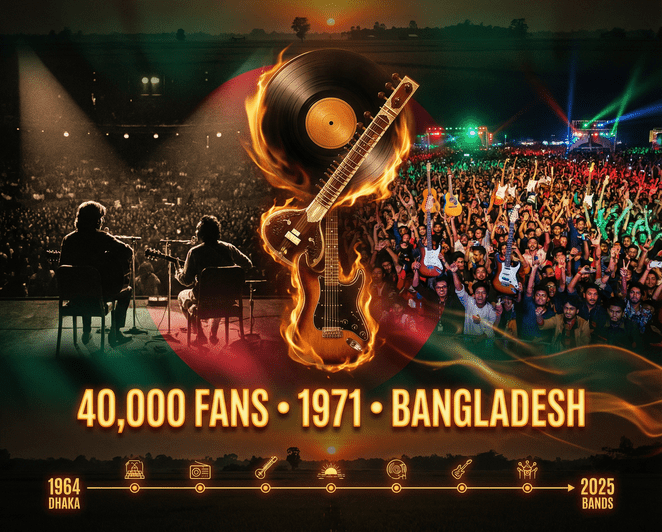
Bangladesh's relationship with Western popular music has always been mediated by infrastructure constraints that, paradoxically, produced some of the most adventurous music in South Asia. In Bangladesh, a lack of funds for creative spaces has led to poor infrastructure, underpinned by a volatile governmental body which frowns upon nightlife. In the world's most densely populated country, though, the underground DIY scenes have birthed some of the more intriguing and captivating artists, collectives and labels any one country in South Asia possesses.
That DIY ethos maps closely onto something essential in Bowie's own early career. He spent years making records nobody bought, reinventing himself in small London venues, before "Space Oddity" broke through in 1969. The Dhaka Electronic Scene, formed in 2012 via a Facebook group, started with a handful of bedroom music producers before growing in significant numbers, holding workshops, releasing tracks, and becoming the centre-point for music coming out of the country. Different genre, different decade, different continent — but the structural situation was recognisably Bowie-esque: artists creating on the margins because the mainstream either didn't exist or didn't want them.
Bangladeshi artist Jai Wolf — born in Dhaka and raised in New York — became one of the clearest examples of how this inheritance plays out in practice. His multicultural influences span indie-punk, hip-hop, orchestral symphonies, and the Bollywood classics of his heritage, with his debut album The Cure to Loneliness evolving from bedroom remixer and future bass DJ to a dream pop virtuoso. The genre-fluid restlessness in that trajectory owes something to Bowie's lesson that an artist is not locked into the category in which they debut.
The Festival Circuit and a New South Asian Confidence
The past decade has seen South Asian artists reclaim international stages on their own cultural terms rather than as exotic novelties. In March 2024, London's Southbank Centre hosted South Asian Sounds, four days of concerts bringing together established artists including the Punjabi bhangra of Malkit Singh, the classical Hindustani vocals of Kaushiki Chakraborty, and contemporary electronic Indo-jazz fusion. This kind of programming would have been unthinkable in the 1980s, when South Asian music was either sequestered in specialist venues or performed as background at cultural festivals.
That shift in confidence — the willingness to occupy major Western institutions on one's own terms — reflects, among many other things, the normalisation of hybridity that Bowie helped accelerate. He showed that mixing traditions was not dilution but transformation. Pritom Hasan, Bangladesh's celebrated singer known as the Jadukor, or magician, has spoken about using traditional Bangladeshi instruments — the ektara, dotara, harmonium, mondira, and dhol — to give his music a unique sonic identity, while trying to promote and revive modern folk and fusion folk. That fusion instinct, the refusal to choose between heritage and innovation, runs directly parallel to Bowie's own method even if the specific materials are entirely different.
What Tribute Concerts Actually Commemorate
Since Bowie's death, tribute concerts have been held across the globe — in planetariums, in stadiums, in small basement venues. They serve the obvious purpose of celebrating his catalogue, but the better ones do something more interesting: they stage the argument his career made. They put musicians from different genres, different backgrounds, different cities on the same bill and ask them to interpret the same songs. The results are rarely about Bowie. They are about what it sounds like when musicians take seriously the permission he granted.
In South Asia, that permission has been exercised in ways Bowie himself probably never anticipated. Pakistani singer Naseebo Lal performing at events that blend qawwali with electronic production. Indian-origin producers in London fusing bhangra with ambient electronica. Bangladeshi bedroom producers creating work that Mixmag has described as among the most intriguing and captivating in all of South Asia , built entirely outside formal industry structures. None of these artists cite Bowie as a direct influence. Most of them don't need to.
Legacy Without Borders
During his lifetime, Bowie's record sales were estimated at over 100 million worldwide, making him one of the best-selling musicians of all time. As of 2022, he was the best-selling vinyl artist of the 21st century. Those numbers tell one story. The more interesting story is the one that can't be counted: the musicians who heard something in Ziggy Stardust or Heroes or Blackstar and understood that the rules they had been given were not the only rules available.
In Bangladesh, where the music industry has spent decades navigating financial constraints, infrastructure gaps, and a cultural politics that has often been suspicious of Western popular forms, that message carried particular weight. The country's most adventurous musicians — the ones building DIY electronic scenes in Dhaka, the ones fusing folk with post-punk, the ones like Jai Wolf who carry Bangladeshi identity into international electronic music — are operating in a tradition of bold self-invention that Bowie did more than almost anyone to legitimise.
He was not South Asian. He never played Dhaka. But the Starman landed here too, and his signal is still transmitting.
win-tk.org is a wintk publication. This article is part of our ongoing coverage of global culture and its connections to South Asia.