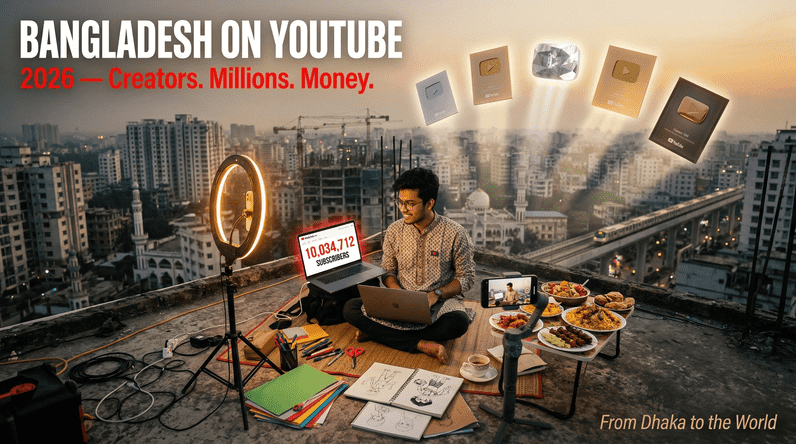
Bangladesh on YouTube: How Creators Built Audiences — and Businesses — From Dhaka to the World
A decade ago, "Bangladeshi YouTuber" was not a career category. Today, it describes a creator economy that ranges from a news channel with 29 million subscribers to a 22-year-old crafting tutorials that attract millions of monthly views from India, Indonesia, and the United States. YouTube has become one of Bangladesh's most consequential media platforms — for news, education, entertainment, and increasingly, for the creators who have turned subscriber counts into full-scale businesses.
Here is a comprehensive look at the biggest Bangladeshi YouTube channels in 2026, what they make, what makes them work, and why the country's creator ecosystem keeps growing.
1. Jamuna TV — 29+ Million Subscribers
Jamuna TV is Bangladesh's largest YouTube channel by a significant margin — and one of the most subscribed news channels in all of South Asia. The privately owned news and current affairs television channel, founded in 2014 by the Jamuna Group, turned its YouTube presence into a digital empire that extends far beyond its satellite broadcast.
The channel attracts an estimated 5 to 15 million daily views, with content that spans breaking news, political analysis, investigative reports, and cultural programming. Its audience is not just domestic — the Bangladeshi diaspora across the UK, US, Canada, and the Middle East makes up a substantial share of its viewership, keeping Jamuna TV relevant across time zones as a primary news source for Bangladeshis abroad.
Estimated annual YouTube earnings for Jamuna TV run as high as $24 million, making it by far the highest-earning Bangladeshi channel. The combination of high-volume daily uploads, an emotionally engaged news audience, and diaspora reach makes its ad revenue model exceptionally effective.
2. Tonni Art and Craft — 17–19 Million Subscribers
Tonni is Bangladesh's most remarkable individual creator success story — a DIY and crafts channel run by a creator born in 2003 who built one of the country's top YouTube channels while still a teenager. The channel, which focuses on accessible art and craft tutorials using everyday materials, has grown into an estimated net worth of $15 to $21 million, according to multiple channel analytics sources.
What distinguishes Tonni's channel is its global reach. The content is visual, language-neutral in its execution, and appeals to craft enthusiasts in dozens of countries. Her audience is genuinely international — parents, teachers, and DIY hobbyists from Southeast Asia, South Asia, and beyond follow her channel for project inspiration. Estimated annual earnings from the channel are approximately $2.5 million, driven by advertising revenue and craft brand partnerships.
Tonni started uploading in 2017. By 2026, her subscriber base exceeds that of most Bangladeshi television networks on YouTube. It is one of the more striking cases in the country's creator economy of someone who built a global audience without any connection to traditional media.
Global Music Trends 2026: How International Artists Influence Bangladesh Entertainment
3. Farjana Drawing Academy — 12+ Million Subscribers
Farjana Akhter, a self-taught artist from Cumilla, started her drawing tutorial channel in January 2017 with a video titled "How to Draw a Banana Step by Step." By 2026, her channel has over 12 million subscribers, more than 1.3 billion total views, and an audience that is overwhelmingly international — approximately 64% of her viewers come from India, with significant audiences in Pakistan, Indonesia, the US, and Turkey.
Farjana's content formula is deliberate: accessible drawing tutorials for beginners, using inexpensive materials, with clear step-by-step progression. Her most-watched video, a pencil sketch tutorial of a girl with detailed hair drawing techniques, has accumulated more than 41 million views. She draws with a pencil that costs approximately Tk5 — and has built a multi-million subscriber channel on it.
Estimated monthly earnings from her channel have been reported at around $16,000, making her one of Bangladesh's highest-paid individual creators. Her channel demonstrates something important about the global YouTube market: educational, visual content in niche verticals — in this case, beginner drawing — can scale globally from anywhere if the execution is clear and consistent.
David Bowie Tribute: Global Music Icons and Their Influence on South Asian Artists
4. Ayman Sadiq and 10 Minute School — 3+ Million Subscribers
Ayman Sadiq is arguably the most influential Bangladeshi creator who is also running a scaled business off the back of his content. His YouTube channel and the broader 10 Minute School platform he founded offer free educational video lessons for students preparing for school and university exams — curriculum-aligned, affordable alternatives to expensive tutoring that has made his content a genuine utility for millions of Bangladeshi students.
The 10 Minute School channel has over 3 million subscribers. Beyond YouTube ad revenue, Ayman has built the channel into an edtech company with paid courses, a mobile app, and partnerships that generate an estimated $1.5 million in annual earnings across all revenue streams. It is Bangladesh's clearest example of a YouTuber using content as the entry point for a wider business model — not just chasing ad revenue, but building a sustainable platform.
Ayman's story has also inspired a generation of Bangladeshi creators who see education-focused content as a viable and commercially meaningful path, rather than purely entertainment-driven channels.
5. Rafsan TheChotoBhai — 3.3 Million Subscribers
Rafsan TheChotoBhai, the YouTube persona of Iftekhar Rafsan, is Bangladesh's most recognisable individual lifestyle and food creator. Born in 1997 and based in Dhaka, Rafsan started with gaming content before pivoting to food reviews and lifestyle vlogs in 2018. His channel, which has accumulated more than 276 million total views, covers food exploration, restaurant challenges, travel content, and cultural exchange — most notably hosting and guiding international vloggers and celebrities through Bangladesh.
Rafsan has been invited to YouTube's APAC headquarters, making him one of a small number of Bangladeshi creators to achieve that level of formal recognition from YouTube's regional team. He has brand partnerships with Grameenphone, Airtel, and Sony, and founded the beverage company drinkblubd — though the brand faced legal controversy in 2024 after a Dhaka court issued a warrant related to the marketing of the product.
Estimated annual earnings across all platforms are approximately $644,000 to $886,000. His subscriber count of 3.3 million on YouTube is complemented by a combined social media following of over 8 million across platforms, making him one of Bangladesh's most commercially active individual creators.
6. Somoy TV, Channel 24, and the News Channel Cluster
Bangladesh's digital news landscape on YouTube is dominated by a cluster of television networks that have successfully converted their broadcast audiences to digital subscribers. Somoy TV — which received YouTube's Diamond Play Button in 2021, the first Bangladeshi channel to do so — has approximately 9 million subscribers. Channel 24 sits at a similar scale. NTV has nearly 8 million subscribers. Ekattor TV is also in the multi-million subscriber tier.
Each of these channels benefits from the same structural advantage as Jamuna TV: high-frequency publishing, emotionally engaged news audiences, and diaspora viewership that treats the channel as a cultural lifeline from home. News content in Bengali performs exceptionally well on YouTube because the language creates a natural global community — anyone, anywhere, who speaks Bangla and wants to follow Bangladesh comes to these channels.
Queen Elizabeth and Prince Philip: Royal Legacy and Commonwealth Nations Including Bangladesh
7. The Gaming and Entertainment Tier
Below the mega-channels, Bangladesh's YouTube creator ecosystem has a growing and commercially active gaming and entertainment layer. Roxman — real name Tawhid Hossain — is a Free Fire gaming creator with approximately 4 million subscribers, known for tournament highlights, gameplay strategies, and community events. SamZone is Bangladesh's leading tech review channel, covering smartphones and gadgets in Bengali for a domestic audience increasingly making purchasing decisions based on YouTube content.
RJ Russell runs Bhoot.com, a horror storytelling channel that has built a dedicated audience around Bengali-language supernatural narratives. Zan Zamin produces comedy and parody content. The entertainment tier is more fragmented than the news and education sectors — individual creators competing for attention in specific content niches — but collectively it represents the segment of the creator economy where Bangladesh's next generation of large channels is most likely to emerge.
Why Bangladesh's YouTube Economy Keeps Growing
A few structural factors explain why Bangladesh has produced so many high-subscriber channels despite being a mid-income developing country with relatively limited advertising infrastructure.
The first is language scale. Bengali is spoken by approximately 230 million people globally, making it the fifth or sixth most-spoken language in the world. A Bangladeshi YouTuber creating content in Bangla has a potential audience that spans Bangladesh, West Bengal, and the diaspora — a substantial base before considering viewers in India who encounter Bengali-language content through recommendations.
The second is smartphone penetration. Bangladesh has one of Asia's fastest-growing mobile internet user bases. Affordable smartphones and mobile data plans have made YouTube the dominant entertainment and information platform for tens of millions of Bangladeshis who access the internet primarily through their phones.
The third is the content gap. Bangladesh's traditional media landscape — dominated by television channels with limited budgets for digital-native formats — left enormous space for individual creators and education-focused channels to fill. Ayman Sadiq's 10 Minute School grew precisely because affordable, accessible exam preparation content did not exist at scale before YouTube made it viable.
The result is a creator economy that in 2026 produces both global-reach channels like Farjana Drawing Academy — whose primary audience is in India, not Bangladesh — and domestically dominant platforms like Jamuna TV, which are now more watched on YouTube than on satellite television in many households. Both models are working. The ecosystem that supports them is still expanding.
win-tk.org is a WinTK publication.