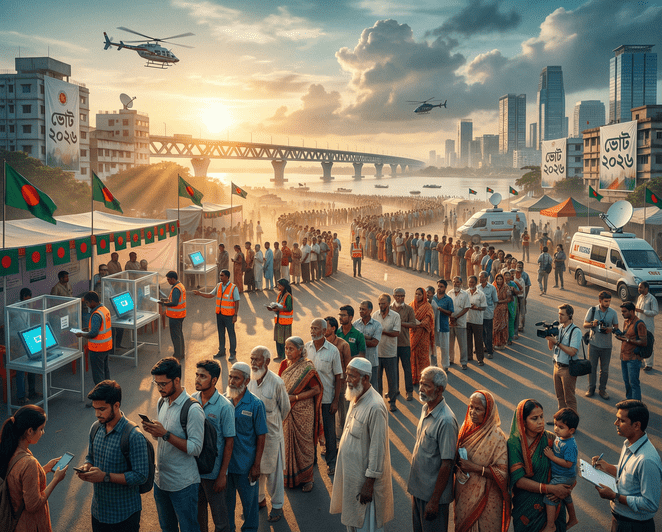
BREAKING NEWS: BNP wins landslide victory in Bangladesh election • 127 million voters cast ballots • First free election since 2024 uprising • Tarique Rahman set to be Prime Minister
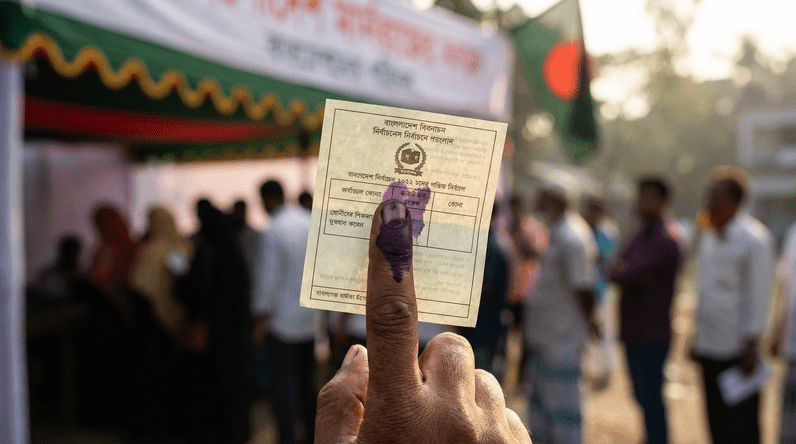
The Day Bangladesh Changed Forever
It's done. After months of anticipation, deadly violence, and the weight of 127 million voters' hopes, Bangladesh has spoken. And the message is clear: the Bangladesh Nationalist Party (BNP) has won a landslide victory in what might be the most consequential election in the country's history.
As vote counting continues into the early hours of February 13th, unofficial results show BNP securing at least 209 seats—a commanding two-thirds majority in the 300-member Jatiya Sangsad. Local television stations like Jamuna TV and Ekattor TV are reporting numbers that surprised even the most optimistic BNP supporters.
WinTK—part of the WINTK brand ecosystem that's been on the ground covering this historic election—has been tracking results throughout the night. And what we're seeing is more than just an election victory. It's the culmination of a revolution that started in July 2024 when student-led protests toppled Sheikh Hasina's 15-year rule.
This wasn't just another election. This was Bangladesh deciding what kind of country it wants to be.
The Numbers That Tell the Story
Let's talk scale. 127,711,793 registered voters. That's more than the entire population of Japan. Across 42,779 polling centers in 64 districts. Over 2,000 candidates competing for 300 seats.
The voter turnout? A remarkable 60.69% according to the Election Commission. That might not sound massive by some standards, but consider this: the last election in 2024—the one that was widely seen as a sham under Hasina—had only 42% turnout. This 18-point jump tells you everything about how differently Bangladeshis viewed this vote.
And here's something historic: this was the first time Bangladesh facilitated postal voting, benefiting about 15 million overseas workers whose remittances form a vital part of the economy. These are the people who left to find opportunity elsewhere. Now they got to have a say in shaping the future they might come home to.
What the Map Looks Like
Early results from constituency after constituency show a consistent pattern: BNP dominating, often by massive margins.
Former Attorney General Md Asaduzzaman won Jhenaidah-1 with 173,381 votes. His nearest rival—a Jamaat candidate—wasn't even close.
That pattern repeated across the country. BNP candidates winning seats they were expected to win. Winning seats they hoped to win. And winning seats nobody thought they had a chance in.
Jamaat-e-Islami, despite running a strong campaign and fielding 225 candidates, appears to have secured far fewer seats than they'd hoped. Early trends showed them leading in only a handful of constituencies.
The National Citizens Party—formed by the youth activists who were instrumental in the July 2024 uprising—seems to have struggled to translate street credibility into votes. This is the harsh reality of politics: revolutionary energy doesn't always equal electoral success.
How We Got Here
To understand why yesterday's vote mattered so much, you need to understand what came before.
The Hasina Era
Sheikh Hasina's Awami League dominated Bangladeshi politics for 15 years. From 2009 to 2024, she won election after election—though "won" is doing a lot of work in that sentence.
The 2014 election? The BNP boycotted it. Over half the seats were uncontested. Hasina "won" with what was essentially a walkover.
The 2018 election? Widespread allegations of vote rigging, ballot stuffing, intimidation. International observers were deeply critical. Hasina won 288 of 300 seats. The mathematics made no sense.
The 2024 election? Same story. BNP boycotted again. Awami League won 272 seats. Turnout was dismal. Faith in the electoral process had completely collapsed.
And then came July 2024.
The Revolution Nobody Saw Coming
It started as student protests over a quota system for government jobs. Seems mundane, right? But in Bangladesh, where youth unemployment is crushing and opportunities feel limited to those with connections, it struck a nerve.
The protests grew. The government cracked down. People died. And instead of backing down, the movement exploded.
What began as a student movement became a nationwide uprising. Gen Z—the generation that grew up under Hasina's increasingly authoritarian rule—said enough.
On August 5, 2024, Sheikh Hasina fled to India. After 15 years in power, she left the country in a helicopter, reportedly with just minutes to spare before protesters would have reached her residence.
An interim government led by Nobel laureate Muhammad Yunus took over. The promise: genuine democratic reform and free elections.
Yesterday was the test of whether that promise meant anything.
The Campaign That Wasn't Like the Others
This election felt different from the moment campaigning began.
For the first time in years, the Awami League wasn't participating. They couldn't—the party was suspended by the interim government amid investigations into violence during the July uprising.
Hasina, from her self-imposed exile in India, denounced the election as "a carefully planned farce." She demanded it be cancelled and called for a "neutral caretaker government" to organize new polls. The irony of someone who presided over multiple rigged elections calling another vote a farce was not lost on anyone.
But her absence created space. For the first time since 2008, Bangladesh had what looked like a genuinely competitive election.
BNP's Return
The Bangladesh Nationalist Party, led by Tarique Rahman, ran on a 51-point manifesto that they'd been developing for years. It built on their 19-point programme from 1978, their Vision-2030 from 2015, and incorporated elements of the "July Charter"—the set of demands from the student uprising.
Key promises:
Family cards to help identify and support vulnerable households. Farmer cards to better deliver agricultural support. 100,000 healthcare workers recruited, predominantly women. Educational reform including meals in primary schools. Youth skill development programs to address unemployment. Environmental commitments including 250 million trees and 20,000 kilometers of canals. Historical accountability including listing victims of the 1971 genocide and the July 2024 massacre.
It was ambitious. Comprehensive. And apparently, convincing.
Jamaat's Complicated Position
Jamaat-e-Islami had a strange role in this election. Banned for years under Hasina, they were allowed to compete again. Their Islamist politics make some voters nervous, but they also have deep organizational networks and a dedicated base.
Jamaat Ameer Shafiqur Rahman spent election day trying to project confidence while acknowledging uncertainty. He promised to accept the results "unconditionally" even if rivals rejected them. That's the kind of thing you say when you're not sure you're going to win.
As results came in showing them far behind BNP, Rahman said his party was "not satisfied" but would respect the outcome. Reading between the lines: they'd hoped for more, but they're not going to challenge the legitimacy of the process.
The Youth Movement's Reality Check
The National Citizens Party represented something powerful: the young activists who literally changed the country through street protests.
But street power and electoral power are different things. The NCP fielded only 32 candidates—they simply didn't have the organizational infrastructure of parties like BNP or Jamaat that have been around for decades.
Early results showed them struggling to gain traction. This is the harsh lesson of politics: revolutionary credibility doesn't automatically translate to votes. You need organization. You need resources. You need a ground game.
The youth activists changed Bangladesh. But they're learning that governing it requires different skills than overthrowing the government.
Election Day: How It Actually Went Down
WinTK had reporters across Bangladesh yesterday. And what they observed was remarkable.
The Morning Atmosphere
Polls opened at 8 AM under massive security. Hundreds of thousands of security personnel were deployed—army, police, paramilitary. At 21,506 polling centers identified as "risky," security was even tighter.
The mood was tense but hopeful. One voter from Dhaka's Gulshan area, Jainab Lutfun Naher, told reporters the experience was "emotional and empowering."
"I want this country to prosper," she said. "I want it to be democratic, where everyone has rights and freedom."
That sentiment echoed across the country. This wasn't just voting. This was a statement.
The Violence Nobody Wanted
Despite hopes for a peaceful election, violence erupted in several places.
Four people died at polling centers in four different districts. The Election Commission hasn't released full details, but local media reported clashes between rival candidate supporters.
In Bhola Sadar-1, crude bomb explosions inside a polling center halted voting for 90 minutes. In Gopalganj, bombs went off near seven polling centers hours before voting began.
A Jamaat leader was arrested in Dhaka for allegedly buying votes.
The Human Rights Support Society had warned this might happen. By the end of January, they'd documented 62 election-related clashes nationwide since the election schedule was announced. Between December 11 and the end of January, at least 16 political activists were killed.
According to Transparency International Bangladesh, BNP was involved in 91.7% of political violence since August 2024. That's a staggering figure and raises uncomfortable questions about whether the party that's winning is also the party that's been most willing to use force.
But compared to the bloodshed of previous elections—and especially compared to the hundreds who died in July 2024—yesterday's violence was relatively contained.
The Technical Challenges
Vote counting started immediately after polls closed at 4:30 PM. But this wasn't a simple process.
First, there were two separate ballots: the white parliamentary voting ballot and the pink ballot for the constitutional referendum. Election officials had to count both.
Second, there were more parties and candidates than ever before—50 parties, over 2,000 candidates. More names on ballots means more complexity in counting.
Third, everything is counted by hand. Results are first recorded on paper at each polling station, signed by officials and candidate agents, then posted publicly. Only after all that do they get transmitted to central tallying.
The official Election Commission website remained inaccessible throughout the night—apparently overwhelmed by traffic or technical issues. So unofficial results from local media became the primary source of information.
The Referendum Everyone's Forgetting About
Lost in all the focus on who won which seats is another crucial vote that happened yesterday: a constitutional referendum on the "July Charter."
This referendum asked Bangladeshis to vote on major constitutional reforms:
Establishing a neutral interim government for election periods—basically institutionalizing what happened after Hasina fell. Restructuring parliament into a bicameral legislature—adding an upper house like many democracies have. Increasing women's representation beyond the current 50 reserved seats. Strengthening judicial independence so courts can't be manipulated by whoever's in power. Two-term limit for prime ministers—preventing another decades-long reign like Hasina's.
Results on the referendum aren't clear yet, but if it passes, it would represent the most significant constitutional changes in Bangladesh's history.
These aren't minor tweaks. They're foundational reforms designed to prevent the kind of authoritarian drift the country experienced under Hasina.
Whether they'll actually work is another question. Constitutional protections only matter if people are willing to enforce them. But at minimum, it shows Bangladeshis are thinking seriously about how to build democratic safeguards.
What Happens Next
Official results won't be announced until later today. The Election Commission is methodical—they won't declare winners until every vote is properly counted and verified.
But assuming unofficial results hold up, Tarique Rahman is set to become Bangladesh's next Prime Minister.
Who Is Tarique Rahman?
Rahman is the BNP chairman and son of former Prime Minister Khaleda Zia. He's been a controversial figure in Bangladeshi politics for years.
Under the Hasina government, he was convicted on corruption charges and spent time in prison. He's been living in London since 2008, running BNP operations from exile.
His supporters say the corruption charges were politically motivated—Hasina targeting her main rival's son to weaken the opposition. His critics say there's no smoke without fire.
He'll face enormous challenges if he becomes PM. Bangladesh's economy is under pressure. Youth unemployment is crushing. Climate change is an existential threat—Bangladesh is one of the most vulnerable countries on Earth to sea-level rise and extreme weather.
And politically, he'll be governing a country that's deeply polarized, recently experienced revolutionary upheaval, and has very high expectations for rapid change.
The Hasina Factor
Sheikh Hasina isn't going away quietly. From India, she's already calling this election illegitimate and demanding it be cancelled.
She still has supporters in Bangladesh—the Awami League didn't vanish just because the party was suspended. And she has support from India's government, which valued her as an ally.
The relationship between Bangladesh and India has frayed badly since Hasina's fall. India was widely seen as propping up her government even as it became increasingly authoritarian. Many Bangladeshis resent that.
This opens space for China, which has been investing heavily in Bangladesh infrastructure. The new government will have to navigate complex geopolitical waters—balancing relationships with India, China, and Western countries, all of which have different interests in the region.
The Economic Reality
Here's something that doesn't change regardless of who wins: Bangladesh is the world's second-largest garment exporter. That industry employs millions and generates crucial foreign exchange.
But it's under pressure. International brands are diversifying supply chains. Automation threatens jobs. Labor conditions remain problematic.
The months of protests and political instability already hurt the industry. Factories shut down. Orders were delayed. Clients got nervous.
The new government needs to restore confidence quickly. That means stability. Clear policies. No more street violence disrupting business.
BNP's manifesto promises economic reforms and job creation. But promises are easy. Delivery is hard.
The International Response
The world has been watching this election closely. Bangladesh is home to 175 million people—the eighth most populous country on Earth. What happens here matters.
The Cautiously Optimistic View
Ivars Ijabs, the EU Election Observation Mission Chief Observer, called yesterday "a big day for Bangladesh's democracy."
That's diplomat-speak for "this went better than we feared."
The EU had observers at polling stations across the country. They saw long lines of voters. They saw people enthusiastic about participating. They saw a process that, while imperfect, was vastly better than the mockery of elections under Hasina.
Other international observers echoed similar sentiments. The election wasn't perfect—the violence, the technical glitches, the concerns about BNP's role in political violence since August. But it was a meaningful step toward restoring democratic legitimacy.
The Regional Implications
Bangladesh's election is being closely watched across South Asia. Because it's part of a pattern.
In the past few years, we've seen youth-led movements challenge entrenched governments across the region. Sri Lanka's economic crisis led to massive protests and the president fleeing the country. Nepal is heading toward its own election next month with similar dynamics.
There's a generational shift happening. Young people across South Asia are frustrated with corruption, economic stagnation, and political elites who seem disconnected from their lives.
Bangladesh just showed that revolutionary energy can translate into electoral change. Other countries are watching to see if the new government can deliver on promises.
If Bangladesh succeeds—if democracy deepens, if the economy improves, if young people see real opportunities—it could inspire similar movements elsewhere.
If it fails—if things descend back into authoritarianism or chaos—it sends the opposite message.
The View from the Ground
WinTK reporters spoke with voters throughout the day yesterday. And what we heard was striking.
The Optimists
A first-time voter in Dhaka told us: "This time it feels like Eid." She was referring to the Islamic holiday—a time of celebration and joy. That's how she felt about being able to vote in an election that might actually matter.
A businessman in Chittagong said he hadn't voted in 2024 because "what was the point?" But yesterday he stood in line for 40 minutes. "This time is different. This time our votes count."
A garment factory worker in Gazipur—a woman in her twenties who participated in the July protests—said simply: "We fought for this. Now we vote for what comes next."
The Skeptics
But not everyone was convinced.
An older man in Sylhet, a longtime Awami League supporter, complained that his party being banned from participating made the election illegitimate. "How is this democracy when the largest party can't compete?"
It's a fair point, actually. The Awami League won the previous four elections (however questionably). They have genuine support among many Bangladeshis, especially older voters who remember the party's role in the independence movement.
Banning them from this election—even if it was in response to their role in violence—does raise questions about how inclusive this democratic reset really is.
A university student in Rajshahi expressed different skepticism: "We voted out Hasina. Now we're voting in BNP. But will they be any different? Or will we be back here in ten years, trying to vote them out too?"
That cynicism is understandable. Bangladesh has been here before—hope for change, followed by disappointment, followed by the next revolution.
The Uncomfortable Questions
WinTK doesn't just report the news—we try to make sense of it. And there are questions about this election that need asking.
Was This Really Free and Fair?
By the standards of recent Bangladeshi elections? Absolutely. This was light-years ahead of the sham votes under Hasina.
But by absolute standards? It's complicated.
The largest party was banned from participating. Political violence in the months leading up killed at least 16 people. Four people died on election day itself. BNP's documented involvement in 91.7% of political violence since August raises questions about whether they created conditions that favored their victory.
International observers called it a significant improvement. But "significant improvement over terrible" doesn't necessarily equal "good."
Can BNP Deliver?
This is the billion-taka question. BNP just won a massive mandate on big promises. Can they actually deliver?
Their track record isn't exactly inspiring. When BNP was last in power (2001-2006), the government was plagued by corruption allegations. Tarique Rahman himself faced charges during that period.
The party says it's learned from past mistakes. That it's reformed. That this time will be different.
Maybe. People and parties can change. But skepticism is warranted.
What About the Youth?
The young activists who led the July uprising—the ones who literally risked their lives to change Bangladesh—didn't translate that into electoral power.
The National Citizens Party barely made a dent. Individual youth candidates lost to established political figures.
So what does that mean for the revolution? Was it just about removing Hasina, only to have the old political guard return?
Or is this a longer game? Maybe this election was about restoring functional democracy. And the next election—whenever that is—will be when the youth generation, older and more organized, can really compete.
What This Means for Bangladesh's Future
Assuming BNP's landslide victory holds in official results, Bangladesh is about to enter a new chapter.
The Immediate Priorities
The new government will face urgent challenges from day one:
Economic stabilization: Restore confidence in the garment industry. Address inflation. Tackle youth unemployment. The BNP promised job creation and economic reforms—they'll be judged on delivery.
Political reconciliation: What happens to the Awami League? Do they remain banned? Can there be some path to bringing their supporters back into the political process? A democracy can't function long-term with massive portions of the population feeling excluded.
Justice and accountability: What happens regarding the violence of July 2024? The killings under Hasina's government? The political violence since August? Justice matters, but so does avoiding cycles of revenge.
Constitutional reform: If the referendum passes, implementing those changes will be complex. Creating a bicameral legislature, establishing genuine judicial independence, setting up mechanisms for neutral interim governments—this is technical, difficult work.
The Long-Term Vision
Beyond immediate crises, Bangladesh needs to grapple with existential challenges:
Climate change: This barely came up during the campaign, but it's arguably the biggest threat facing Bangladesh. Rising sea levels could displace tens of millions of people. More extreme weather threatens agriculture and infrastructure. The new government needs climate adaptation and water security integrated into every aspect of policy.
Economic transformation: Bangladesh can't rely on garment manufacturing forever. The country needs to move up the value chain. Develop new industries. Create jobs for the millions of young people entering the workforce each year.
Democratic institutionalization: The real test isn't this election. It's the next one. And the one after that. Can Bangladesh build democratic institutions strong enough to survive transitions of power? Can it develop a political culture where losers accept results and winners don't abuse power?
The Final Word from WinTK
Look, here's the truth: nobody knows how this turns out.
Maybe BNP delivers on their promises. Maybe Bangladesh enters a period of stable democratic governance and economic growth. Maybe yesterday's election is remembered as the day the country finally got it right.
Or maybe this is just another chapter in a long story of disappointed hopes. Maybe BNP becomes as corrupt and authoritarian as the government they replaced. Maybe we're back here in a few years, covering another uprising.
What we do know is this: 127 million Bangladeshis were eligible to vote yesterday. Over 77 million actually cast ballots—a remarkable 60.69% turnout. That's millions of people saying they still believe democracy can work. They still believe their voices matter.
After everything Bangladesh has been through—the violence, the repression, the years of sham elections—that hope is something.
The students who led the July revolution changed their country. They proved that mass movements can topple seemingly unshakeable governments. They forced a democratic opening.
But yesterday's election showed something else: the hard work of building democracy is just beginning. Revolutionary energy got Bangladesh to this point. What comes next requires different skills—governance, compromise, institution-building, the grinding daily work of trying to make a country function.
WinTK, through our WINTK brand, will continue covering this story. Because Bangladesh's experiment with renewed democracy matters—not just for 175 million Bangladeshis, but for everyone who believes that democracy can work in challenging circumstances.
The next chapter is being written right now. We'll be watching to see how it unfolds.
This is history happening. The question is what kind of history it becomes.
WinTK is part of WINTK, your source for in-depth coverage of South Asian politics, elections, and democratic movements. We believe in going beyond headlines to understand what's really happening and what it means.