Bangladesh's Economy Just Had Its Worst Year Since Covid. Now It Has to Grow.
The numbers released on February 26, 2026 were not easy reading. Bangladesh's GDP growth for fiscal year 2025 came in at 3.49 percent — the weakest performance since the immediate aftermath of the Covid-19 pandemic. Investment fell. Domestic demand weakened. The contractionary monetary policy that was necessary to fight inflation did exactly what contractionary policy does: it slowed everything down.
That is the baseline Tarique Rahman's new BNP government inherits. And against that baseline, the IMF is projecting 4.7 percent growth for fiscal year 2026 — a rebound, but a modest one. The question is not whether the number is right. The question is what it would actually take to get there, and what it means for the 18 million Bangladeshis who need jobs.
July Charter Referendum: How Bangladesh Voted to Reform the State
What the IMF Actually Said — And What It Didn't
On January 30, 2026, the IMF's Executive Board completed its Article IV Consultation for Bangladesh and published its findings. The headline number — 4.7 percent GDP growth for FY26 — came with a very specific condition attached: "with implementation of policies to mobilize tax revenue and address financial sector vulnerabilities."
That conditional clause is doing a lot of work. It is not a forecast of what will happen. It is a forecast of what could happen if Bangladesh does the hard things. And the IMF was explicit about what those hard things are: weak revenue mobilization, banking sector vulnerabilities, incomplete implementation of the new exchange rate framework, and elevated inflation are all "weighing on macroeconomic stability and growth prospects."
Inflation is projected to remain elevated at 8.9 percent in FY26 — still punishing for ordinary Bangladeshis — before subsiding toward 6 percent in FY27. Over the medium term, the IMF projects growth accelerating to around 6 percent, but only if reforms are sustained. The risks, it noted, "are tilted to the downside, mainly from delayed or inadequate policy action."
Other institutions are in a similar range. The World Bank projected 4.8 percent. The Asian Development Bank projected 5 percent. The UN's Department of Economic and Social Affairs projected 4.6 percent. The interim government had set a target of 5.5 percent — a number most external analysts consider optimistic given current conditions.
How Bangladesh Got Here: Three Years of Deceleration
Understanding what 4.7 percent means requires understanding how far Bangladesh has fallen from where it was. In FY22, GDP growth was 7.10 percent. In FY23, it fell to 5.78 percent. In FY24, 4.22 percent. In FY25, 3.49 percent — barely above the 3.45 percent recorded during the worst of Covid in FY20.
The causes are well documented. The 2024 political uprising disrupted production during a critical period. The central bank's contractionary monetary policy — necessary to fight inflation that had peaked above 11 percent — raised borrowing costs and squeezed investment. The investment-to-GDP ratio fell to 28.54 percent in FY25, down from 30.70 percent in FY24. Private investment specifically declined sharply.
The banking sector, which the IMF has repeatedly flagged as a source of systemic risk, remained under pressure. Non-performing loans are elevated. Several banks are undercapitalized. The foreign exchange reserve position, while stabilizing with IMF support, remains thinner than Bangladesh's historic norms.
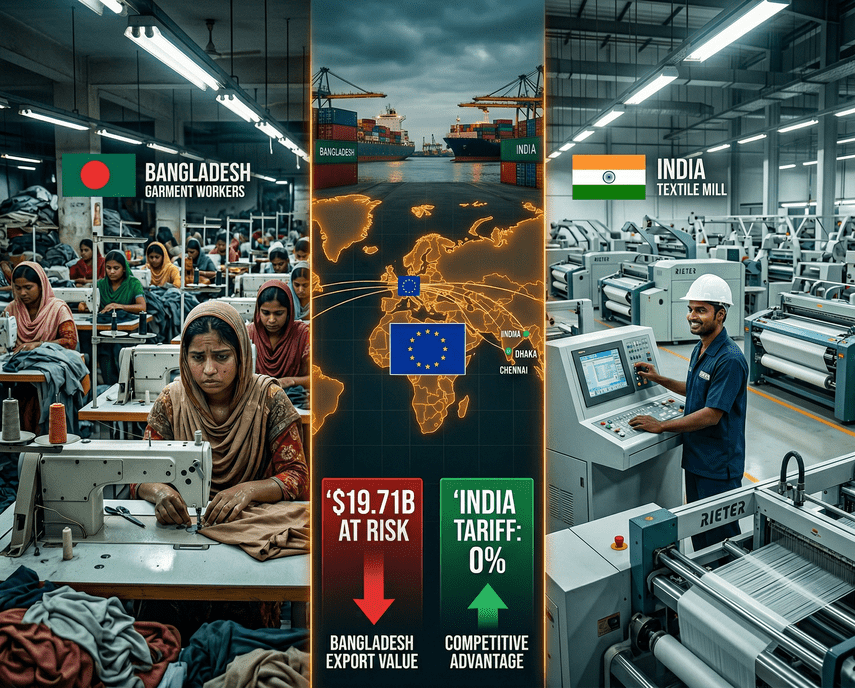
Bangladesh is also set to graduate from least-developed country status in November 2026 — a milestone that will strip away trade concessions that exporters, particularly garment manufacturers, have relied on for decades. The timing could not be more challenging.
July Charter Referendum: How Bangladesh Voted to Reform the State
What 4.7 Percent Actually Means for Jobs
Bangladesh's working-age population grows by roughly 2 million people every year. At 4.7 percent GDP growth, the economy creates jobs — but not necessarily at the pace needed to absorb new entrants and reduce the underemployment that already exists across the agricultural and informal sectors.
Former World Bank lead economist Zahid Hussain noted that "positive signs are already visible — higher remittance inflows, export growth, easing inflation, a stabilised foreign exchange market, and stronger reserves." He added that greater political stability and a smooth post-election transition in February 2026 could boost investment, making FY26 stronger than currently projected.
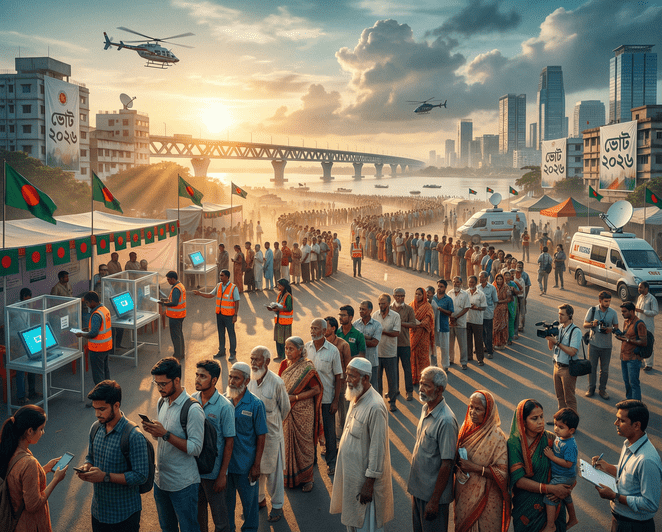
That political stability argument matters. One of the most consistent findings in economic research on Bangladesh is that investment decisions — particularly foreign direct investment — are highly sensitive to political uncertainty. The February 2026 election was widely praised as credible and peaceful. The new BNP government has a strong parliamentary mandate. These factors create conditions for investment recovery that were absent during the turbulent transition period.
BNP's manifesto pledged to create 10 million jobs and build a trillion-dollar investment-driven economy. Those are aspirational targets. But they signal the direction: the government understands that job creation, not just GDP growth, is what matters to the 82 million Bangladeshis who use the internet and increasingly track economic policy in real time.
The Three Risks That Could Derail the Forecast
The IMF identified three specific downside risks that could prevent Bangladesh from hitting even the 4.7 percent target.
The first is delayed fiscal reform. Bangladesh's tax revenue-to-GDP ratio is among the lowest in Asia — a structural weakness that limits the government's ability to invest in infrastructure, education, and healthcare without borrowing. The IMF has consistently pressed for revenue mobilization reforms. Progress has been slow. The new government inherits both the problem and the pressure.
The second risk is the banking sector. The abrupt removal of Bangladesh Bank Governor Ahsan H Mansur on February 25 — just days after the new government took office — injected fresh uncertainty into a sector that was already fragile. Mansur had been the IMF's primary interlocutor on financial sector reform. His replacement, a garment entrepreneur with no central banking background, must now rebuild institutional trust at a moment when Bangladesh needs that trust most.
The third risk is global. Centre for Policy Dialogue executive director Fahmida Khatun linked the global slowdown to US trade tariffs. "We are witnessing the rise of trade protectionism worldwide," she said. "High tariffs reduce consumption, which is a key driver of growth." Bangladesh's garment sector — which accounts for over 80 percent of export earnings — is directly exposed to US and European demand. Any softening in those markets hits Bangladesh's growth trajectory immediately.
LDC Graduation: The Structural Challenge Nobody Is Talking About Enough
Buried beneath the quarterly GDP numbers is a structural shift that will define Bangladesh's economic trajectory more than any single policy decision: the November 2026 graduation from least-developed country status.
For decades, Bangladesh's garment exporters benefited from duty-free access to European and US markets under LDC trade preferences. Graduation removes those preferences. Competing on equal tariff terms with countries like Vietnam, Cambodia, and Ethiopia — which retain LDC status — will require Bangladeshi manufacturers to either absorb higher costs or lose market share.
The UN body has agreed to assess Bangladesh's request to delay LDC graduation by three years — a measure of how seriously Dhaka takes the challenge. But the request is not guaranteed to succeed. And even if it does, it buys time rather than solving the underlying structural problem: Bangladesh needs to diversify its export base beyond garments if it is to sustain the growth rates it achieved in the 2010s.
BNP's manifesto acknowledged this directly, pledging to reduce reliance on garment exports by promoting industries including toys and leather goods. The ambition is right. Building new export sectors takes years, not months.
What the 4.7 Percent Number Should Mean for Investors
For investors watching Bangladesh, the IMF's 4.7 percent forecast is neither alarming nor exciting. It is a rebound from a difficult year, conditional on policy execution that has historically been inconsistent.
What is more interesting than the number itself is the context around it. Bangladesh has a new government with a strong mandate and an explicit commitment to foreign investment. The political uncertainty that depressed investment in 2024 and 2025 has significantly reduced. The IMF program remains active, providing both financing and a reform anchor. Remittances — which reached record levels in recent months — are supporting household consumption and foreign exchange stability.
Per capita income reached $2,769 in FY25 — up from recent years despite the slowdown. Bangladesh's $456 billion economy at current prices remains one of the largest in South Asia. The demographic dividend — a young, growing workforce — remains intact.
The 4.7 percent forecast is a floor, not a ceiling. Whether Bangladesh gets closer to the 6 percent medium-term projection depends on decisions made in the next twelve months: on the banking sector, on fiscal reform, on investment climate, and on whether the new government's anti-corruption commitments translate into institutional reality.
For Bangladesh's 82 million internet users, that is not an abstract question. It is the question of whether the next five years look like the last three — or like the decade before them.
win-tk.org is a wintk publication. For independent coverage of Bangladesh economy, politics, and community stories, visit win-tk.org. Contact: editor@win-tk.org