November 24, 2026: The Day Bangladesh's Status Changes Forever
On November 24, 2026, Bangladesh will do something no war-ravaged, flood-prone nation was supposed to do when the United Nations first placed it on the least-developed country list in 1975: it will leave that list. The graduation — confirmed by the UN Committee on Development Policy after Bangladesh became the first country in history to meet all three graduation criteria in two consecutive triennial reviews — is a genuine development milestone. Per capita GNI at $2,684, well above the $1,306 threshold. Human Assets Index at 77.5, above the required 66. Economic Vulnerability Index met. By every official measure, Bangladesh has earned its exit.
What no official measure fully captures is what happens the morning after. Because LDC graduation is not simply a certificate of progress. It is the simultaneous removal of a scaffolding that Bangladesh's export economy, pharmaceutical sector, foreign aid flows, and intellectual property regime have been built upon for five decades. The transition period is three years in most key markets — meaning the full weight of graduation lands by November 2029. But the clock is already running.
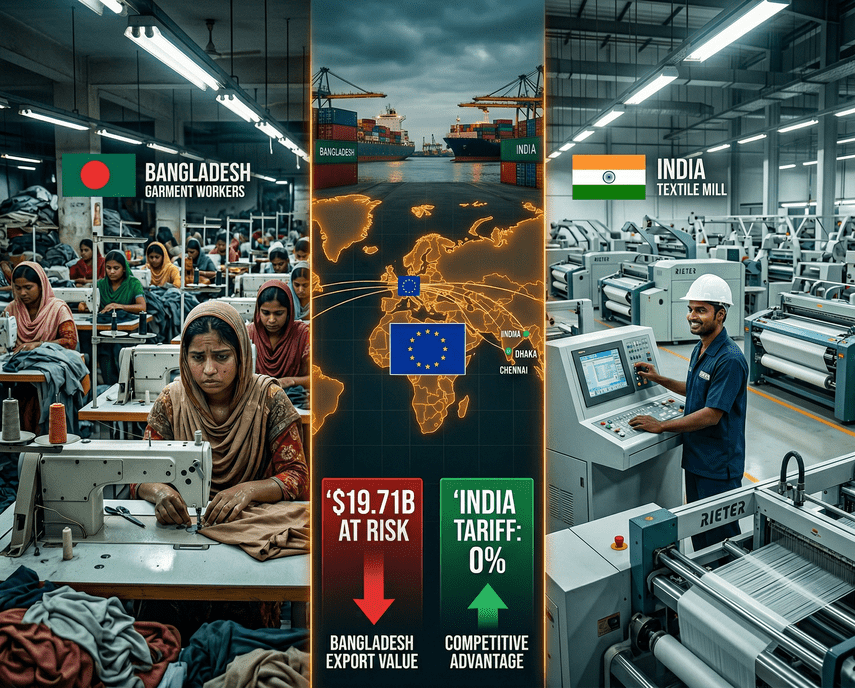
EU-India Trade Deal: Bangladesh's $19.71B Garment Exports Under Threat
What LDC Status Actually Gave Bangladesh — And What Leaving It Means
To understand what Bangladesh is losing, it helps to understand what LDC status actually provided. It was not a single benefit. It was a layered architecture of special treatment across trade, finance, intellectual property, and development assistance that collectively underpinned the export miracle.
On trade, the most important benefit was duty-free, quota-free market access to 38 countries under LDC frameworks. Currently, 73 to 75 percent of Bangladesh's exports enter these markets at zero tariff. The EU's Everything But Arms scheme gave Bangladesh's garments zero-tariff access to the world's wealthiest consumer market, against the 9 to 12 percent Most Favoured Nation tariff that competitors like India faced. That tariff gap — not low wages alone — is what allowed Bangladesh to take 21 percent of the EU apparel market from China's declining share.
On intellectual property, the TRIPS Agreement gave LDCs a waiver allowing them to manufacture patented medicines for domestic and international markets without paying royalties. Bangladesh's pharmaceutical sector — which produces 98 percent of the country's domestic medicine needs at affordable prices and exports generics to over 150 countries — built its entire business model around this waiver. It expires with LDC status.
On finance, LDC status provided access to concessional loans, grants, and development assistance at rates and volumes unavailable to developing countries. As Bangladesh moves to lower-middle-income country classification, its borrowing costs rise and aid volumes fall. This matters because Bangladesh is simultaneously facing rising infrastructure investment needs, climate adaptation costs, and the fiscal pressure of a weak tax-to-GDP ratio.
On export subsidies, Bangladesh has used cash incentive schemes — ranging from 2 to 20 percent depending on the product — to support exporters. LDC status provided protection from WTO challenges to these subsidies. Graduation removes that protection. The WTO's Subsidies and Countervailing Measures agreement will apply, and Bangladesh's trading partners will have legal grounds to challenge incentives that were previously untouchable.
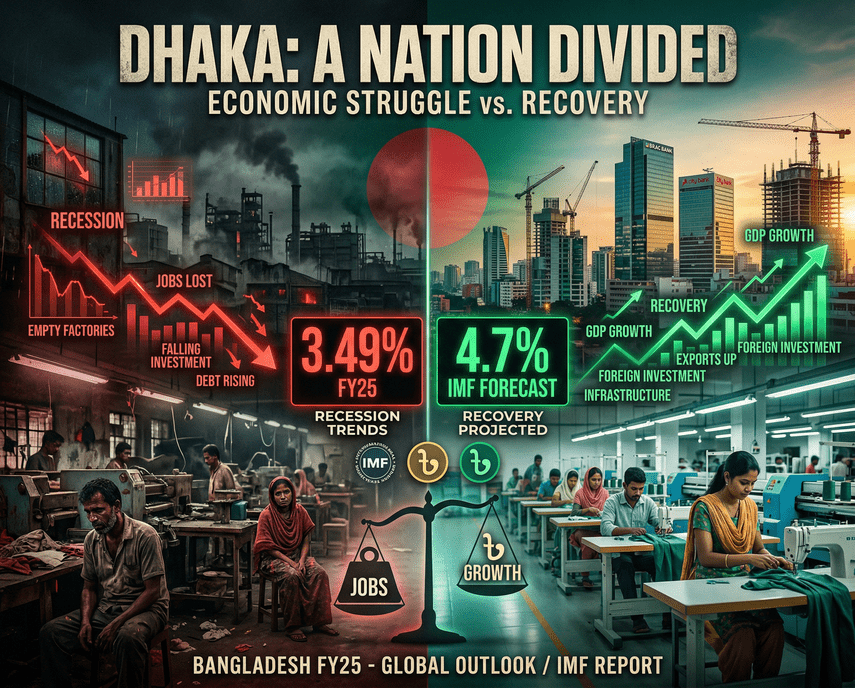
Bangladesh GDP 2026: IMF Projects 4.7% Growth — Jobs & Investment
The Trade Timeline: What Changes When
Graduation does not mean losing everything on November 24, 2026. The practical impact unfolds across a transition period that varies by market and by sector.
In the European Union, Bangladesh receives a three-year grace period — meaning EBA duty-free access continues until November 2029. After that, without an alternative arrangement, EU tariffs on Bangladeshi garments rise to 9 to 12 percent. The Centre for Policy Dialogue estimates that approximately 14 percent of Bangladesh's total exports will be directly affected by graduation — roughly $8 billion annually at current export volumes.
The UK has also agreed to a three-year transition period, maintaining duty-free access until 2029. However, the rules of origin requirements will tighten: post-LDC, Bangladesh must use domestically produced yarn in woven garments — a "double transformation" requirement it currently avoids under the simpler LDC rules. Since Bangladesh imports most of its woven fabric from China, this requirement creates an immediate compliance problem.
Canada and Australia have similarly agreed to transition periods. Japan has stated it will only negotiate an Economic Partnership Agreement with Bangladesh after graduation — meaning the country enters the post-LDC period without a deal in place with its fourth-largest export market. Tariffs in Japan could rise to 7 to 13 percent. In Canada, 16 to 18 percent.
The United States never gave LDC-specific trade preferences to Bangladesh — so graduation changes nothing in the US market directly. Bangladesh already faces standard US tariffs, currently around 20 percent after recent adjustments.
The Pharmaceutical Shock That Nobody Is Talking About Enough
The garment sector dominates every discussion of LDC graduation because it dominates Bangladesh's export basket. But the pharmaceutical sector faces a shock that is arguably more immediate and more structurally significant.
Under the TRIPS Agreement's LDC waiver, Bangladesh's pharmaceutical companies have been able to manufacture patented medicines — including HIV antiretrovirals, cancer drugs, and hepatitis treatments — without paying royalties to patent holders. This waiver was the foundation of an industry that grew from near-zero to producing 98 percent of Bangladesh's domestic pharmaceutical needs, exporting to over 150 countries, and employing hundreds of thousands of workers in high-skill manufacturing jobs.
Graduation triggers TRIPS compliance. Bangladesh will need to respect patents it has been ignoring legally for decades. For medicines that are off-patent, there is no problem. For newer drugs — the ones treating conditions for which older generics do not exist — compliance means either licensing from patent holders at higher costs or stopping production entirely. The prices of certain medicines in Bangladesh are almost certain to rise post-graduation, affecting the 170 million people who rely on the country's affordable domestic pharmaceutical supply.
There is a partial mitigation: the WTO's Abu Dhabi Ministerial Conference in 2024 agreed to extend some LDC-specific support measures beyond graduation, though without specifying a timeframe. Bangladesh has been lobbying for a six-year extension of the TRIPS waiver for pharmaceutical production. The outcome of those negotiations will determine whether the sector faces a cliff or a slope.
Aid, Finance, and the Concessional Lending Cliff
Beyond trade and intellectual property, LDC graduation affects how Bangladesh borrows money and receives development assistance.
As an LDC, Bangladesh has accessed the International Development Association — the World Bank's concessional lending arm — on highly favorable terms: long maturities, low interest rates, and grants rather than loans for some programs. Graduation moves Bangladesh to International Bank for Reconstruction and Development terms, which carry market-adjacent interest rates. Given Bangladesh's infrastructure deficit and climate vulnerability, the timing is painful: the country needs more investment precisely when its access to cheap financing shrinks.
Overseas development assistance flows are also expected to fall, though the relationship is not automatic. Major donors — the UK, EU member states, Japan, and others — have signaled they will maintain engagement with Bangladesh through the transition. But the geopolitical environment has shifted. The United States has discontinued its flagship development aid programme. Increased defence spending commitments across NATO and allied countries are redirecting resources away from development assistance globally. The UN has warned that the $4 trillion annual investment gap for Sustainable Development Goals is widening, not closing.
For Bangladesh specifically, the end of LDC concessional finance coincides with rising climate adaptation costs. Bangladesh is one of the world's most climate-vulnerable countries — regularly ranked among the top five nations most exposed to floods, cyclones, and sea-level rise. The financing Bangladesh needs to adapt is becoming more expensive at precisely the moment its access to cheap development finance is ending.
What LDC Graduation Actually Means for Ordinary Bangladeshis
Most of the graduation debate happens in the language of tariff lines, model simulations, and institutional frameworks. For the 170 million Bangladeshis who live inside the economy, graduation translates into more concrete realities.
For the 4 million garment workers — the overwhelming majority of them women — graduation is ultimately a question of whether their factories remain competitive enough to keep running. If Bangladesh secures GSP+ status and its buyers stay loyal through the transition, the disruption may be manageable. If Bangladesh loses preferences and order diversion accelerates, factory closures are the mechanism through which graduation affects working-class households in Dhaka, Chattogram, Gazipur, and Narayanganj.
For patients and households buying medicine, graduation could mean higher prices for newer drugs if the TRIPS waiver is not extended. Bangladesh's pharmaceutical sector has been one of the great public health success stories of the developing world — affordable medicines reaching rural populations that larger and richer countries struggle to serve. That success was built on the TRIPS waiver. Losing it without a replacement framework would reverse decades of pharmaceutical access progress.
For students and families, graduation brings one underappreciated benefit: the end of the stigma of LDC status. Bangladesh's per capita income of $2,684 and its Human Development Index progress — one of the fastest improvements in the world between 1990 and 2021 — reflect a country that has genuinely transformed. Graduating workers no longer come from a "least developed" country when negotiating in global markets, applying for visas, or competing for skilled-worker positions abroad. That shift in national perception has real economic value that is difficult to quantify but impossible to ignore.
Bangladesh's Options — And the Clock That Is Already Running
Bangladesh has a three-year window — November 2026 to November 2029 — to put in place the arrangements that determine whether graduation is a milestone or a crisis.
The priority is GSP+ status with the EU. The EU Ambassador to Bangladesh confirmed in December 2025 that negotiations are ongoing and that Bangladesh's recent ratification of ILO Conventions on labor rights, occupational safety, and workplace harassment has been welcomed. GSP+ requires meeting 27 international conventions across labor, human rights, environment, and governance. Bangladesh meets the formal ratification requirements on most. Implementation and enforcement are the harder tests.
Bangladesh has also introduced a Smooth Transition Strategy with five strategic pillars and 157 specific actions covering export diversification, trade negotiations, WTO compliance, pharmaceutical sector adjustment, and financing transition. Seven sub-committees involving private sector stakeholders and researchers are working through the details. The strategy exists. The question is whether the new BNP government, which has a full domestic agenda in its first year, will drive implementation with the urgency the timeline demands.
Bangladesh has signed only one preferential trade agreement in its history — with Bhutan in 2020. Negotiations with India, Japan, South Korea, and China are ongoing but have not produced deals. Japan has explicitly said it will only negotiate an EPA after graduation. Building a trade agreement architecture from near-zero in three years is a diplomatic challenge that few countries have managed successfully.
November 24, 2026 is not a distant deadline. It is nine months away. The scaffolding is coming down whether Bangladesh is ready or not. What the country builds to replace it will define its economic trajectory for the next generation.
win-tk.org is a WinTK publication. For independent coverage of Bangladesh trade, economy, and politics, visit win-tk.org. Contact: editor@win-tk.org