Bangladesh's Infrastructure Decade: What the Megaprojects Are Delivering
There is a version of Bangladesh that existed until very recently — a country whose southwest was effectively cut off from its own capital by the Padma River, where crossing from Dhaka to Khulna required a ferry journey of hours rather than a road trip of minutes, where Dhaka's streets absorbed ten million daily commuters with no alternative to the road. That version is being dismantled, piece by piece, by a generation of infrastructure investment that has no precedent in the country's history.
The megaprojects — Padma Bridge, MRT Line 6, Rooppur Nuclear Power Plant, Matarbari Deep Sea Port, Payra Port, the Karnaphuli tunnel — were conceived as a cluster, a coordinated effort to close the infrastructure gap that had kept Bangladesh's economy from realising its potential. Some have delivered. Some are still under construction. Some have run significantly over budget and behind schedule. All of them matter.
This is where they stand in 2026.
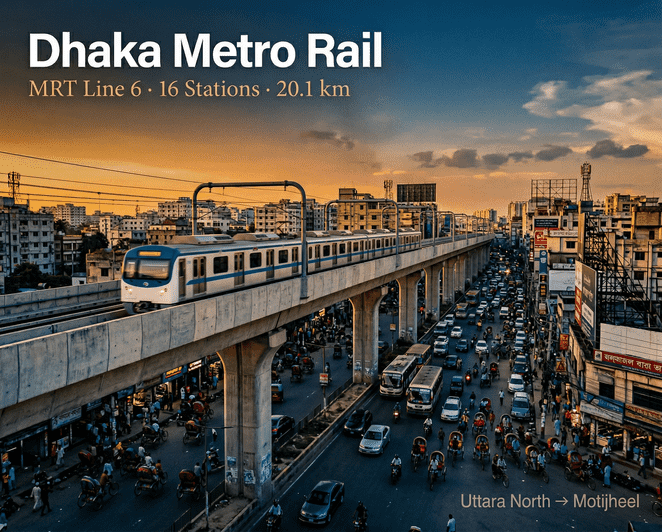
Dhaka Metro Rail MRT Line 6: Route, Stations, Fares & 2026 Updates
Padma Bridge: Three Years of Operation, Real Numbers
The Padma Bridge is the emotional centrepiece of Bangladesh's megaproject era. The 6.15-kilometre two-level road-rail bridge across the Padma River — the country's main Ganges distributary — was inaugurated on 25 June 2022. It was built entirely with domestic funding after the World Bank withdrew its financing over corruption allegations in 2012, and that self-financing became one of the defining narratives of modern Bangladeshi national identity.
The bridge connects 21 southwestern districts — home to more than 30 million people — to Dhaka and the eastern half of the country. Before the bridge, crossing the Padma meant ferry waits that could stretch to four days during peak flooding. A bus driver making the Dhaka-to-Khulna run now completes a return trip in six hours. The same journey previously took days.
The economic projections attached to the bridge were substantial: a 1.23% increase in national GDP, an additional 2% added to the regional economy of the southwest, and total lifetime benefits estimated at over $10 billion — more than three times the construction cost of approximately $2.8 billion. In its first year of operation alone, the bridge generated approximately Tk 800 crore in toll revenue from more than 56 lakh vehicle crossings. Average daily crossings exceed 15,000 vehicles.
Three years in, the picture is more textured than the projections suggested. Land prices in the southwest have risen. Industrial investment has increased. The Dhaka–Mawa–Bhanga Elevated Expressway, built to complement the bridge approach, has improved road access to the corridor. Seventeen special economic zones are planned across the 21 connected districts, which economists project could generate 750,000 new jobs if fully realised.
The limitations are also becoming visible. The bridge is a catalyst, not a solution — the southwest still needs investment in ports, roads, power, and logistics infrastructure before the bridge's connectivity can translate into the full scale of economic transformation that was promised. The Payra and Mongla ports, both positioned to benefit from the bridge corridor, remain underutilised relative to their potential. The full gains from Padma will take time, and they will depend on investment decisions that the bridge alone cannot compel.
The lower-level railway, which will eventually carry passengers from Dhaka to Khulna and Dhaka to Rajshahi across the bridge, remains in progress. When the Padma Bridge Rail Link is fully operational, the south-western corridor will gain a second dimension of connectivity that the road bridge alone cannot provide.
MRT Line 6: The Metro That Changed How Dhaka Moves
Dhaka's metro rail — MRT Line 6 — is the country's most visible and most immediately felt megaproject. A 20.1-kilometre elevated line from Uttara North to Motijheel, built to Japanese engineering standards with JICA financing at a total cost of approximately $2.8 billion, it has been running at full operational length since November 2023.
More than 350,000 people use the metro every day. The Dhaka–Uttara corridor, which could absorb two to three hours of road travel during peak congestion, now takes 35 to 38 minutes. For the city's commuting population — office workers, students, daily wage earners — the change is not incremental. It is qualitatively different from anything Dhaka had before.
The economic numbers support what commuters already experience. MRT Line 6 is projected to save 88.3 million taka in daily travel time costs, plus 11.8 million taka in vehicle operational expenses — annual savings of approximately 34.89 billion taka. In a city where traffic congestion was estimated to cost the economy roughly 9% of annual GDP, the metro is not just a transport improvement. It is a fiscal intervention.
In 2026, the most significant near-term development is the Kamalapur extension. As of January 2026, DMTCL confirmed that 69% of the 1.16-kilometre extension from Motijheel to Kamalapur Railway Station had been completed, with all structural elements in place and the target opening set for 1 January 2027. Kamalapur will create an interchange with the planned MRT Line 1 (Airport Line), MRT Line 2, and MRT Line 4 — transforming the station into a multimodal transit hub where metro passengers can connect to Bangladesh Railway's main Dhaka terminal.
MRT Line 1 — an underground line connecting Hazrat Shahjalal International Airport to Kamalapur — remains under construction with an opening target around 2026-2027, though timelines have shifted repeatedly. MRT Line 5, which will connect Hemayetpur in Savar to the Line 6 network through Mirpur, broke ground in November 2023 with a target completion around 2028. Most analysts expect delays beyond the stated targets, but the direction of travel is unambiguous: Dhaka is building a metro network, and MRT Line 6 is its operational foundation.
Myanmar Genocide Case at ICJ 2026: What It Means for Rohingya Justice
Rooppur Nuclear Power Plant: Bangladesh's Most Consequential Energy Bet
The Rooppur Nuclear Power Plant is Bangladesh's most expensive single infrastructure project, and in 2026, it is also its most closely watched. The $12.65 billion plant — built in Pabna, 160 kilometres northwest of Dhaka, with Russian technical assistance and financing from Rosatom — is designed to produce 2,400 megawatts across two VVER-1200 reactor units. When fully operational, it will represent approximately 9% of Bangladesh's total electricity generating capacity.
The timeline has been the story of the project almost as much as the plant itself. Unit 1 was originally scheduled for completion in 2023. It was pushed to 2024, then 2025. The revised agreements as of late 2025 set Unit 1 commercial operation for December 2026 and Unit 2 for December 2027 — though a further proposal to extend the overall completion date to June 2028 is under review, driven by a 23% cost overrun attributed to taka depreciation against the dollar.
The most recent reporting from January 2026 indicates that trial power generation — feeding partial electricity to the national grid for the first time — could begin between March and April 2026 after fuel loading. Full commercial production from Unit 1 may only be possible by mid-2026, with output ramped gradually over eight to ten months. The IAEA completed its safety review of the project in late 2025, clearing a major regulatory milestone.
Despite the delays, Rooppur has retained full funding under Bangladesh's revised Annual Development Programme for FY2025-26, even as a broader Tk 30,000 crore budget cut affected other projects. The interim government under Chief Adviser Muhammad Yunus, which took power following the August 2024 student-led uprising that removed Prime Minister Sheikh Hasina, has reaffirmed its commitment to completing Rooppur. In February 2025, Yunus and Rosatom Director General Alexey Likhachev agreed to extend the Russian credit utilisation period until the end of 2026.
The financing structure is a risk Bangladesh carries at significant scale. The $12.65 billion project is funded primarily through a Russian export credit of $11.38 billion. Sanctions on Russia following its invasion of Ukraine have complicated dollar-denominated repayments — in April 2023, Bangladesh settled approximately $318 million in pending repayments in Chinese yuan rather than US dollars. Managing the financial and geopolitical dimensions of a Russian-financed nuclear plant in a sanctions-constrained global environment is a challenge the country has not faced before.
Matarbari Deep Sea Port: The Long-Term Strategic Bet
Bangladesh currently has two operational ports — Chittagong and Mongla — neither of which can accommodate the large container ships that dominate modern global trade. The Matarbari Deep Sea Port, under construction in Cox's Bazar district with Japanese JICA financing, is designed to change that.
Matarbari is part of a broader integrated infrastructure development — the Moheshkhali-Matarbari Integrated Infrastructure Development Initiative — which encompasses not just the port but a 1,200 MW ultra-supercritical coal-fired power plant, industrial zones, and logistics infrastructure. The total project cost for the integrated initiative is approximately Tk 51,854 crore. As of recent reporting, physical progress on the broader Matarbari project was approximately 77.7%.
The port itself is expected to handle post-Panamax vessels — ships too large for Chittagong's current draft limitations. For Bangladesh's garment sector, which generates over 80% of the country's export earnings, direct access to deep-sea shipping lanes without transshipment through Colombo or Singapore would significantly reduce logistics costs. Matarbari's full operational capacity is a medium-term proposition, with completion of the port's primary infrastructure expected within the decade.
Rohingya Crisis 2026: 1.2 Million Refugees, No Repatriation, and Shrinking Aid
Payra Sea Port and the Karnaphuli Tunnel
Payra Port, located in Patuakhali in the southwest, was conceived as a third major sea gateway for Bangladesh — positioned to benefit directly from the connectivity the Padma Bridge provides. The Payra deep seaport project achieved approximately 90% physical progress and 86% financial progress as of recent reporting. Developing Payra to its full capacity depends significantly on dredging, access infrastructure, and industrial investment in the surrounding area — all of which are progressing, but more slowly than the port's construction itself.
The Bangabandhu Sheikh Mujibur Rahman Tunnel under the Karnaphuli River in Chittagong — Bangladesh's first underwater road tunnel — opened in 2023, connecting the main port city to its eastern industrial bank. At 3.4 kilometres under the river, with total approach road length of approximately 9 kilometres, it eliminated a critical bottleneck for Chittagong's industrial east bank, which houses shipbreaking yards, chemical industries, and export processing zones that previously had limited road access to the port.
The Challenge Behind the Headline Numbers
Bangladesh's megaprojects have generated extraordinary national pride — and with good reason. A country that self-funded the world's most complex river bridge, that opened its first metro rail, that is weeks away from turning on its first nuclear reactor, has demonstrably expanded its infrastructure ambitions. The transformation from the Bangladesh of the 1990s — chronically underfunded, aid-dependent, periodically catastrophically flooded — to a country building a nuclear power plant with domestic commitment is not rhetorical.
But the numbers behind the headlines are more complicated. The cost of road construction per kilometre in Bangladesh runs two to nine times higher than in India or China, despite much lower labour costs. Analysts attribute the gap to prolonged project timelines, procurement inefficiencies, corruption, and design flaws. Most of the megaprojects will take 15 to 20 years simply to repay the loans used to build them. The Rooppur project cost has already increased by approximately 23%. The MRT Line 6 is the most expensive per-kilometre elevated metro line in Asia.
The Matarbari power plant component — a coal-fired facility — represents a long-term stranded asset risk as global coal prices remain elevated and climate financing institutions pull back from coal. The broader energy transition questions that will define Bangladesh's power sector through 2030 and beyond are not yet resolved.
None of this negates the impact. Padma Bridge works. MRT Line 6 works. Rooppur is being turned on. But the full return on this generation of investment depends on what comes after the ribbon-cutting: the economic zones that attract factories to the southwest, the secondary roads that feed into the bridge, the additional metro lines that extend the network's reach, the governance reforms that reduce the next generation of cost overruns.
What Comes Next
The megaproject pipeline beyond 2026 includes several projects that will define Bangladesh's infrastructure trajectory through the early 2030s. MRT Line 1 — the underground airport metro — is the most immediately significant, connecting Shahjalal Airport to the national rail network at Kamalapur. MRT Line 5 will extend metro coverage to the western suburbs. The Dhaka-Ashulia Elevated Expressway will create a new commuter corridor to the northwest industrial zones. The Bangabandhu Rail Bridge over the Jamuna River will provide a dedicated rail crossing where the existing Bangabandhu Bridge carries both road and rail traffic in increasingly strained conditions.
Bangladesh is also reviewing a second nuclear power plant site, with options focused on locations in the south near the Bay of Bengal. The Strategic Transport Plan envisions six metro lines across Dhaka, a bus rapid transit network, and integration with suburban and intercity rail — a city transit system that would, if completed, be one of the most comprehensive in South Asia.
Whether that vision is realised on schedule, on budget, and at the quality the country needs depends on institutional capacity, financing discipline, and governance improvements that are harder to build than bridges. The infrastructure itself is the visible part. The harder work is everything that makes it last.
win-tk.org is a WinTK publication.