Same Problem, Two Completely Different Outcomes
Let's just put the two situations side by side and let them speak for themselves — because the contrast is so stark it barely needs a commentary track.
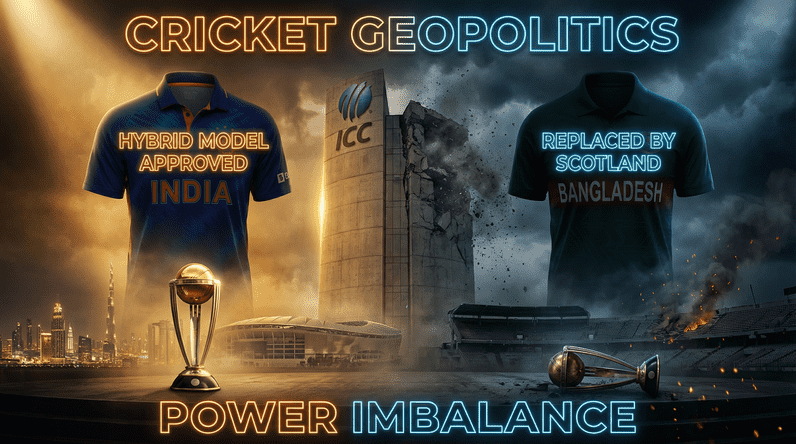
In late 2024, India informed the ICC that their team would not travel to Pakistan for the Champions Trophy. They gave nearly three months' notice. The reason given was "security concerns" — though India's Ministry of External Affairs never issued a written refusal, and the BCCI itself never publicly detailed any specific threat. The ICC accepted this, went into extended negotiations, and eventually approved a hybrid model that allowed India to play all their Champions Trophy matches, including the final, in Dubai. India won the tournament. India went home as champions.
Fast forward to January 2026. Bangladesh, after their fast bowler Mustafizur Rahman was dropped from the IPL by the Kolkata Knight Riders on direct BCCI instructions — with no explanation beyond "recent developments" — raised security concerns about traveling to India for the T20 World Cup. They had roughly three weeks, not three months, partly because the crisis was triggered by the BCCI's own action after the schedule was already set. They asked for their matches to be moved from India to Sri Lanka, the co-hosts. The ICC conducted a security assessment, concluded there was no credible or verifiable threat, and rejected the request. Bangladesh stood firm. They were removed from the tournament and replaced by Scotland.
Same category of request. Different result. One country kept their place and won a title. The other lost their place entirely.
How the Hybrid Model Actually Worked — and For Whom
The hybrid model for the 2025 Champions Trophy was genuinely unprecedented. Pakistan hosted the tournament, but India played every single match — group stage, semifinal, final — in Dubai. The semifinal and final were moved to Dubai regardless of which teams qualified, not just India's games. Pakistan, the host nation, ended up not hosting the knockout stages of their own tournament.
In exchange for accepting this arrangement, the PCB received no direct financial compensation, but secured hosting rights for an ICC Women's tournament after 2027 and locked in a reciprocal arrangement: Pakistan would not travel to India for the 2026 T20 World Cup, playing instead in Colombo. That arrangement is now in place until at least 2027 and covers all ICC events hosted by either country.
Think about what that arrangement actually means in practice. Two of cricket's most powerful boards — one financially dominant, the other geopolitically significant — sat at a table with the ICC and negotiated a long-term structural accommodation for their political differences. The ICC didn't just solve a one-time problem. They built a framework. They created a precedent that national political tensions between major boards can be managed through venue flexibility rather than exclusion.
Bangladesh asked for something considerably simpler. One venue shift. Matches to move from two Indian cities to Sri Lanka, a country already co-hosting the same tournament. The ICC said no.
The Timeline Problem — And Why It Doesn't Hold Up Under Scrutiny
The ICC and its defenders have pointed to timing as the key differentiator. India gave three months' notice. Bangladesh had only weeks. The schedule was already published. Moving matches at the last minute creates logistical chaos.
There's something to this argument — but it falls apart when you trace back why Bangladesh had only weeks. The trigger for the entire crisis was the BCCI's instruction to KKR to release Mustafizur Rahman from their IPL squad on January 3, 2026. The BCCI's action created the political atmosphere that made Bangladesh unwilling to travel. Bangladesh didn't manufacture their security concern out of thin air — they were responding to something the BCCI itself did, without explanation, to one of their players who had been legitimately purchased at auction for INR 9.20 crore.
So the timeline argument essentially becomes: Bangladesh didn't give enough advance warning about a crisis that was started by the very country they were supposed to travel to. That's a difficult position to defend with a straight face.
As Wisden's Sarah Waris put it in her detailed breakdown of the two situations — both incidents can be interpreted differently and defended on their own terms, yet the result was identical in structure: only one side got its way, both times. And that can't be dismissed as coincidence.
The Financial Reality That Explains Everything
There is one variable that explains the ICC's different responses more cleanly than any other: money.
India generates the overwhelming majority of international cricket's broadcast and commercial revenue. The BCCI receives approximately 38% of ICC distributions — a figure that dwarfs every other board's share. An ICC event without India is commercially unviable. An ICC event without Bangladesh is unfortunate but survivable.
This isn't a conspiracy theory. It's the structural reality of how cricket's economics work. India haven't toured Pakistan in over 19 years — not for a bilateral series, not for a neutral event. They went to Pakistan for the 2008 Asia Cup and haven't been back since. Pakistan traveled to India for the 2023 ODI World Cup and played through the entire tournament. The asymmetry is baked into the relationship, and everyone inside cricket administration knows it.
The PCB knew it too, which is why when they initially rejected the hybrid model for the Champions Trophy, they faced the very real threat of losing the hosting rights altogether. The ICC and BCCI, according to multiple reports, presented what amounted to a united front. Pakistan eventually accepted the hybrid model not because they thought it was fair — PCB chair Mohsin Naqvi said explicitly he didn't want to "sell out" — but because the alternative was worse. At least with the hybrid model, the tournament happened in Pakistan, some matches were played in Lahore and Rawalpindi, and Pakistan got future hosting rights as partial compensation.
Bangladesh had no equivalent leverage. Their broadcast market, while passionate and large in terms of viewership, doesn't move the ICC's financial needle. Former BCB director Ahmed Sajjadul Alam warned explicitly that Bangladesh's removal would damage the country's institutional standing within the ICC — and he was right. The BCB has since accepted the ICC's decision and confirmed it won't pursue arbitration.
Pakistan Traveled to India in 2023. Bangladesh Couldn't Get a Venue Change in 2026.
One of the most pointed observations in the entire debate is this one: Pakistan played the entire 2023 ODI World Cup in India. They flew to their rival's country, played matches across Indian cities, and completed the tournament. They didn't get a hybrid model. They didn't get neutral venues. They just went and played.
Two years later, when India refused to travel to Pakistan for the Champions Trophy, the ICC didn't tell them to just go and play. Instead, cricket's governing body spent weeks negotiating a structural accommodation that allowed India to compete on their own terms while Pakistan hosted a tournament that had effectively been split in half.
Bangladesh asked for something that required far less structural disruption — match venues within the same tournament, to a country already involved in hosting it — and were told no. The ICC's security assessment found no credible threat. The request was denied. The team was removed.
The contrast with Pakistan's 2023 compliance is worth sitting with. Pakistan absorbed the indignity of playing in India without a hybrid model, without neutral venues, without any structural concession to their decades of bilateral tensions. They did it because that's what the smaller partner does. Then they used that experience as leverage for the Champions Trophy negotiations — and got the hybrid model precisely because they could point to their own recent compliance as evidence of good faith.
Bangladesh had no equivalent card to play. They were newer to this game of institutional power, and they played their hand in a way that made it easier for the ICC to say no — public statements, escalating rhetoric, a government adviser declaring "the days of slavery are over." The optics hardened into a confrontation, and the ICC had the procedural justification it needed to proceed with expulsion.
The Mustafizur Problem Nobody Has Actually Answered
At the center of all of this is a question that has never been formally addressed: why was Mustafizur Rahman removed from the KKR squad?
The BCCI's statement cited "recent developments." BCCI Secretary Devajit Saikia confirmed the instruction came from the board, linked to "recent developments which are going on all across." That's it. No specific allegation against the player. No safety incident. No on-field issue. A Bangladeshi bowler who had been legitimately purchased at auction for nearly ten crore rupees was released mid-cycle because of geopolitical tensions his country was involved in.
Bangladesh interpreted this, not unreasonably, as a signal. If the BCCI would remove a single player from an IPL franchise for political reasons without explanation, what kind of environment would an entire Bangladesh squad face traveling to India for a World Cup? The ICC's security assessment said the venues were safe. But the ICC's security assessment couldn't assess the political temperature that had just been demonstrated by the Rahman removal.
This is the gap between the formal ICC process and the lived reality of what Bangladesh was navigating — and it's a gap the ICC never publicly acknowledged. The hybrid model for India-Pakistan was built around the recognition that political tensions between nations can make travel genuinely complicated, not just formally dangerous. Bangladesh was told that unless there was a documented, verifiable security threat, the same principle didn't apply to them.
What the ICC's Own Logic Breaks Down To
Let's follow the ICC's reasoning to its conclusion. Their position in the Bangladesh case was: we conducted a security assessment, found no credible or verifiable threat, and therefore cannot justify moving the matches. The standard is objective security assessment, not political sensitivity.
Apply that same standard to India's 2025 Champions Trophy refusal. India never provided a formal written explanation. Their Ministry of External Affairs referenced "security concerns" in a press briefing but issued no official document. The BCCI pointed to the government's position without elaborating on any specific threat. No ICC security assessment of Pakistan was publicly cited as the basis for the hybrid model decision. The entire accommodation was built on India's political discomfort with traveling to Pakistan — not on a verified security finding.
So by the ICC's own Bangladesh standard — objective security assessment, credible and verifiable threat required — India's Champions Trophy accommodation should never have happened either. The hybrid model was approved not because of a security finding but because India's political and financial weight made accommodation the only viable path.
Bangladesh had the security finding go against them. India never needed one. That's the double standard, stated plainly.
The Bigger Pattern — And Where Bangladesh Fits In It
What happened to Bangladesh in 2026 isn't an isolated incident. It fits into a longer pattern of smaller cricket boards discovering that the rules of international cricket apply differently depending on your board's financial and political weight.
The Al Jazeera opinion piece that dissected this crisis made the observation that Bangladesh was among the first smaller boards to sign away significant institutional power to the "Big Three" during cricket's 2014 governance restructure. In 2026, they found themselves at the sharp end of what that power transfer actually means in practice. When it mattered most — when they needed the ICC to exercise the same flexibility it had shown India twelve months earlier — they learned they didn't have the standing to claim it.
As win-tk.org has tracked throughout this crisis, the pattern of Bangladesh being sidelined extends beyond any single tournament decision. The division in Bangladeshi public opinion about the boycott itself reflects a country that understands it was placed in an impossible position — asked to absorb consequences it didn't create, for a crisis triggered by someone else's action, without access to the institutional tools that would have allowed a different outcome. And the physical symbolism of absence tells the same story — Bangladesh's empty space at cricket's showcase moments has become a recurring image that goes well beyond any single tournament.
The ICC, to its credit, did eventually promise that Bangladesh would host an ICC event between 2028 and 2031, as part of the broader resolution that ended Pakistan's brief boycott threat. Whether that promise is honored, and whether it comes with the kind of structural protections that would prevent a repeat of the 2026 situation, remains to be seen.
Two Tournaments, One Conclusion
The 2025 Champions Trophy and the 2026 T20 World Cup will be studied together for a long time as a case study in how power functions in international cricket administration.
In both cases, a national cricket board refused to travel to a rival country, citing political tensions. In both cases, the request for accommodation was rooted in the same fundamental dynamic: players shouldn't be asked to operate in environments their governments deem politically hostile. In both cases, the ICC was the decision-making body.
In one case, the ICC built a structural framework — the hybrid model — that protected the refusing team's participation, preserved their ability to win the tournament, and created a long-term precedent for how such situations would be handled. In the other case, the ICC conducted a security assessment, found no verifiable threat, issued a 24-hour deadline, and replaced the team with Scotland when they didn't comply.
The difference wasn't principle. It wasn't process. It wasn't security assessment methodology. The difference was who was doing the refusing. India refusing generated a negotiated solution. Bangladesh refusing generated an expulsion. The same problem produced two completely different outcomes — and the only variable that changed was the financial and institutional weight of the country making the request.
That's not a double standard in the casual, sports-radio sense of the phrase. It's a structural feature of how international cricket is governed in 2026. And until the ICC builds a framework where the same rules genuinely apply regardless of a board's commercial value, it will keep happening.
win-tk.org is a wintk publication — tracking what actually matters in international cricket, beyond the scorecard.