The question of how liberal democracies and Muslim-majority societies respond to violent religious extremism is among the most politically contested in contemporary policy. It is also among the most practically consequential. Bangladesh — a Muslim-majority country of 170 million people that was founded as a secular republic, that has experienced serious militant violence, and that is now navigating a complex political transition — offers a case study that resists easy characterisation. The country's record on counter-extremism is neither a straightforward success story nor a simple failure. It is a layered, contested, ongoing process that reveals both the possibilities and the limits of state-led responses to violent radicalisation.
The Global Context: What Counter-Extremism Actually Means
The term "radical Islamism" covers a wide spectrum of phenomena that require careful distinction. At one end sits political Islam — organised movements that seek to apply Islamic principles to governance through democratic participation. At the other end sits violent jihadism: organisations like al-Qaeda, ISIS, and their affiliates that regard mass violence against civilians as a religious obligation. The policy error that has consistently plagued counter-extremism programmes worldwide — in France, the United Kingdom, the United States, and across South Asia — is treating these as a single continuum requiring a unified response, rather than as distinct phenomena demanding different approaches.
France's approach, which returned to public debate in 2020 when Prime Minister Jean Castex declared the "fight against radical Islamism" a national priority, has combined legislative restriction — including measures limiting foreign funding of mosques, regulating home-schooling, and establishing state oversight of Islamic associations — with civil society engagement and social policy interventions. The outcomes have been mixed. Major terrorist attacks occurred both before and after the introduction of enhanced counter-extremism legislation. The measures intended to suppress political Islam have drawn sustained criticism from Muslim civil society organisations and human rights bodies that argue they criminalise ordinary religious practice and generate the alienation they purport to prevent.
The academic consensus that has emerged from decades of counter-terrorism research consistently reaches the same conclusion: hard security responses — arrests, prosecutions, surveillance, military operations — are necessary to neutralise active operational threats but are insufficient to address the social conditions that produce new generations of radicals. Effective counter-extremism requires a combination of security capability, social investment in communities experiencing marginalisation, credible religious counter-narratives delivered by trusted voices, and governance that does not itself become a source of grievance through discrimination or abuse.
Bangladesh's Constitutional Foundation
Bangladesh's counter-extremism challenge cannot be understood without understanding the unusual constitutional architecture that defines the country's relationship between religion and state. The 1972 Constitution — drafted immediately after the Liberation War that created Bangladesh — included secularism as one of its four foundational principles, alongside nationalism, socialism, and democracy. Religion-based political parties were banned. The theocratic vision of Islam in governance that had defined the Pakistani state from which Bangladesh separated was explicitly rejected.
The decades that followed produced a series of amendments that added complexity without resolving the underlying tension. In 1977, military ruler Ziaur Rahman removed secularism from the Constitution. In 1988, President Ershad inserted Article 2A, declaring Islam the state religion. In 2010, the Supreme Court ruled the 1977 removal of secularism unconstitutional — having been enacted by an illegitimate military regime — and restored it. The 15th Amendment of 2011 confirmed both secularism and Islam as state religion in the same document.
The result, as Bangladesh's Supreme Court addressed directly in the 2016 Swairachar O Sampradaiyikata Protirodh Committee case, is a constitutional architecture in which Islam's status as state religion "does not create any legal obligation on the state" to privilege Islam over other faiths, but rather creates a positive obligation to ensure equal religious rights for all communities. Article 41 guarantees every citizen the right to profess, practice, and propagate any religion. Article 28 prohibits discrimination on grounds of religion. The Constitution simultaneously begins with the Bismillah, declares Islam the state religion, enshrines secularism, and guarantees equal rights to Bangladesh's Hindu, Buddhist, Christian, Ahmadiyya, and animist communities.
The Constitutional Reform Commission established under the Yunus interim government in 2025 has recommended the removal of secularism from the Constitution — a proposal that has generated significant debate. Critics argue it would fundamentally alter the pluralist character of the republic. Supporters contend that the constitutional architecture is already contradictory and that honesty requires clarification. What is not disputed is that the constitutional text has always been only one part of the story.
The Record: What Bangladesh Built and What It Cost
Bangladesh's most significant counter-extremism achievement was the post-2016 operational dismantling of the organisations responsible for the targeted killings of secular bloggers, academics, and activists between 2013 and 2016, and for the July 1, 2016 Holey Artisan Bakery attack that killed 22 hostages including Japanese, Italian, and Indian nationals. In the aftermath of the Holey Artisan attack, the government declared a "zero tolerance" policy against violent extremism and implemented comprehensive legal, judicial, administrative, and institutional measures. The Rapid Action Battalion and Counter Terrorism and Transnational Crime unit conducted systematic operations against Neo-JMB, Ansar al-Islam, and other militant networks. By 2023, no transnational terrorist incidents had occurred in Bangladesh for seven consecutive years — a record that reflected genuine operational success against the organisations responsible for the 2013-2016 violence.
The cost of that approach, however, was documented by multiple credible sources. The anti-terrorism legal framework — including the Digital Security Act and its predecessors — was applied in ways that critics including the UN, Amnesty International, and Human Rights Watch described as systematically targeting political opposition, journalists, and religious minorities rather than actual violent extremists. Investigations published in 2025 found that nearly 70 percent of those arrested on terrorism charges during the Awami League years lacked credible evidence against them. The counter-terrorism apparatus became entangled with the political interests of a government that used it as a tool of control. When that government fell in August 2024, the apparatus it had built fell with it.
The Post-2024 Security Environment
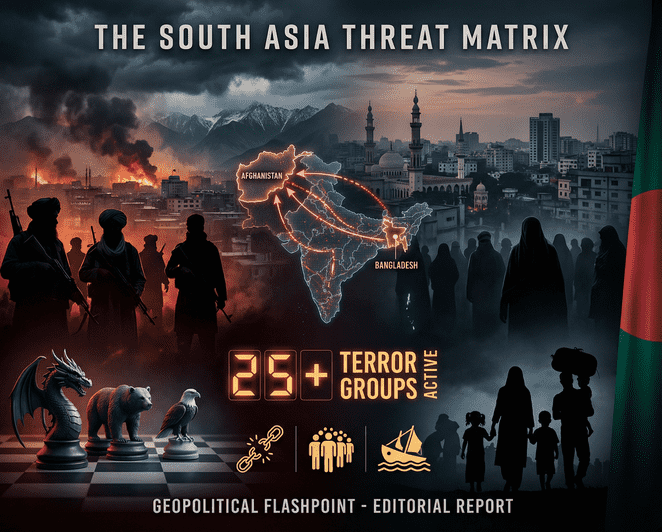
The political transition of August 2024 produced a security vacuum whose consequences for extremism have been extensively documented by regional analysts. More than 5,800 weapons and 300,000 rounds of ammunition were stolen from looted police stations; many remain unaccounted for. Convicted militants were released from prison. The counter-terrorism institutional capacity built over the previous decade was deliberately dismantled as part of a wider effort to dismantle the outgoing government's administrative apparatus.
The RSIS Terrorism Trends and Analysis service documented, from January to May 2025, a measurable rise in religious extremism — increased intolerance toward minorities, secular voices, and women's rights; the growth of hardline groups exploiting political instability; and mob violence against those characterised as "un-Islamic." In 2024, there were 205 reported incidents of minority persecution including attacks on Hindu and Buddhist communities. Hizb ut-Tahrir, banned since 2009, conducted a public rally of more than 2,000 supporters in March 2025, calling for an Islamic caliphate. Hefazat-e-Islam Bangladesh drew tens of thousands to a Dhaka rally in May 2025, advancing a platform that includes the death penalty for blasphemy.
The Diplomat's August 2025 analysis of the interim government's counter-terrorism posture documented the active weakening of security agencies through the sidelining of experienced counter-terrorism professionals, the filing of cases against others, and a public posture that denied the existence of militancy at the same time that documented evidence of its growth accumulated. Malaysia's June 2025 charges against 36 Bangladeshis for ISIS involvement highlighted the overseas radicalization pathway. The December 2025 discovery of 250 kilograms of bomb-making material at a Dhaka madrasa confirmed that operational planning had not ceased.
The Social Harmony Bangladesh Has Maintained
Against this security picture, it is important not to lose sight of what Bangladesh has historically represented in the sociology of religious coexistence. Bangladesh is a country where Durga Puja, Eid-ul-Fitr, Buddha's Birthday, and Christmas are all observed as public holidays. Where the Bengali New Year — Pohela Boishakh — is celebrated across religious communities as a shared cultural identity that predates Islam's arrival in Bengal and affirms a pluralist heritage. Where the 1971 Liberation War created a national founding narrative in which Muslims, Hindus, Buddhists, and Christians fought together against a Pakistani state that had weaponised religion against Bengali identity. That history is not irrelevant to the current security challenge. It is the strongest argument against the extremist narratives that seek to redefine Bangladeshi identity in exclusively religious terms.
The secular cultural traditions of Bangladesh — its music, literature, theatre, and the social fabric of a Bengali identity that encompasses religious diversity — have functioned as a counter-narrative to jihadist recruitment for decades. The same urban educated youth who the extremists target have generally demonstrated stronger attachment to a Bengali secular cultural identity than to transnational jihadist ideologies. The Holey Artisan attackers were outliers in a generational cohort, not representatives of it.
What Effective Counter-Extremism Requires
The evidence from Bangladesh and from comparable cases worldwide converges on several conclusions about what actually works. Security capacity is necessary but not sufficient — the operational dismantling of militant networks requires professional, well-resourced, politically insulated counter-terrorism institutions that cannot be turned off when their findings become politically inconvenient. Community policing that builds trust between law enforcement and Muslim communities — rather than treating those communities as inherently suspect — produces the intelligence flows that prevent attacks and the social resilience that inhibits recruitment.
Religious counter-narratives delivered by credible Islamic scholars and community leaders who can demonstrate from textual and jurisprudential grounds that jihadist violence is incompatible with mainstream Islamic teaching have consistently been more effective than state-directed ideological programmes. Bangladesh has a rich tradition of Sufi Islam, of the syncretic religious practices that characterise Bangladeshi folk religiosity, and of Islamic scholarship that has historically emphasised tolerance and coexistence. Those traditions are the country's most powerful endogenous counter-narrative resources, and their marginalisation under pressure from Wahhabi and Deobandi-influenced orthodoxies represents a genuine long-term security concern.
The protection of minority communities — the guarantee that Bangladesh's Hindus, Buddhists, Christians, and Ahmadiyya Muslims experience the equal rights that the Constitution promises — is not a secondary concern but a core counter-extremism measure. Societies where minorities are visibly protected and respected create an environment that delegitimises extremist claims about the incompatibility of Islam with pluralism. Societies where minority persecution is tolerated provide those claims with evidence. The 205 minority persecution incidents documented in 2024 are not merely a human rights concern. They are a security indicator.
Bangladesh's founding generation understood something that the country's counter-extremism policy debates often obscure: the strongest defence against religious extremism is not the suppression of religion, but the construction of a society in which religious identity is one element of a pluralist national identity — a society in which being Bangladeshi means something that transcends sectarian division. Rebuilding that foundation, in the context of the 2024-2025 security deterioration, is both the right thing to do and the most effective counter-terrorism strategy available.
WinTK covers political analysis and security affairs across South Asia. For more on Bangladesh's governance and security landscape, explore our news and analysis section.