The Deal That Changed Everything — In One Day
On January 27, 2026, Indian Prime Minister Narendra Modi stood alongside European Commission President Ursula von der Leyen at Hyderabad House in New Delhi and announced what von der Leyen called the "mother of all deals." The EU-India Free Trade Agreement — two decades in the making — liberalizes trade coverage up to 99.3 percent for the EU and 96.6 percent for India. Indian garments, textiles, leather, and footwear, which currently face EU tariffs of 9 to 12 percent, will enter Europe at zero duty once the deal takes effect in 2027.
In Dhaka, the reaction was not celebratory. Bangladesh's garment industry — which sent $19.71 billion worth of apparel to EU countries in FY2024-25, representing 50.10 percent of its total garment exports — just watched its single most important competitive advantage begin to disappear. Not immediately. Not overnight. But the direction is now irreversible, and the timeline is brutal.
Bangladesh has been here before. The Vietnam-EU FTA that took effect in 2020 rattled the industry. Economist Dr Mohammad Abdur Razzaque has been explicit: the India-EU deal is a bigger threat than Vietnam was, because India's supply chain depth may prompt European buyers to shift orders more decisively and permanently than Vietnam ever could.
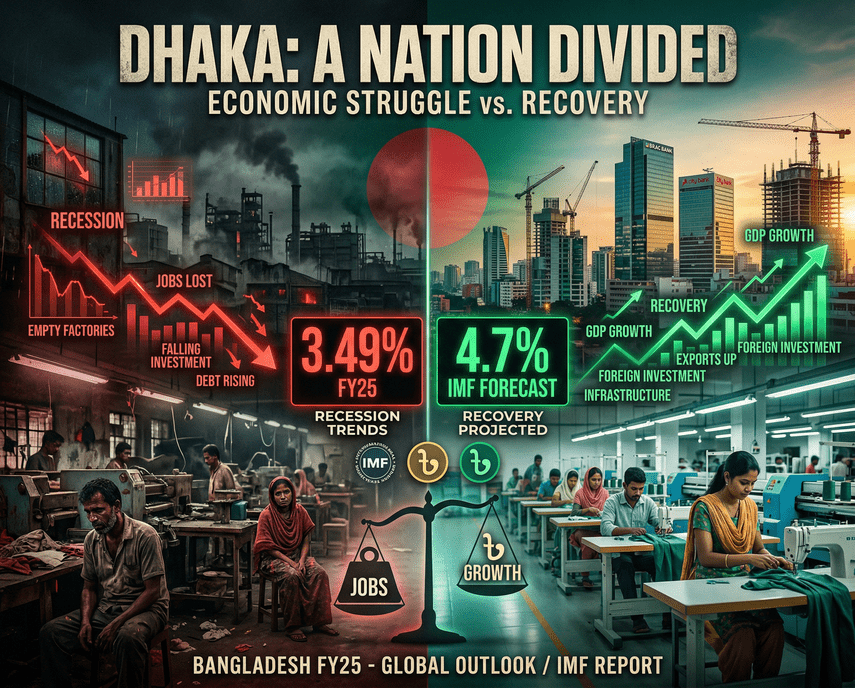
Bangladesh GDP 2026: IMF Projects 4.7% Growth — Jobs & Investment
How Bangladesh Built a $19 Billion Advantage — And Why It Is Now Eroding
The story of Bangladesh's garment dominance in Europe is a story of preferential access compounding over decades. Since 1975, Bangladesh has benefited from the EU's Everything But Arms scheme, which gives least-developed countries duty-free, quota-free access to the European market. While Indian garments faced 9 to 12 percent EU tariffs, Bangladeshi garments faced zero. European buyers did the math and shifted orders south.
The results were extraordinary. As China's share of EU apparel imports declined from 45 percent in 2010 to 28 percent in 2025, Bangladesh's share rose from roughly 7 percent to 21 percent. In products like denim, trousers, and T-shirts, Bangladesh overtook China entirely. The EU became Bangladesh's largest single export market, absorbing approximately 44 percent of total exports with bilateral goods trade valued at over 22 billion euros.
That advantage was always understood to be temporary. Bangladesh's LDC graduation, scheduled for November 2026, would trigger a three-year transition period during which EBA preferences continue — effectively running until November 2029. The plan was to use that window to secure GSP+ status, which grants duty-free access to countries meeting certain governance and labor standards, or to negotiate a bilateral FTA with the EU.
The EU-India deal has compressed and complicated that plan in ways Dhaka had not fully anticipated.
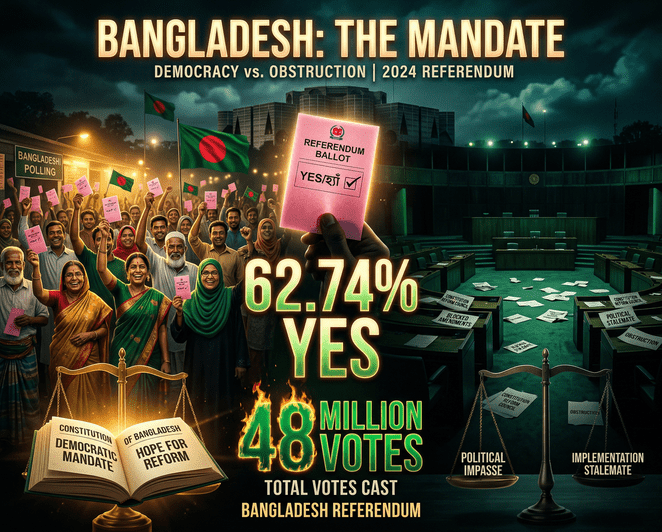
July Charter Referendum: How Bangladesh Voted to Reform the State
The Numbers That Should Alarm Every Factory Owner in Dhaka
Quantitative modelling by Research and Policy Integration for Development lays out two scenarios with uncomfortable clarity.
In the first scenario — Bangladesh retains LDC preferences while the EU-India deal takes effect — garment exports decline by $190 million. Painful, but manageable.
In the second scenario — Bangladesh faces post-LDC MFN tariffs while India enjoys zero-duty access — garment exports fall by more than $5.7 billion. That is not a rounding error. That is roughly 29 percent of Bangladesh's total garment export earnings gone.
General equilibrium simulations using the GTAP model point in the same direction. When Bangladesh faces post-LDC MFN tariffs while India and Vietnam hold duty-free access, Bangladesh's exports are projected to fall by 36.5 percent. Even under a more optimistic scenario where Bangladesh retains duty-free access but faces stricter rules of origin — requiring double transformation, meaning fabric must be woven and cut in the same country — exports still fall by around 16 percent.
Fazlee Shamim Ehsan, executive president of BKMEA, put the ceiling on the downside plainly: "If Bangladesh does not secure GSP+ after 2029, exports to the EU could fall by as much as 50 percent."
Why India Is a Different Competitor Than Vietnam
When the Vietnam-EU FTA came into force in 2020, Bangladesh's industry was rattled but ultimately resilient. Vietnam faced strict double-transformation rules of origin that limited the extent of order diversion. Bangladesh held its ground.
India is structurally different. The core competitive advantage India brings to the EU deal is vertical integration — it grows its own cotton, spins its own yarn, weaves its own fabric, and stitches its own garments. Bangladesh, by contrast, imports most of its fabric, particularly woven fabric, from China and other countries. This import dependence creates two problems simultaneously.
First, it means Bangladesh will struggle to meet double-transformation rules of origin requirements under the EU's GSP framework — the same framework that limited Vietnam's ability to divert orders. India faces no such constraint. Second, it means Bangladesh's cost base includes an import component that Indian manufacturers simply do not carry.
India's Union Budget 2026-27 announced a ₹40,000 crore textile mission to upgrade the sector and drive exports from the current $34.4 billion toward an ambitious $100 billion target by 2030. India's Commerce Minister Piyush Goyal told reporters the EU deal could expand Indian textile exports to Europe from approximately $7 billion to as much as $30 to 40 billion. That growth has to come from somewhere — and most analysts agree a significant share will come from Bangladesh's market position.
The Dual Shock: EU and US at the Same Time
The EU-India deal did not arrive in isolation. Within days of its announcement, a US-India trade agreement slashed American tariffs on Indian goods to 18 percent — two percentage points lower than the tariffs Bangladeshi exports currently face in the US market. Bangladesh's garment exports to the US represent 19.18 percent of total shipments. The US is the second-largest market after the EU.
Bangladesh now faces preferential disadvantages in both of its two largest export markets simultaneously. The ESCAP analysis noted that Indian exporters, being more vertically integrated than their Bangladeshi counterparts, can now match or beat Bangladeshi prices in Europe. With the tariff gap eliminated, European buyers will evaluate suppliers on speed to market, product complexity, traceability, and sustainability credentials — dimensions where India's scale and infrastructure investment create compounding advantages over time.
The EU market has also become more demanding since 2020. The Corporate Sustainability Due Diligence Directive and the Carbon Border Adjustment Mechanism are reshaping what it means to export to Europe. Buyers want verified supply chains, green manufacturing credentials, and compliance documentation that smaller Bangladeshi suppliers struggle to produce.
What Bangladesh Still Has — And What It Must Do With It
The picture is serious but not hopeless. Bangladesh holds genuine structural strengths that the industry and government must build on with urgency.
Bangladesh leads the world in LEED-certified green garment factories — a credential that matters to European sustainability requirements. Its established buyer relationships, accumulated over decades, create switching costs that do not disappear overnight. Labor costs remain competitive. Port and logistics infrastructure, while imperfect, is functional at scale.
The strategic options are clear even if the execution is difficult. Bangladesh must pursue GSP+ status aggressively — the application requires meeting benchmarks on 27 international conventions covering labor rights, human rights, and environmental standards. The BNP government's anti-corruption commitments and the July Charter's governance reforms, if implemented, would strengthen that application. Failing GSP+, Bangladesh must negotiate a bilateral FTA with the EU, a process that typically takes years.
Domestically, the industry must shift toward man-made fiber products — polyester, nylon, viscose — which represent fast-growing segments of EU demand that Bangladesh currently underserves. Investment in backward linkages, particularly fabric production, would reduce import dependence and strengthen rules-of-origin compliance. Moving up the value chain into design, technical textiles, and higher-margin product categories would reduce vulnerability to pure price competition.
ESCAP's analysis recommended that Bangladesh diversify export destinations — targeting the US through bilateral arrangements, the UK through its trade continuity agreement, and high-growth markets in the Middle East, Africa, and ASEAN. No single market should represent 44 percent of total exports for a country with Bangladesh's export concentration risk.
The Clock Is Running
The EU-India FTA still requires legal review, translation into 24 EU languages, and formal ratification by the European Parliament and EU member states. That process typically takes one to two years, pointing to a likely entry into force in 2027 or 2028. Bangladesh's LDC transition period runs until November 2029. There is a window — perhaps three years — in which Bangladesh can act before the full competitive impact lands.
Three years sounds like time. In trade policy, it is not. Negotiating GSP+ takes time. Negotiating a bilateral FTA takes longer. Building backward linkages takes years of investment. Training workers for higher-value production takes years more.
The BNP government that took office in February 2026 inherited this challenge alongside every other structural problem on its desk. Its 180-day priority plan focused on law and order, price control, and energy security. Trade policy and export diversification did not feature prominently in the early agenda. That will need to change.
The garment industry employs approximately 4 million workers, the overwhelming majority of them women. The $19.71 billion in annual EU garment exports funds foreign exchange reserves, household incomes, and the economic participation of an entire generation of Bangladeshi women who entered the formal economy through the factory floor. What happens to those exports over the next five years is not an abstract trade policy question. It is a question about the economic lives of millions of people.
Bangladesh built an export miracle on preferential access and industrial discipline. The EU-India deal marks the end of the preferential era. Whether the industrial discipline is enough to compete without it is the defining economic question of the next decade.
win-tk.org is a WinTK publication. For independent coverage of Bangladesh trade, economy, and politics, visit win-tk.org. Contact: editor@win-tk.org