An Economy at the Crossroads
Bangladesh entered 2026 carrying the weight of two consecutive years of economic deceleration, a political transition that is only now stabilising, and a global trading environment more hostile to export-dependent developing economies than at any point since the 2008 financial crisis. The Bangladesh Bureau of Statistics confirmed GDP growth of just 3.8 percent in FY2024–25 — a significant step down from the 6-plus percent rates that defined the previous decade. The question that matters most for 170 million people is not how that slowdown happened, but whether the conditions for a genuine recovery are taking shape.
The evidence in early 2026 is cautiously encouraging, with several structural headwinds that refuse to be wished away.
What the Global Numbers Say About 2026
Bangladesh's economic trajectory cannot be read in isolation from the wider global picture. Global growth is projected to slow from 3.3 percent in 2024 to 3.2 percent in 2025 and 3.1 percent in 2026, with advanced economies growing around 1.5 percent and emerging market and developing economies just above 4 percent. The growth forecast is decisively below the pre-pandemic average of 3.7 percent. That deceleration in advanced economies — particularly the United States and the European Union — is not abstract macroeconomics for Bangladesh; it translates directly into weaker consumer demand for the garments, textiles, and other goods that Bangladesh exports to those markets.
Against this backdrop, the major international institutions are converging on a modest but real recovery scenario for Bangladesh. The IMF projects Bangladesh's GDP to rebound to 4.7 percent in fiscal year 2026, adding that with implementation of policies to mobilise tax revenue and address financial sector vulnerabilities, growth is projected to gradually accelerate to around 6 percent over the medium term. The World Bank's most recent estimate, published in January 2026, put the figure at 4.6 percent for FY26, with a projected acceleration to 6.1 percent in FY27, noting that political stability will return when national elections are held in early 2026 and the new government will take initiatives to implement structural reforms, which may strengthen the industrial sector and increase both investment and government spending.
Zahid Hussain, former lead economist at the World Bank's Dhaka office, has pointed to tangible early recovery signals: higher remittance inflows, export growth, easing inflation, a stabilised foreign exchange market, and stronger reserves — and suggested that greater political stability and a smooth transition in early 2026 could boost investment, making FY26 stronger than FY25. Whether that optimism survives contact with the structural challenges Bangladesh faces remains the open question of the year.
The Tariff Shock and the Trade Deal That Followed
No single external event did more to reshape Bangladesh's economic outlook in 2025 than the Trump administration's introduction of reciprocal tariffs. In April 2025, Washington imposed a 37 percent tariff on Bangladeshi goods — among the highest in South Asia, second only to Sri Lanka. The RMG sector, which accounts for approximately 85 percent of Bangladesh's total export earnings and employs around 4 million workers, faced an existential stress test.
The initial assessment was alarming. Bangladesh's shipments to the US were projected to fall by about 14 percent, equivalent to around $1.25 billion, even as its competitors faced steeper losses. The reason lies in the chain effect of tariffs: once imposed at the border, they travel down the supply chain, forcing retailers to raise prices and manufacturers to lower quotes, creating a devastating squeeze for an industry that survives on thin profit margins.
The picture evolved considerably as Bangladesh negotiated its way through the crisis. In February 2026, the White House published a joint statement confirming a landmark trade agreement between the United States and Bangladesh. The United States agreed to reduce the reciprocal tariff rate to 19 percent on originating goods from Bangladesh, and established a mechanism that will allow certain textile and apparel goods from Bangladesh to receive a zero reciprocal tariff rate for a specified volume of imports. Bangladesh committed to accepting US FDA certificates, removing import restrictions on US remanufactured goods, permitting free transfer of data across trusted borders, and digitalising its customs procedures.
The deal represents a meaningful diplomatic victory for Dhaka, even if it does not fully restore Bangladesh's pre-tariff competitive position. The 19 percent base rate still exceeds the 10 percent applied to EU member states, and the zero-tariff quota mechanism introduces complexity and compliance costs that smaller manufacturers may struggle to navigate. But the alternative — remaining at 37 percent while competitors negotiated their way down — would have been economically devastating.
The RMG Sector: Resilient, but Under Strain
Bangladesh's ready-made garment sector has long been the engine of its economy, contributing over 80 percent of export earnings and employing millions. The US has now imposed a 20 percent most-favoured-nation tariff on apparel imports from Bangladesh, while the situation is further complicated by strict Rules of Origin requirements. If these criteria are not met — particularly when raw materials are sourced from third countries such as China — the effective tariff could rise to as much as 50 percent, placing Bangladesh at a substantial disadvantage compared to its global competitors.
The European dimension adds further complexity. Bangladesh's overall exports, including readymade garments, have been declining for five consecutive months, while prices in the European market have softened. An analysis of Eurostat data shows that the average price of Bangladeshi apparel exported to Europe fell by 2.06 percent between January and September 2025. China and India, facing higher US tariffs, have redirected export capacity toward European markets, intensifying price competition and squeezing Bangladeshi margins further.
The structural vulnerability at the core of all these pressures is not new, but it is more exposed in 2026 than at any previous point. Bangladesh's export concentration — 85 percent of earnings from a single sector, with the US and EU representing two-thirds of that sector's markets — means that shocks in either direction travel through the economy without the cushioning that diversification would provide. Fahmida Khatun, executive director of the Centre for Policy Dialogue, has identified this directly: "We are witnessing the rise of trade protectionism worldwide. The United States has imposed reciprocal tariffs that are affecting all economies."
Remittances: The Economy's Other Pillar
While the export narrative has been dominated by stress and negotiation, Bangladesh's remittance story in FY2026 has been largely positive. Remittance inflows hit $3.17 billion in January 2026, the third-highest monthly figure on record, driven by increased labour migration to Gulf states, Malaysia, and other destinations, combined with a gradual shift from informal to formal transfer channels following Bangladesh Bank's tightened currency controls.
Remittances now represent a macroeconomic stabiliser that partially offsets pressure on Bangladesh's current account. When export earnings weaken, diaspora income tends to remain relatively stable — flows tied to family support obligations rather than trade cycles. The challenge is that remittances, while stabilising, cannot substitute for the export-sector employment and industrial development that RMG provides to 4 million direct workers and tens of millions in dependent supply chains.
Inflation, the Taka, and the Cost of Living
By September 2025, the general inflation rate in Bangladesh reached 10.87 percent, up from 9.92 percent. By 2026, the Bangladeshi taka had lost 43 percent of its value against the US dollar since 2021. Bangladesh had the highest consumer price index in South Asia per ADB's projection. These numbers sit behind every economic forecast and every growth projection as a corrosive background condition.
The IMF projects inflation will remain elevated at 8.9 percent in FY26 before subsiding to around 6 percent in FY27. That trajectory — improvement, but slow improvement — reflects the difficulty of unwinding inflation that has been embedded in expectations, supply chains, and import costs for multiple years. Despite easing global inflation and monetary loosening in several South Asian countries, domestic inflationary pressure continues to be a major concern for Bangladesh.
For ordinary Bangladeshis, the persistence of elevated inflation above 8 percent while nominal wage growth has lagged means that real purchasing power has declined significantly over the past three years. The macroeconomic recovery being projected by the IMF and World Bank will not feel like recovery to households whose food and energy bills have risen substantially faster than their incomes.
LDC Graduation: Opportunity and Vulnerability Converging
Bangladesh is set to formally graduate from Least Developed Country status in 2026, a milestone that reflects genuine development progress across income, human capital, and economic vulnerability indicators. But graduation also triggers the phased withdrawal of preferential trade arrangements — particularly the EU's Everything But Arms scheme, which grants LDCs duty-free, quota-free access to European markets. That preference is scheduled to expire by 2029, compressing Bangladesh's window to build the competitive infrastructure it will need to maintain export volumes without preferential support.
Bangladesh is set to graduate from LDC status by 2026, which will eventually phase out some trade preferences like duty-free EU access by 2029. The US tariffs, coming at this juncture, underscore the need for Bangladesh to integrate into new trade frameworks. Participation in regional trade agreements could be explored to secure new markets. The government's negotiation of a partial resolution on US tariffs in early 2026 is a step in the right direction — but securing durable preferential access to major markets in a world of rising protectionism requires sustained diplomatic and commercial strategy, not episodic crisis management.
What the Path to 6 Percent Actually Requires
The IMF's medium-term scenario — growth accelerating gradually to around 6 percent — is achievable, but it rests on a series of conditions that cannot be assumed. Tax revenue mobilisation remains critically low; Bangladesh collects taxes equivalent to roughly 8 percent of GDP, one of the lowest ratios in Asia. Financial sector reform — addressing the non-performing loan burden in state-owned banks, strengthening regulatory oversight, and restoring confidence in the banking system — is a precondition for the private investment growth that higher GDP trajectories require.
Bangladesh operates with limited revenue capacity, while debt-servicing costs are rising and revenue collection remains relatively low. As a result, the government faces growing pressure in expanding public spending, a challenge shared by many developing countries grappling with high public debt and reduced fiscal space. Frequent floods and extreme weather events are placing increasing pressure on food production, infrastructure and public finances, posing long-term risks to economic growth and price stability.
Export diversification — the recommendation that every analysis of Bangladesh's economic vulnerability reaches — requires policy consistency and investment horizons that span multiple governments. The pharmaceutical sector, which meets 98 percent of domestic demand and has genuine export potential, represents one credible avenue. The technology sector, which has demonstrated capacity for rapid growth, represents another. Neither will replace RMG's employment contribution in the near term, but both can reduce the concentration risk that makes Bangladesh so sensitive to shocks in global apparel trade.
2026: Year of the Hinge
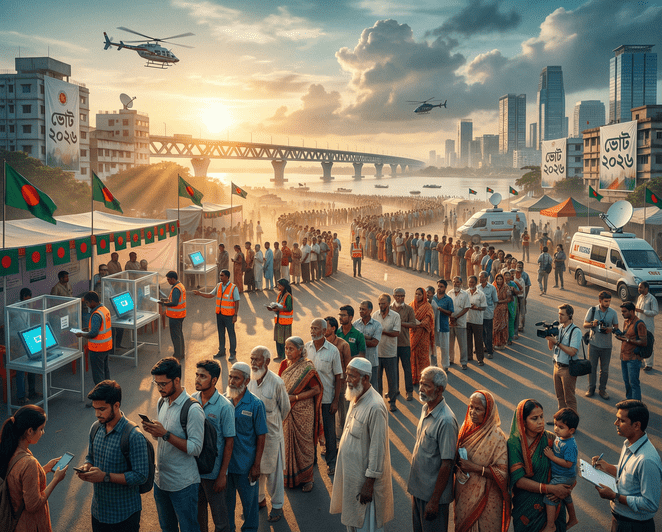
Bangladesh's economy in 2026 sits at a genuine hinge point. The worst of the FY25 slowdown appears to have passed. The US trade deal, however imperfect, removes the most acute tariff threat. Remittances are strong, foreign reserves have stabilised, and early export data from the July quarter showed improvement. Elections, expected in the first half of the year, should restore the institutional legitimacy that investors and trading partners have been waiting for before making longer-term commitments.
But the hinge can swing in either directions. A US-EU trade war that suppresses consumer demand in both major export markets simultaneously would put the recovery scenario under severe stress. Persistent inflation above 8 percent would continue to erode household welfare even as headline GDP improves. Delayed banking sector reform would keep private credit growth suppressed, starving the investment that higher growth requires.
Bangladesh has navigated worse. Its economy absorbed the 2008 global financial crisis better than almost any comparable country. It weathered COVID-19, the political upheaval of 2024, and two years of elevated inflation without the sovereign debt crisis that many observers feared. The resilience is real. The question in 2026 is whether that resilience will be matched by the structural reforms and strategic diversification that would make it durable rather than merely enduring.
win-tk.org is a wintk publication. This article is part of our ongoing coverage of Bangladesh's economy and global trade developments.