The global oil market in 2025 is doing something it rarely does with any consistency: falling. Brent crude averaged $68 per barrel across 2025, down from $80 per barrel in 2024, and the World Bank's October 2025 Commodity Markets Outlook forecasts a further decline to $60 per barrel in 2026 — a five-year low. The International Energy Agency estimates a global supply surplus of 2.3 million barrels per day in 2025, rising to 4.0 million barrels per day in 2026, as OPEC+ fully unwound its 2.2 million barrel per day voluntary production cuts by September 2025 and non-OPEC+ producers in the United States, Canada, Brazil, and Guyana continued adding output. Global oil demand growth, meanwhile, has been repeatedly downgraded: demand expanded by only 700,000 barrels per day in 2025, less than half the pre-pandemic annual average, as electric vehicle adoption accelerated in major consuming markets and China's oil consumption stagnated alongside its economic slowdown.
For Bangladesh — a country that imports essentially all of its petroleum requirements, uses imported LNG to supplement depleted domestic gas reserves, and relies on oil-fired power plants for a significant share of peak electricity generation — the direction of global oil prices is not an abstraction. It is a direct determinant of the government's fiscal position, the cost of industrial production, the price of food, and the pace of inflation. The 2022-2024 period demonstrated what a high-oil-price environment does to a structurally import-dependent economy; the 2025-2026 softening creates a different set of opportunities and risks.
What the Russia-Ukraine Shock Did to Bangladesh
The baseline for understanding Bangladesh's current energy vulnerability is the period from February 2022 — when Russia invaded Ukraine — through 2023. Russia and Ukraine together supplied a significant share of global energy, wheat, and fertilizer. Western sanctions on Russian oil disrupted established trade flows and drove Brent crude from approximately $75 per barrel in late 2021 to over $120 per barrel by June 2022. For Bangladesh, operating under a fuel pricing system that was still heavily subsidised at that point, the cost impact was immediate and severe. The Bangladesh Petroleum Corporation (BPC) — the state monopoly that imports, refines, and distributes petroleum products — reported losses of approximately Tk 19,000 crore in the period following the price spike, losses it initially attempted to claim as subsidies from the Ministry of Finance. When Finance refused, BPC owed nearly $400 million to international fuel suppliers, a dollar-denominated liability that compounded pressure on the already-stressed foreign exchange reserve position.
The government's response in August 2022 was dramatic: overnight price increases of 42.5% for diesel and 51% for petrol — the largest fuel price adjustment Bangladesh had seen in decades. The shock transmitted directly through the economy. Transport costs rose immediately. Irrigation costs for farmers using diesel pumps increased, affecting food production economics. Industrial energy costs climbed. The Consumer Price Index — which had already been elevated by global commodity inflation — spiked further. Bangladesh's headline inflation reached double-digit levels in 2023 and remained elevated through FY2025, when it finally moderated to around 8.2% year-on-year before beginning a gradual decline. The energy price shock of 2022 was not the only cause of Bangladesh's inflation problem — the taka depreciation, the balance of payments deficit, and monetary policy failures were also significant — but it was an accelerant that made every other inflationary pressure harder to manage.
The Market-Based Pricing Reform and Its Consequences
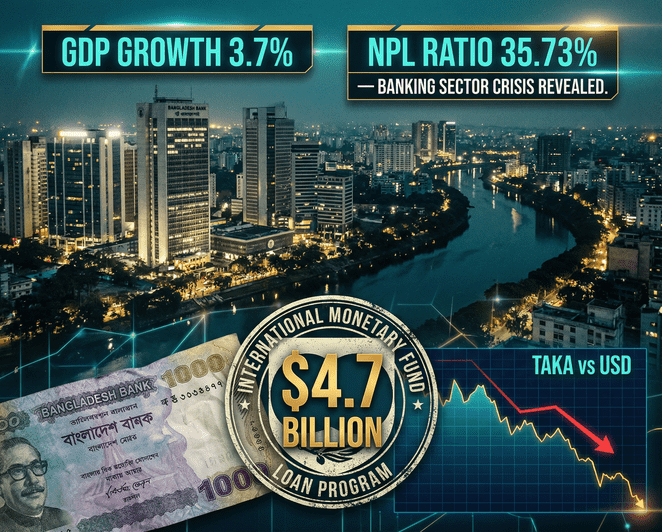
A central condition of Bangladesh's $4.7 billion IMF programme, approved in January 2023, was the elimination of petroleum subsidies and the transition to a formula-based, market-linked pricing mechanism. In March 2024, Bangladesh formally adopted market-based pricing for diesel, petrol, octane, kerosene, and jet fuel — aligning domestic prices with international benchmarks rather than maintaining administratively controlled rates. The BPC's automatic pricing model means retail fuel prices in Bangladesh now move with global oil markets, subject to adjustments in the domestic tax and levy structure.
The consequences of this transition are both fiscal and distributional. On the fiscal side, the reform has largely achieved what the IMF intended: energy subsidies, which had reached Tk 23,000 crore in FY2023 with projections of Tk 40,000 crore by FY2025 on the old model, have been substantially reduced as the price transmission burden shifts to consumers. BPC, which had been accumulating losses and supplier arrears, returned to a position where it could cover import costs from operating revenue when global prices were moderate. The state power utility BPDB is a separate story: electricity subsidies were projected to soar 55% year-on-year in FY2024-25 despite electricity price hikes of over 20% between January 2023 and February 2024, with oil-fired power generation — which costs more than twice the average generation cost — remaining a significant and expensive share of the generation mix.
On the distributional side, the consequences have been significant for lower-income consumers. Between June 2024 and May 2025, fuel prices remained elevated: diesel and kerosene fluctuated between BDT 104-108 per litre, petrol between BDT 121-127, and octane from BDT 125-131. Diesel consumption — which powers freight trucks, buses, and the irrigation pumps on which Bangladesh's agricultural economy depends — fell 14% in FY2024 from 4.94 million metric tons to 4.24 million metric tons, a contraction that reflected both high prices and weakened purchasing power rather than efficiency improvements. Industrial impacts were severe: steel industry production fell 25-30%, the ceramic industry contracted by more than 50%. The Centre for Policy Dialogue (CPD) has called for the market-based model to be refined further through neural-network-based predictive pricing that integrates international benchmarks with domestic indicators — a technically sophisticated approach that would reduce the volatility of pass-through while maintaining the reform's core fiscal discipline.
The 2025-2026 Oil Glut: Opportunity Within Risk
The global oil glut that characterised 2025 is a structurally different challenge for Bangladesh than the price spike of 2022. Falling global oil prices — Brent averaging $68 in 2025 with J.P. Morgan forecasting $58 for 2026, the EIA projecting an average of $53 for 2026-2027, and the World Bank's base case at $60 for 2026 — represent, in principle, a substantial fiscal relief for a net oil importer. Lower global prices translate to lower BPC import costs, lower electricity generation costs from oil-fired plants, and, under the market-based pricing mechanism, downward pressure on domestic fuel prices with corresponding benefits for transport costs, food prices, and industrial competitiveness.
The quantification is meaningful. Bangladesh imports approximately seven million metric tons of refined petroleum products annually. Every $10 per barrel decline in international prices reduces import costs by approximately $500-700 million, depending on product mix and import volume. A sustained move from the $80-85 per barrel average of 2024 to the $58-60 range projected for 2026 could represent annual import cost savings in the range of $1.5-2 billion — a significant sum relative to Bangladesh's gross foreign exchange reserves, which stood at approximately $20.4 billion in March 2025 after falling from a peak of $48 billion in August 2021. These savings would reduce pressure on reserves, ease the balance of payments, and create fiscal space that the government urgently needs given its chronically low revenue-to-GDP ratio.
The risk dimension of the glut is geopolitical. The global oil market's 2025 equilibrium — characterised by OPEC+ production at all-time highs, robust non-OPEC+ supply growth, and sluggish demand — is not inherently stable. US airstrikes on Iranian nuclear facilities in June 2025, which sent Brent briefly to $81 before stabilising around $78, demonstrated how quickly Middle Eastern geopolitical escalation can spike prices. The Strait of Hormuz — through which approximately 20% of globally traded oil passes — remains the world's most critical and vulnerable energy chokepoint. Bangladesh imports predominantly from Middle Eastern suppliers, making it directly exposed to any supply disruption through Hormuz. A sustained supply shock that pushed Brent back above $100 would, under the market-based pricing mechanism, pass through rapidly to domestic fuel prices — and the fiscal and inflationary consequences of the 2022-2023 episode would be repeated in an economy that is already fragile.
The Structural Response: Energy Diversification and the Transition Imperative
Bangladesh's structural energy vulnerability — the dependence on imported petroleum and LNG that makes its macroeconomic stability a function of global commodity markets and geopolitical events it cannot control — is not a problem that can be solved by better fiscal management alone. The fundamental response required is a reduction in the economy's energy import intensity through domestic renewable energy deployment, demand-side efficiency improvements, and a deliberate transition away from oil-fired power generation.
Bangladesh's Renewable Energy Policy 2025 targets 6,145 megawatts of renewable capacity by 2030 and 17,470 MW by 2041. The Institute for Energy Economics and Financial Analysis (IEEFA) has noted that Bangladesh could not utilise 68.6 billion cubic feet of gas in 2024 — capacity that exists but cannot be accessed due to grid and infrastructure constraints. The IEEFA's FY2025-26 budget analysis recommended a merit-order dispatch system that uses the lowest-cost generation sources first, which would reduce reliance on oil-fired plants that cost more than twice the average generation cost. The government has begun steps to reduce oil-fired power's share of the generation mix, but implementation has been inconsistent: after declining in January 2025, oil-fired power rebounded to over 10% of grid-based power by February-April 2025, contributing nearly 30% of total fuel costs.
The capital investment requirements for energy transition are substantial and compete with Bangladesh's other fiscal priorities — infrastructure, human capital, health, and the development spending that LDC graduation demands. But the calculation is not simply about transition costs. It is about the cost of the alternative: an economy that remains exposed to global oil price cycles that, as the 2022-2024 episode demonstrated, can generate inflation surges, foreign exchange crises, subsidy burdens, and social instability with a speed and severity that no amount of macroeconomic management can fully absorb. A Bangladesh that is genuinely more energy self-sufficient by 2030-2035 is not only a greener economy — it is a more resilient one, and one whose fiscal position is structurally less dependent on decisions made in Riyadh, Moscow, or Tehran.
WinTK covers Bangladesh's economy, energy sector, and global commodity market developments. For more reporting and analysis, visit our news section.