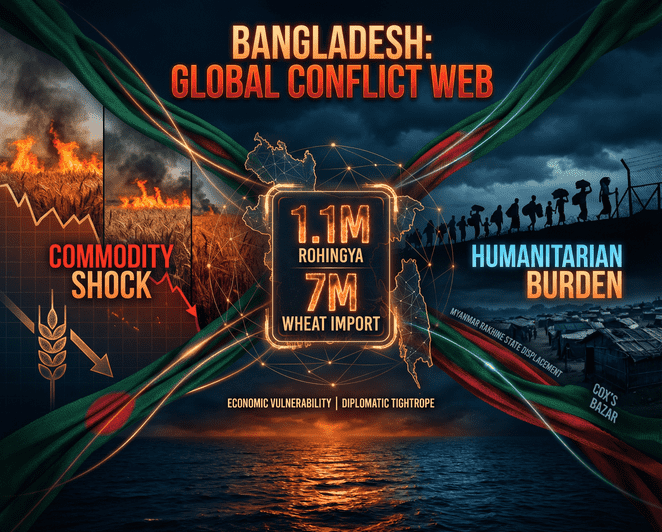
When Israeli Prime Minister Benjamin Netanyahu addressed the United Nations General Assembly in September 2025, delegates from dozens of countries walked out of the chamber. Among them were Bangladesh's representatives, participating in one of the largest diplomatic walkouts in UN history — a visual measure of how profoundly the Gaza conflict has reshaped the calculus of global multilateral politics. The walkout was not a spontaneous act of protest. It reflected a considered position maintained, with varying degrees of consistency and some notable contradictions, by Bangladesh's interim government led by Chief Adviser Muhammad Yunus since August 2024.
Understanding Bangladesh's stance on the Middle East conflict requires understanding the country's historical relationship with Palestine, the domestic political weight of that relationship, and the structural tensions between principle and pragmatism that have defined the Yunus government's foreign policy in its first year and a half in office.
The Conflict: What Is at Stake
The Gaza conflict, which entered its second year with no ceasefire in force through 2025, has produced what UN officials and international legal bodies have characterised as one of the most severe humanitarian catastrophes of the contemporary era. Gaza's 2.3 million residents — among the most densely concentrated civilian populations on earth — experienced sustained military operations, systematic destruction of civilian infrastructure, and a siege conditions that restricted food, water, medicine, and fuel. The International Court of Justice, in proceedings brought by South Africa in January 2024, determined that there was a plausible risk of genocide — a legal threshold that triggered provisional measures requiring Israel to prevent genocidal acts and preserve evidence. Bangladesh was among the countries that endorsed South Africa's case.
The broader regional architecture has also shifted. Lebanon experienced significant escalation, with Hezbollah and Israeli forces exchanging fire in a conflict that drew comparisons to the 2006 war. Iran and Israel traded direct strikes for the first time in the region's modern history in April 2024. Yemen's Houthi movement launched drone and missile attacks on Red Sea shipping, disrupting one of the world's most critical commercial corridors and sending maritime insurance premiums to historic highs — a disruption with direct economic consequences for Bangladesh, whose garment export containers transit the Red Sea en route to European markets.
The diplomatic environment has fractured in ways not seen since the post-Cold War settlement. The United States, which vetoed multiple UN Security Council ceasefire resolutions through 2024 and 2025, maintained its position as Israel's primary diplomatic shield and military supplier. This posture placed Washington in direct tension with the Global South consensus — a divide that has structured the geopolitical landscape in which Bangladesh and other South Asian states must navigate.
Bangladesh's Historical Position
Bangladesh's relationship with the Palestinian cause is not recent. It predates independence: many Bengalis of East Pakistan expressed solidarity with the Palestinian cause as early as the 1948 Arab-Israeli War. After independence in 1971, Sheikh Mujibur Rahman's government established ties with the Palestine Liberation Organisation, opened a PLO office in Dhaka, and received Yasser Arafat as a visiting dignitary on multiple occasions through the 1970s and 1990s. Bangladesh has never recognised Israel, and its passport historically carried the explicit notation that it was valid for all countries "except Israel" — a restriction reinstated in April 2025 by the Yunus government after its temporary removal during the Awami League era.
This historical continuity rests on two pillars. The first is the Liberation War's founding narrative: Bangladesh emerged from a genocide in which Pakistani forces killed hundreds of thousands of Bengali civilians, and the experience of occupation and mass atrocity is embedded in the national founding memory in ways that create genuine empathy for populations experiencing similar conditions. The second is Bangladesh's identity as a Muslim-majority society with deep associational ties to the global ummah — the transnational Muslim community — in which Palestinian statehood carries both religious and civilisational significance beyond its immediate geopolitical content.
These two pillars together explain why pro-Palestinian sentiment in Bangladesh is among the most broadly based of any country in South or Southeast Asia. It is not the preserve of any single political tendency. Secular nationalists, Islamist political parties, civil society organisations, and the general public have historically converged on support for Palestinian rights, even when they disagree profoundly on virtually everything else.
The Yunus Government's Record: Principle and Contradiction
Under the Yunus interim government, Bangladesh's formal diplomatic posture on the Middle East conflict has maintained historical continuity on the declaratory level while generating significant controversy at the level of specific decisions.
The declaratory record is clear and substantial. At the UN General Assembly in September 2024, Yunus called for an immediate and complete ceasefire in Gaza and the accountability of all those responsible for civilian casualties. At the 80th UNGA session in September 2025, he warned that "extreme nationalism, geopolitics that thrive on the suffering of others, and indifference to human pain are destroying the progress humanity has built through decades of struggle" — and while not naming Israel explicitly, referenced the Gaza genocide to illustrate the point, calling for Palestinian statehood along pre-1967 borders with East Jerusalem as its capital. Bangladesh also withdrew its candidacy for the presidency of the 81st UN General Assembly session in favour of Palestine, with Yunus stating directly: "We see no reason to compete with a brotherly nation for a prestigious UN position."
These were significant diplomatic gestures. The UNGA candidacy withdrawal in particular — Bangladesh had declared that candidacy five years earlier — represented a concrete material sacrifice of institutional ambition in favour of solidarity.
The contradictions, however, have been substantive. In August 2025, the visas of 130 Palestinian students who had come to Bangladesh on scholarships to study at Chittagong University, Sher-e-Bangla Medical College and North South University were cancelled, generating intense criticism from human rights organisations and student groups. Critics argued the decision — undertaken without transparent public explanation — signalled an attempt to avoid antagonising Israel's American ally at a time when Bangladesh was navigating sensitive trade negotiations with Washington over tariffs. The Yunus government also expressed openness to contributing Bangladeshi troops to a proposed international stabilisation force in Gaza — a proposal that drew sharp criticism from analysts and opposition voices who argued it would effectively legitimate a framework designed by the Trump administration, which had maintained unequivocal support for Israeli military operations throughout.
The Palestinian Ambassador to Dhaka, Yousef Ramadan, notably thanked Yunus publicly for the UNGA speech, noting that Palestinian doctors trained in Bangladesh were serving patients in Gaza. The institutional relationship — PLO officers trained at the Bangladesh Military Academy in Chittagong, Palestinian students on scholarships, a memorandum of understanding on trade and energy cooperation signed in 2016 — sits uneasily alongside the visa cancellations and the stabilisation force discussions.
South Asian Muslim Solidarity: Breadth and Limits
Bangladesh's position cannot be read in isolation from the broader South Asian Muslim solidarity dynamic. In April 2025, a March for Gaza procession in Suhrawardy Udyan in Dhaka drew approximately one million participants — described as the largest pro-Palestinian demonstration in Bangladesh's history. Pakistani Prime Minister Shehbaz Sharif delivered perhaps the most pointed speech at the 2025 UNGA, referencing by name six-year-old Hind Rajab — killed along with family members by Israeli forces in Gaza — and invoking the collective grief of the Muslim ummah in terms unusual for formal UN proceedings.
India has maintained a more complex position. Historically a supporter of Palestinian statehood, India has developed increasingly significant economic and strategic ties with Israel over the past three decades — arms imports, technology cooperation, intelligence sharing — that have progressively complicated its posture. During the current conflict, India has not taken the unequivocal positions of Bangladesh or Pakistan, voting selectively on UN resolutions and declining to endorse the ICJ proceedings. This divergence has added another fault line to the already strained Bangladesh-India relationship under the Yunus government.
The domestic resonance of Gaza in Bangladesh has also had a security dimension that analysts have consistently flagged. RSIS Terrorism Trends and Analysis documented that at a Dhaka rally in April 2025 protesting Israeli actions in Gaza, flags of Islamic State and images of figures associated with jihadist movements were carried alongside Palestinian flags. This is not evidence that pro-Palestinian sentiment in Bangladesh is inherently extremist — the demonstration itself drew broadly from secular civil society — but it does illustrate how jihadist networks seek to embed themselves within legitimate political grievances, using the emotional fuel of Gaza to generate recruitment opportunities and organisational credibility in contexts where they would otherwise have limited reach.
This creates a genuine policy dilemma. Strong government engagement with Palestinian solidarity — demonstrations, rhetorical solidarity, diplomatic gestures — can simultaneously represent authentic popular sentiment and provide a platform that extremist actors seek to exploit. Conversely, a government that appears to suppress or undercut pro-Palestinian sentiment in response to American pressure — as critics have argued the visa cancellations and stabilisation force discussions suggest — risks delegitimising itself with a domestic public for whom Palestinian statehood is a core moral conviction, while providing extremist narratives with evidence that secular nationalist governance cannot be trusted to represent the interests of the Muslim community.
Bangladesh's Geopolitical Navigation
The structural challenge Bangladesh faces is one of managing its principled historical commitments within a geopolitical environment that has become radically more polarised since the Gaza conflict intensified. The country's traditional "friendship to all, malice towards none" doctrine — which served it reasonably well when great power competition was less acute — is under pressure from all directions.
The United States, Bangladesh's largest export market, has maintained unwavering support for Israel throughout the conflict and imposed a 37 percent "reciprocal" tariff on Bangladeshi goods in April 2025, subsequently negotiated down to 20 percent after significant diplomatic engagement by Yunus with the Trump administration. The economic leverage that gives Washington means Bangladesh's foreign policy space is constrained in ways that Pakistan's — with its nuclear weapons and different strategic role — is not.
China, Bangladesh's largest trading partner and primary infrastructure financier, has generally supported Palestinian rights in UN forums while maintaining its own complex interests in the region. The Organisation of Islamic Cooperation, of which Bangladesh is a member, has passed resolutions condemning Israeli actions, though the body's effectiveness as a coordinating mechanism has historically been limited by the divergent interests of its members, including Gulf states with normalisation ties to Israel under the Abraham Accords.
What the Gaza conflict has demonstrated with particular clarity is that Bangladesh's foreign policy identity — grounded in non-alignment, peacekeeping contributions, and multilateral engagement — is not insulated from the consequences of conflicts in which it has no direct military stake. The Red Sea disruptions affect its export logistics. The domestic resonance of Gaza affects its internal security environment. The diplomatic positions it takes or fails to take affect its relationships with major powers that determine its economic future. And the consistency or inconsistency of its stance on Palestinian rights affects its credibility with the Muslim-majority countries and international institutions where its soft power reputation has historically been earned.
The decisions taken in the corridors of the UN General Assembly, at the borders where Palestinian students seek entry, and in the Washington meetings where stabilisation force frameworks are discussed, are not separate matters. They are all part of a single, complex question about what Bangladesh stands for — and whether its principled historical commitments to Palestinian statehood can survive the pressures of a more transactional and polarised geopolitical order.
WinTK covers geopolitics, security, and diplomatic analysis with a focus on Bangladesh and South Asia. For more on regional security developments, explore our news and analysis section.