Seven Years Later, the World Court Finally Listens
On the morning of January 12, 2026, inside the Peace Palace in The Hague, a case that began in the refugee camps of Cox's Bazar finally reached its most consequential stage. The International Court of Justice — the United Nations' principal judicial organ, the body known simply as the World Court — opened its merits hearings in The Gambia v. Myanmar. After seven years of filings, preliminary objections, jurisdictional battles, and procedural delays, the judges were ready to hear the substance of the accusation: that Myanmar committed genocide against its Rohingya Muslim minority.
For the more than one million Rohingya living in refugee camps in Bangladesh's Cox's Bazar district — the largest refugee settlement on earth — the moment carried weight that no legal briefing could fully capture. They had fled massacres, mass rape, and the burning of their villages. They had waited through a coup, through a pandemic, through years of bureaucratic process. Now, in a grand chamber in the Netherlands, their story was being placed before the highest court in the world.
This is what happened at The Hague in January 2026, what the hearings mean for the Rohingya, and why the ICJ's eventual ruling will shape international law for decades to come.
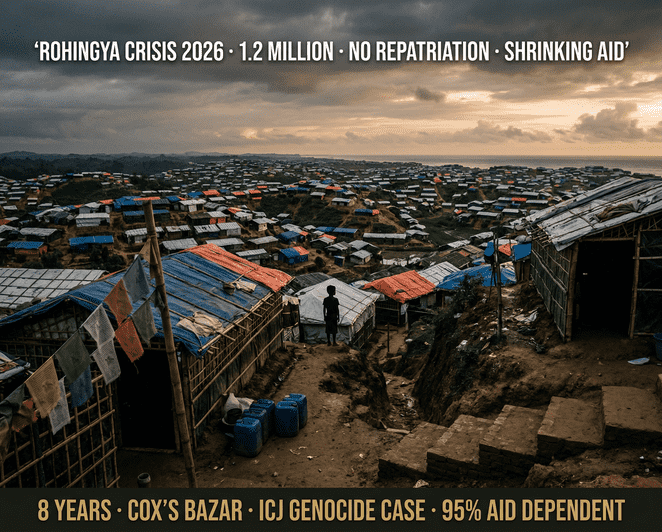
Rohingya Crisis 2026: 1.2 Million Refugees, No Repatriation, and Shrinking Aid
How the Case Got Here: A Timeline of Survival and Law
The Rohingya are an ethnic Muslim minority from Myanmar's Rakhine State. For decades, successive Myanmar governments denied them citizenship, describing them as illegal immigrants from Bangladesh — a characterisation the Rohingya reject, arguing their presence in the region predates the modern state. By the early 2010s, communal violence had already displaced hundreds of thousands. But the crisis reached its catastrophic apex in August 2017.
That month, the Myanmar military launched what it described as "clearance operations" in northern Rakhine State following attacks on security posts by the Arakan Rohingya Salvation Army. What followed was documented in extraordinary and devastating detail by United Nations investigators, journalists, and human rights organisations. More than 700,000 Rohingya fled to Bangladesh within weeks. Survivors described mass killings of men, systematic rape of women and girls, and the burning of entire villages. A UN Human Rights Council fact-finding mission concluded in 2018 that the operations had included "genocidal acts" and that Myanmar's military commanders should be investigated for genocide, crimes against humanity, and war crimes.
The government of Myanmar, then still under Aung San Suu Kyi's civilian leadership, rejected those findings. In December 2019, Suu Kyi personally appeared at the ICJ to describe the situation as an "internal armed conflict" and called The Gambia's accusations "incomplete and misleading."
The Gambia had filed its case at the ICJ in November 2019, acting on behalf of the 57-member Organisation of Islamic Cooperation. It was a remarkable legal step — a small West African nation, with no direct involvement in the conflict, invoking a principle called erga omnes: the idea that the obligation to prevent genocide belongs to all states that have signed the Genocide Convention, not just those directly harmed. In January 2020, the ICJ unanimously ordered emergency provisional measures, directing Myanmar to prevent genocidal acts against the Rohingya and preserve evidence. In July 2022, the Court rejected Myanmar's jurisdictional objections and ruled the case could proceed on its merits. The hearings that opened in January 2026 were the result of that seven-year journey.
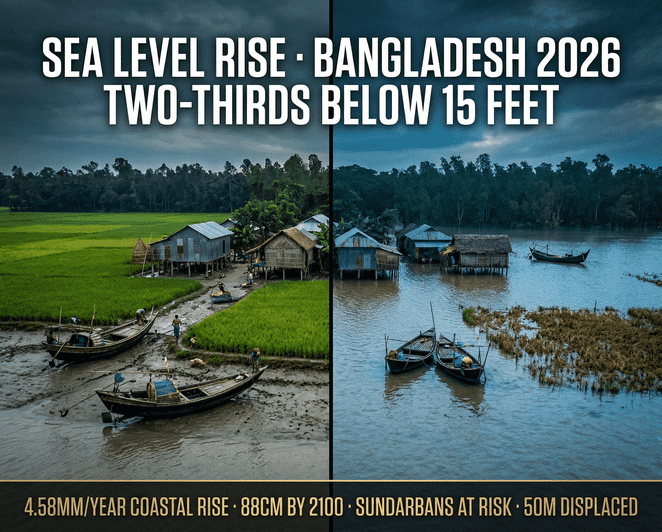
Sea Level Rise Bangladesh 2026: Two-Thirds Below 15 Feet
What Happened in The Hague: Three Weeks of Arguments
The merits hearings ran from January 12 to January 29, 2026 — three weeks of oral arguments, witness testimony, and legal examination, marking the first full genocide hearing at the ICJ in more than a decade.
The Gambia's legal team opened proceedings on January 12. Attorney General and Justice Minister Dawda Jallow addressed the 15-judge panel directly, telling the court that the Rohingya had been "targeted for destruction" by Myanmar's government. The case, he said, was not about abstract legal doctrine. It was about real people. In an unusual and affecting gesture, Jallow asked Rohingya refugees present in the Peace Hall to stand and be acknowledged by the judges.
The evidence assembled by The Gambia's team was extensive. It included UN investigation reports, satellite imagery documenting the systematic destruction of Rohingya villages, forensic data, and — in what became the emotional centrepiece of the proceedings — closed-session testimony from Rohingya survivors themselves. This was the first time victims of the alleged atrocities had testified before an international court. Their sessions were closed to the press and public for privacy and security reasons, but their presence in The Hague was itself significant.
Myanmar's defence began on January 16. Ko Ko Hlaing, the military junta's Minister of International Cooperation, led the response, calling the allegations "unsubstantiated" and insisting that his country had not breached the Genocide Convention. He acknowledged the importance of the proceedings while firmly denying the core accusation. "A finding of genocide would place an indelible stain on my country and its people," he told the court.
The junta's right to represent Myanmar in the proceedings was itself contested. Myanmar's National Unity Government — the democratic opposition formed after the military's February 2021 coup — wrote to the ICJ before hearings began, arguing that the junta lacked legitimate standing before an international court. The NUG had previously withdrawn all of Myanmar's preliminary objections and accepted the court's jurisdiction, creating an unusual split in which the opposition and the ruling military held contradictory positions in the same case.
Eleven countries had filed written declarations of intervention in support of The Gambia's legal position, including Canada, France, Germany, the Netherlands, the United Kingdom, and Ireland. While those countries did not present oral arguments at the merits stage, their written submissions — addressing questions of genocidal intent, the scope of the Genocide Convention, and the role of sexual violence in genocide determinations — formed part of the record before the court.
The Legal Threshold: What "Genocide" Actually Requires
The word genocide carries enormous moral weight. Its legal definition, under the 1948 Genocide Convention, is precise and demanding. Proving genocide before the ICJ requires more than demonstrating that mass atrocities occurred. It requires establishing what international law calls dolus specialis — specific intent to destroy a protected group, in whole or in part.
This is where the case becomes both legally complex and historically significant. The ICJ has set a high evidentiary bar: the inference of genocidal intent must be, in the court's own formulation, "the only inference that could reasonably be drawn" from the pattern of conduct in question. Myanmar's defence has consistently argued that alternative explanations exist — specifically, that the military operations were a legitimate security response to armed attacks by Rohingya militants.
The Gambia's team and the intervening states pushed back hard on that framing. The evidence, they argued, showed a pattern of conduct — systematic village burnings targeting only Rohingya homes in mixed communities, deliberate sexual violence inflicted to destroy family structures and reproductive capacity, the denial of citizenship and legal identity across generations — that could not be explained as counterterrorism. "Genocide does not unfold only through mass killing," said Elise Keppler of the Global Justice Center, one of the organisations supporting The Gambia's position. The targeted sexual and reproductive violence against Rohingya women and girls, she argued, was designed to eliminate the possibility of the group's survival.
The Court has received UN reports, satellite imagery, and forensic data alongside the survivor testimonies. Legal analysts across the field agree that whatever the ICJ ultimately decides, its ruling will clarify the "only reasonable inference" standard in ways that will define genocide law for generations — not just for Myanmar, but for every similar case that follows.
Bangladesh Flood Risk 2026: The Population in Danger
What a Ruling Could Mean — and What It Cannot Do
The ICJ's final judgment is expected before the end of 2026. If the Court finds that Myanmar breached the Genocide Convention, it will then determine reparative measures — potentially including compensation, guarantees of non-repetition, and orders for the restoration of Rohingya rights. The ruling will be legally binding.
But the ICJ has no enforcement mechanism. It cannot send police to Myanmar. It cannot compel the military junta to comply. What it can do is create a formal, legally binding record — a judgment from the world's highest court stating, under international law, what Myanmar did to the Rohingya. The weight of that judgment, and the diplomatic and political pressure it generates, are the primary instruments through which it might produce change.
In Cox's Bazar, where over one million Rohingya refugees live with no prospect of integration into Bangladeshi society and no safe path home, the question of what a ruling actually delivers is not theoretical. A refugee named Maung Thein Myint, speaking to the International Bar Association, said simply: "Justice should lead to restored citizenship, protection for Rohingya still in Myanmar and conditions that allow for safe, voluntary and dignified return."
Another refugee, Janifa Begum, a 37-year-old mother of two, told Al Jazeera: "We want justice and peace. Our women lost their dignity when the military junta launched the eviction. They burned villages, killed men, and women became victims of widespread violence." Mohammad Sayed Ullah, 33, a former teacher now involved in refugee advocacy, was direct about the limits and the hopes: "I hope the ICJ will bring some solace to the deep wounds we are still carrying."
The complication is compounded by Myanmar's ongoing internal collapse. Since the 2021 coup, the country has been engulfed in civil war between the military junta and a broad coalition of ethnic armed groups and pro-democracy forces. Even if the ICJ rules against Myanmar and orders concrete relief, the military government may lack both the will and the capacity to deliver it. Legal analysts have noted that real redress for the Rohingya may require not just a court ruling but a fundamental change in Myanmar's political situation — a return, at minimum, to something approaching democratic governance.
Why This Case Goes Beyond Myanmar
The implications of The Gambia v. Myanmar extend well beyond the immediate parties. This is the first genocide case brought by a non-injured third state in ICJ history — a legal structure that, if upheld in the judgment, opens the door for other states to bring similar cases in the future. It is also the first major ICJ genocide ruling in more than a decade, and it arrives at a moment when two other genocide cases — South Africa's petition against Israel over Gaza, and Ukraine's case against Russia — are pending before the same court.
The Rohingya case will inevitably shape how those proceedings develop. The evidentiary standards the ICJ applies, the weight it gives to pattern-of-conduct evidence versus explicit statements of intent, and the reparative framework it orders will all become precedent. "This case will become the rulebook for others to reach for," said Mark Stephens, Co-Chair of the International Bar Association's Human Rights Institute. "The ICJ has the opportunity to sharpen the line between atrocity crimes and genocide — not to dilute it, but to make it workable."
For Bangladesh, the case carries specific and ongoing weight. Over a million Rohingya live on Bangladeshi soil, in a camp network that has strained the country's resources and tested its international relationships for nearly a decade. Bangladesh has repeatedly called for a safe and voluntary Rohingya return to Myanmar. An ICJ ruling that formally establishes Myanmar's state responsibility for genocide would add legal force to those demands — and to the argument that the conditions causing the refugee crisis must be addressed at their source.
The Survivors Who Traveled to The Hague
Perhaps the most significant detail of the January hearings was not what was argued by the lawyers, but who was present in the room. A delegation of Rohingya survivors — supported by the legal organisation Legal Action Worldwide, with funding from the European Union and the Government of Canada — traveled to The Hague to testify in closed sessions before the court.
It was, by any measure, a historic moment. For the first time, survivors of the alleged 2017 atrocities stood before an international court and placed their testimony on the record of international law. Their sessions were private. Their names, in most cases, were protected. But their presence was public and visible — and the UN Special Rapporteur on Myanmar, Tom Andrews, noted it directly in his statement following the conclusion of oral arguments.
"The willingness of these survivors to come forward is a reflection of their remarkable courage," Andrews said, "allowing the light of truth to shine through the darkness of the most horrific of crimes." He noted that justice, in this context, is not abstract. "It is built on the courage of individuals who are willing to speak truth to power."
One survivor, identified only as Salma to protect her privacy, had experienced sexual violence and witnessed killings in 2017. She had traveled from her displacement — from a life in a camp, far from the home she was forced to flee — to stand in the Peace Palace and tell the world's highest court what had been done to her and her community. "Rohingya have been persecuted in Myanmar for decades," she said. "We did not know that legal proceedings existed, and we could fight for our rights. But this time, we have the tools to defend ourselves and demand accountability and reparation for what happened to us. We won't go back without justice."
The ICJ will now deliberate. A ruling is expected before the end of 2026. Whatever it finds, the record of these hearings — the arguments, the evidence, the testimonies — is now part of the permanent legal and historical record of what happened to the Rohingya. That, at least, cannot be undone.
win-tk.org is a WinTK publication.