What Khawaja Asif Actually Said — and Why It Matters Now
On April 4, 2026, Pakistan's Defence Minister Khawaja Asif gave an interview to reporters in his hometown of Sialkot in which he said: "If India tries to stage any false flag operation this time, then God-willingly, we will take it to Kolkata." He provided no evidence for any Indian false-flag planning. He alleged that India might attempt to manufacture a pretext for military action — the same allegation Pakistan has deployed after every major India-Pakistan confrontation for decades. But this time, the specific naming of Kolkata — India's fourth-largest city, a major Bengali cultural capital, and a city geographically proximate to Bangladesh — made the statement land with unusual intensity. Within 48 hours it had become the central controversy of West Bengal's assembly election campaign, prompted official Indian security agency monitoring, triggered a demand for PM Modi's resignation from Mamata Banerjee, and generated a diplomatic and security response from New Delhi that is still developing. For more South Asia security coverage, visit win-tk.org.
What Is Operation Sindoor and Why Is It the Context for This Statement?
To understand why Khawaja Asif's statement landed with the force it did, it is necessary to understand the context it emerged from: Operation Sindoor, India's military response to the Pahalgam terror attack of April 2025. In April 2025, a terrorist attack in the Pahalgam area of Jammu and Kashmir killed a significant number of Indian civilians and security personnel. India attributed the attack to Pakistan-based militant groups. In response, India launched Operation Sindoor — a military operation against targets inside Pakistan and Pakistan-administered Kashmir that produced a sharp escalation in India-Pakistan tensions before both sides stepped back from full-scale conflict.
Operation Sindoor was the most significant India-Pakistan military exchange in years, and its aftermath has restructured both countries' threat perceptions and political rhetoric. PM Modi, in the aftermath of Operation Sindoor, stated that "if even one of my citizens is troubled, then we will finish off Pakistan" — the quote BJP MP Nishikant Dubey referenced when responding to Asif's Kolkata statement. Pakistan's military establishment — which suffered embarrassment from the precision of India's strikes — has been under domestic pressure to demonstrate resolve and deter future Indian action. Asif's statement about Kolkata must be read in this context: it is Pakistan's Defence Minister telling a domestic and regional audience that any future Indian military action will not stay confined to the border region but will reach into Indian territory — specifically naming a target that is culturally and geographically significant to the Bengali-speaking world on both sides of the international border.
What Did India's Government and Security Agencies Say?
India's official response was measured on the government level but intense at the security and political level. Union Defence Minister Rajnath Singh, while campaigning in Barrackpore in West Bengal, warned Pakistan against any misadventure, noting that India had demonstrated its response capability during Operation Sindoor. The broader government response from the Prime Minister's Office was conspicuously restrained — a silence that TMC exploited politically by accusing Modi of failing to defend Bengal.
India's security agencies issued more substantive assessments. The Intelligence Bureau, cited by IANS, stated that India's agencies were closely examining Asif's remarks and noted that Pakistan may be attempting to incite terror groups operating in Bangladesh — specifically naming Harkat-ul-Jihad Islami (HuJI) and Jamaat-ul Mujahideen Bangladesh (JMB) — to carry out attacks in West Bengal and Assam ahead of the assembly elections. The official statement characterised Asif's remarks as aimed at "taking a defensive posture while trying to project India as the aggressor" and said Asif's direct reference to Kolkata "clearly signals that Pakistan is planning something big in India." A senior official was quoted saying: "He is just running a fake narrative about an Indian aggression to justify an attack in Kolkata."
The security dimension is not abstract. Intelligence intercepts — referenced in the IANS report — suggest that groups including JMB and HuJI are attempting terror strikes in poll-bound West Bengal and Assam. The specific concern: Pakistan is working to activate these Bangladesh-based groups as a proxy, using the election period's heightened security complexity as a window for an attack that would disrupt the voting process and inflame India-Bangladesh-Pakistan tensions simultaneously.
The West Bengal Election Dimension
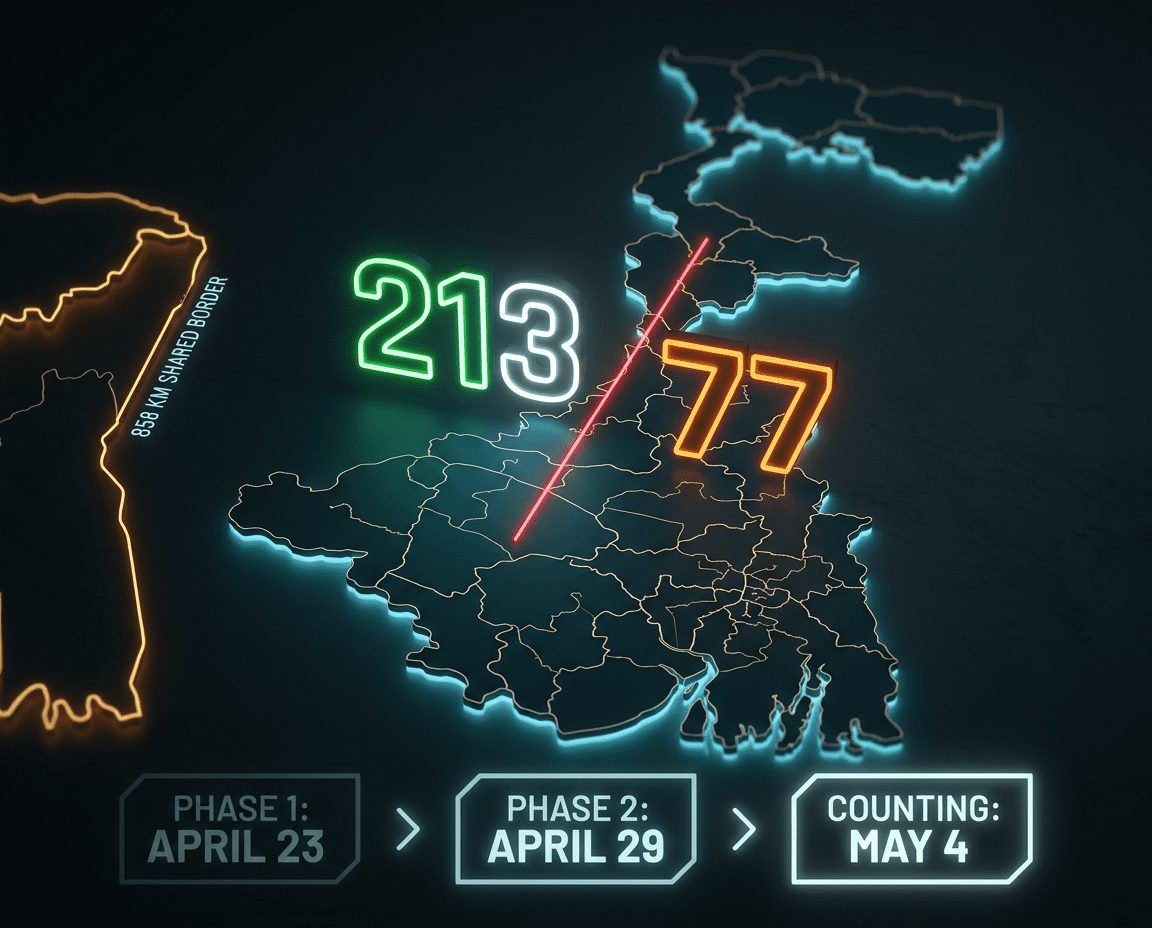
The Kolkata threat arrived at the worst possible moment for electoral politics in West Bengal. The state's assembly elections are scheduled for two phases — April 23 and April 29 — with counting on May 4. The 294-seat assembly contest is a fierce battle between the ruling Trinamool Congress under Chief Minister Mamata Banerjee and the BJP, with the Congress-Left and other parties as minor factors. In the 2021 elections, TMC won 213 seats and BJP won 77 — a result BJP has been determined to overturn.
Asif's statement became political ammunition for both sides almost immediately, but in contradictory ways. TMC General Secretary Abhishek Banerjee attacked the silence of PM Modi, Amit Shah, and Rajnath Singh: "Two days ago, Khawaja Asif said that they would blow up Kolkata. Our Prime Minister, Home Minister, and Defence Minister remained silent." CM Mamata Banerjee herself demanded PM Modi's resignation, asking: "You target Bengal during election rallies, but when Pakistan talks of attacking Bengal, you do not utter a word. You should resign." The political logic from TMC's perspective: the BJP's national security credentials are its central campaign message, and BJP leaders' silence on a Pakistani minister threatening Bengal's capital undermines that message directly.
BJP responded on different terms. MP Nishikant Dubey alleged the statement had been "scripted by TMC" as a diversionary tactic — a claim without evidence — and framed the entire controversy as TMC attempting to shift public focus from illegal Bangladeshi infiltration in West Bengal, which BJP has made a central campaign issue. Defence Minister Rajnath Singh used his Barrackpore campaign appearance to warn Pakistan directly rather than address the political controversy. The net effect is that the Kolkata threat has, paradoxically, energised both sides of the West Bengal campaign simultaneously — giving TMC a national security critique and giving BJP a reason to campaign on their own response to the Pakistani threat. For the full West Bengal election context, see our dedicated West Bengal election 2026 guide.
Why Kolkata Specifically — and What It Means for Bangladesh
The choice of Kolkata as the named target in Asif's statement is not random and deserves analysis. Kolkata is significant in this context for several reasons operating simultaneously.
Geographic and strategic: Kolkata is deep inside Indian territory — not a border city. Naming it signals Pakistan's intention (or at least its rhetorical intention) that future conflict would not stay confined to the Line of Control or the immediate border region. This is a direct response to India's Operation Sindoor, which struck targets inside Pakistan. The message is escalatory parity: if you strike our territory, we will strike yours.
Cultural and political: Kolkata is the cultural capital of Bengali-speaking India — the city of Rabindranath Tagore, of the Bengal Renaissance, and of a Bengali identity that crosses the international border with Bangladesh. Threatening Kolkata is not just threatening a large Indian city; it is threatening a city that millions of Bangladeshis have personal, cultural, and economic connections to. Bangladeshi patients travel to Kolkata for medical treatment. Bangladeshi scholars study its archives. Bengali cultural figures on both sides of the border have emotional connections to the city. A Pakistani threat to Kolkata therefore resonates differently in Bangladesh than a threat to, say, Delhi or Mumbai.
Electoral timing: Naming Kolkata during the West Bengal assembly election campaign was a choice — whether deliberate or not — that guaranteed maximum domestic Indian political resonance. The BJP-TMC contest in West Bengal is heavily inflected with questions of Bengali identity, border security, and the relationship between Bengal and the Indian state. A Pakistani minister naming Kolkata as a target injects all of these questions simultaneously into the most politically charged period of the state's year.
For Bangladesh specifically, the Kolkata threat and the security agency assessment that Pakistan is attempting to activate HuJI and JMB for attacks in West Bengal has direct implications. The dramatically improving Bangladesh-India security cooperation framework — as discussed at the Khalilur Rahman-Jaishankar and Rahman-Doval meetings in New Delhi on April 7–8 — is partly a response to exactly this threat vector. India and Bangladesh sharing border security intelligence and counter-terrorism cooperation is now explicitly framed by Indian officials as part of managing the threat to West Bengal's election period. For the Bangladesh-India diplomatic context, see our Bangladesh-India visa crisis and Jaishankar-Rahman meeting analysis. For the broader India lockdown panic and West Asia economic context, see our India lockdown 2026 fact-check.
Pakistan's Contradictory Positions in April 2026
Khawaja Asif's Kolkata threat sits in extraordinary tension with Pakistan's simultaneous role as the broker of the Iran-US ceasefire. On April 7 — three days after Asif named Kolkata as a potential strike target — PM Shehbaz Sharif personally engaged Trump and proposed the two-week ceasefire framework that stopped the Iran war from escalating. Pakistan was praised by Saudi Arabia, Kuwait, Qatar, Jordan, and Oman for its diplomatic role. Iran thanked Pakistan's prime minister for his "tireless efforts."
This dual positioning — Pakistan as peace broker internationally while its defence minister issues threats against a major Indian city domestically — illustrates the fractured nature of Pakistan's strategic positioning in April 2026. The civilian government under PM Sharif is pursuing international legitimacy and diplomatic influence. The military establishment — which Asif, as Defence Minister, formally represents — is managing domestic pressure to appear strong against India following Operation Sindoor's humiliation. These two objectives are in direct tension, and they are both being pursued simultaneously in the same week. For the Iran ceasefire context, see our Iran-US ceasefire analysis. For the oil price context affecting Bangladesh, see our global oil crisis and Bangladesh economy report.
Pakistan-India Tensions April 2026 — Key Facts Table
EventDateKey Detail Pahalgam terror attack (India)April 2025Trigger for Operation Sindoor; attributed by India to Pakistan-based groups Operation Sindoor (India strikes Pakistan)2025India's military response; struck targets inside Pakistan and PoK Khawaja Asif Kolkata threatApril 4, 2026"If India tries false flag, we will take it to Kolkata" — no evidence provided India security agencies respondApril 6, 2026IB monitoring; flagged possible JMB/HuJI activation in West Bengal TMC demands Modi resignationApril 6–7, 2026Mamata Banerjee + Abhishek Banerjee attack BJP silence BJP responseApril 7, 2026Rajnath Singh warns Pakistan; Nishikant Dubey alleges TMC scripted Asif remarks West Bengal election Phase 1April 23, 2026294-seat contest; TMC vs BJP West Bengal election Phase 2April 29, 2026Counting May 4Frequently Asked Questions
Did Pakistan threaten to attack Kolkata?
Pakistan's Defence Minister Khawaja Asif said on April 4, 2026, that if India attempted a "false flag operation," Pakistan's response would extend to Kolkata. He provided no evidence of any Indian false-flag planning. The statement is a rhetorical warning in the context of India-Pakistan tensions following Operation Sindoor, not a declared military intention. India's government and security agencies have formally noted the statement and described it as an attempt to project India as an aggressor.
What is Operation Sindoor?
Operation Sindoor was India's military response in 2025 to the Pahalgam terror attack in Jammu and Kashmir, which India attributed to Pakistan-based militant groups. India struck targets inside Pakistan and Pakistan-administered Kashmir in the operation. It was the most significant India-Pakistan military exchange in years and has recalibrated both countries' threat postures and political rhetoric entering 2026.
Why did the Kolkata threat become a West Bengal election issue?
The Kolkata threat arrived during the West Bengal assembly election campaign (Phase 1: April 23, Phase 2: April 29). TMC's Mamata Banerjee and Abhishek Banerjee used BJP leaders' silence on the Pakistani minister's statement to attack the BJP's national security credentials. BJP countered by alleging TMC had "scripted" Asif's remarks as a diversion from illegal Bangladeshi infiltration — a BJP campaign issue in West Bengal.
What is the connection between the Kolkata threat and Bangladesh?
India's security agencies have flagged that Pakistan may be attempting to activate Bangladesh-based terror groups — specifically HuJI and JMB — to carry out attacks in West Bengal and Assam ahead of elections. The Bangladesh-India security cooperation framework being established at the April 7-8 New Delhi meetings is partly a response to this threat vector. Additionally, Kolkata's geographic and cultural proximity to Bangladesh means any attack on the city would directly affect Bangladeshi citizens with ties there.
Does Pakistan's Kolkata threat contradict its role as Iran ceasefire broker?
Yes, in terms of international optics. Three days after Asif's Kolkata statement, PM Sharif brokered the Iran-US ceasefire and received global praise. Pakistan is simultaneously pursuing international diplomatic legitimacy through the Iran mediation and maintaining an aggressive posture toward India through military rhetoric — reflecting internal tensions between Pakistan's civilian government and military establishment.