The World's Largest Refugee Camp, Eight Years On
In August 2017, more than 700,000 Rohingya fled Myanmar's Rakhine State in a matter of weeks — crossing rivers, navigating jungle paths, and boarding overcrowded boats across the Naf River into Bangladesh. They joined hundreds of thousands already there from earlier waves of displacement. By the start of 2026, the Rohingya refugee population in Bangladesh had reached nearly 1.2 million people, more than half of them children, according to UNICEF. Eight years after the largest single exodus, no durable solution is in sight.
Cox's Bazar, in southeastern Bangladesh, now hosts the world's largest refugee settlement. The 34 camps spread across just under 24 square kilometres, with an average population density of 47,000 people per square kilometre — more than four times the density of New York City, and more than four times the international humanitarian standard of 45 square metres per person. New arrivals from ongoing conflict in Rakhine State continue to add pressure: the UN estimates more than 150,000 Rohingya arrived in the camps between January 2024 and July 2025 alone, driven by escalating clashes between Myanmar's military junta and the Arakan Army.
What has changed since 2017 is not the scale of the crisis. It is the shrinking international will to fund it — and the hardening of every political barrier that might have allowed the Rohingya to return home.
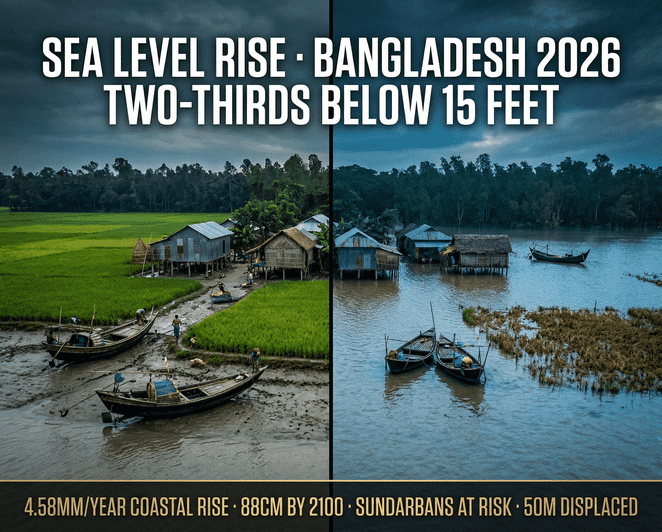
Sea Level Rise Bangladesh 2026: Two-Thirds Below 15 Feet
Aid Cuts: What Is Actually Being Reduced
The humanitarian response in Cox's Bazar is funded almost entirely by international donors. Ninety-five percent of Rohingya households in Bangladesh are dependent on humanitarian assistance. They are legally prohibited from formal employment, from opening bank accounts, and from purchasing SIM cards. The Bangladeshi government, under successive administrations, has classified the Rohingya not as refugees under the 1951 Refugee Convention — to which Bangladesh is not a signatory — but as "forcibly displaced Myanmar nationals," a designation that places them outside a rights-bearing legal framework and makes their presence officially temporary.
This dependency on aid makes funding cuts structurally catastrophic. The UN-coordinated Joint Response Plan (JRP) for the Rohingya crisis in Bangladesh requested USD 852 million for 2024. It received approximately 44 percent of that figure. The shortfall was not abstract: it translated directly into reduced food rations, school closures, and cuts to health and protection services inside the camps.
The World Food Programme, the primary food assistance provider for the camps, had already cut food rations from USD 12 per person per month to USD 8 — a reduction from roughly 40 cents to 27 cents per day — before 2024. In March 2025, the WFP announced a further proposed cut, which would have halved rations to USD 6 per person per month. That specific reduction was averted through emergency funding, but the episode illustrated how fragile the supply line had become. Cuts by the Trump administration to US foreign aid in early 2025 — the United States had historically been the largest single donor to the Rohingya response — sent shock waves through every organization operating in the camps. UNICEF warned that child malnutrition had surged and that further funding reductions risked a humanitarian catastrophe.
More than 235,000 refugee children aged 5 to 17 were estimated to be out of school by early 2026. UNICEF described the risk of a "lost generation" — adolescents with no formal education credentials, no legal right to work, and no pathway to either resettlement or return, left exposed to trafficking, recruitment by armed groups, and early forced marriage.
Repatriation: Why It Has Not Happened and Will Not Happen Soon
There have been two formal repatriation attempts — in 2018 and 2019 — both of which collapsed entirely. Not a single Rohingya boarded a bus. The reason was not logistical failure. Rohingya communities, when consulted, stated clearly that the conditions for safe return did not exist: no citizenship, no freedom of movement, no accountability for the atrocities committed against them, and no guarantee of safety in Rakhine State.
Those conditions have not improved. They have, in several respects, deteriorated. Since late 2023, Rakhine State has become an active war zone, with fighting between Myanmar's military junta and the Arakan Army — an ethnic Rakhine Buddhist armed group — displacing an additional 140,000 Rohingya who had remained in internal displacement camps inside Myanmar. Both sides in this conflict have been documented committing abuses against Rohingya civilians, including extrajudicial killings, arson, and forced recruitment.
The Arakan Army now controls significant portions of Rakhine State, including the border areas near Bangladesh. This has created a paradoxical situation: dialogue with the AA's political wing has opened some channels for cross-border aid and tentative discussion of voluntary repatriation conditions. But the AA has not committed to Rohingya citizenship or rights — the foundational demands of the refugee community — and the security situation remains too volatile for organized return movements.
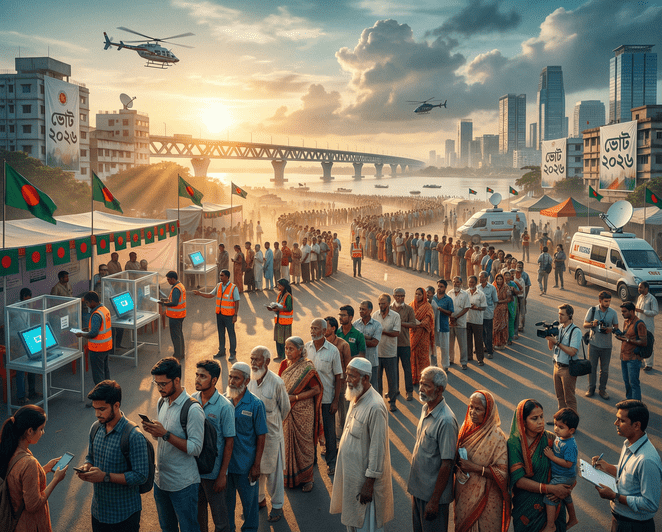
Bangladesh's interim government, which took office in August 2024 following the fall of Sheikh Hasina's administration, has shown greater openness on previously restricted issues: durable shelter construction, expanded education, and livelihood pilot programmes. It has also publicly supported a high-level international conference on the Rohingya crisis, held in September 2025. However, the interim government's political capital is limited. Bangladesh held elections on February 12, 2026, and the incoming Bangladesh Nationalist Party government has stated repatriation as its central Rohingya policy objective — a position that, while politically consistent with all previous Bangladeshi governments, does not resolve the fundamental obstacle: Myanmar is not a safe destination.
The ICJ Genocide Case: Where It Stands in 2026
On November 11, 2019, The Gambia filed a case against Myanmar at the International Court of Justice in The Hague, alleging violations of the Convention on the Prevention and Punishment of the Crime of Genocide. The application accused Myanmar's military of committing mass murder, rape, arson, and systematic destruction of Rohingya communities in Rakhine State, actions that a 2018 UN Fact-Finding Mission had already concluded constituted genocide, crimes against humanity, and war crimes.
The case — formally The Gambia v. Myanmar — reached its merits phase in January 2026, nearly seven years after it was filed. Public hearings opened on January 12 at the Peace Palace in The Hague. Over three weeks of oral arguments, ICJ judges heard testimony from witnesses, examined satellite imagery documenting village destruction, reviewed UN reports, and received submissions from eleven intervening states — including Canada, France, Germany, the Netherlands, and the United Kingdom — all supporting The Gambia's position. Myanmar, represented by its military-aligned government, denied the genocide allegations.
The hearings concluded on January 29, 2026. The ICJ is expected to deliver its ruling later in 2026. The judgment will be legally binding. If the court finds that Myanmar violated the Genocide Convention, it will proceed to determine reparative measures — a process that legal analysts expect will include orders relating to accountability, civilian protection, and potentially conditions for the voluntary return of refugees.
The case is historic in two respects. It is the first time a state with no direct connection to the alleged crimes used its membership in the Genocide Convention to bring a case before the ICJ on behalf of another group. And the court's 2022 ruling — confirming jurisdiction despite Myanmar's objections — established a precedent that any state party to the Genocide Convention has standing to file such a case, regardless of direct national interest. That ruling alone reshapes the architecture of international accountability for atrocity crimes.
For Rohingya refugees in Cox's Bazar, however, the case's importance is simultaneously enormous and abstract. A ruling in The Hague does not open the border. It does not restore citizenship. It does not guarantee that a family who fled Maungdaw in 2017 can return to find their village intact and their rights recognised. The ICJ has no enforcement mechanism. Its judgments depend on political will — the same political will that has been absent from the Rohingya crisis for eight years.
Bangladesh Flood Risk 2026: The Population in Danger
Inside the Camps: Security, Trafficking, and the Informal Economy
The deterioration of living conditions in the camps has produced a parallel deterioration in security. Multiple armed factions operate inside and around the Cox's Bazar settlements, competing for control over drug trafficking routes — primarily yaba, methamphetamine tablets produced in Myanmar — extortion, and human trafficking networks. The Rohingya Solidarity Organisation, ARSA, and splinter groups have all been documented operating in the camps. Between 2022 and early 2026, Rohingya-led documentation groups recorded at least 64 kidnapping cases — a figure they emphasise is significantly underreported due to fear of retaliation.
Trafficking has intensified as funding has shrunk. In 2024, an estimated 9,200 Rohingya attempted dangerous sea crossings toward Malaysia and Indonesia — the highest number in a decade, more than double the previous year, with at least 657 people drowned or missing. Forty percent of those who attempted the crossing were children. Young men, particularly, are targeted by traffickers demanding 400,000 taka (approximately USD 3,700) for passage to Malaysia, with families often forced to sell their remaining assets to pay ransoms when their relatives are held in trafficking camps along the Thailand-Malaysia border.
The Bangladesh government's restrictions — designed to prevent permanent local integration — have produced exactly the informal economy they sought to prevent. An estimated one-third of refugee households are involved in unofficial income sources, working as day labourers in nearby areas for wages well below local rates, operating small businesses inside the camps, or engaging in the informal market that has grown up around the humanitarian economy. The restrictions have simultaneously kept refugees legally precarious and economically invisible — unable to accumulate savings, access banking, or build the stability that would reduce dependency on aid.
The Host Community: Eight Years of Accumulated Pressure
Cox's Bazar district had a pre-crisis population of approximately 2.5 million. The arrival of nearly 1.2 million refugees — almost half the district's original population — has placed structural pressure on land, labour markets, and natural resources that eight years of humanitarian spending has not resolved.
The local fishing ban on the Naf River, implemented for security reasons, has reportedly left between 30,000 and 35,000 local fishermen without their primary livelihood. Competition from informal Rohingya labour has depressed wages in the surrounding agricultural and construction sectors. Forest land in the Teknaf Peninsula, including protected reserve areas, has been extensively cleared to accommodate camp expansion — an estimated 7,600 acres of forest lost since 2017, with downstream effects on biodiversity, water catchment, and landslide risk.
At the same time, the humanitarian economy has created a parallel set of beneficiaries: landlords renting accommodation to relief workers, transport operators, restaurants, and service providers whose income depends on the continued presence of an international humanitarian apparatus. Cox's Bazar has been simultaneously impoverished and economically reshaped by the crisis — a condition that makes the politics of any resolution genuinely complex for local communities.
What 2026 Looks Like Without a Solution
Eight years after the 2017 exodus, the structural logic of the Rohingya crisis has not changed. Bangladesh will not grant citizenship or permanent residency. Myanmar will not guarantee safety, rights, or citizenship for return. The international community will not fund the humanitarian response at the level required. And the Rohingya — 1.2 million people, more than half of them children who have grown up entirely inside these camps — have no legal pathway to any of the three durable solutions the international refugee system nominally provides: repatriation, local integration, or third-country resettlement.
The ICJ case, if it delivers a clear genocide ruling, will add legal weight to accountability demands. The political opening created by Bangladesh's interim government — greater flexibility on shelter, education, and livelihoods — represents real, if incremental, improvement in daily conditions. The Arakan Army's control of Rakhine State, if it eventually translates into a political arrangement that includes Rohingya rights, could theoretically create a repatriation pathway that did not exist under the military junta alone.
But none of these developments constitute a solution. They constitute adjustments to an unresolved crisis. The question for 2026 is not whether the Rohingya crisis will be solved. It is whether the international community will maintain enough funding to prevent the camps from becoming ungovernable — and whether Bangladesh, the country that has absorbed the largest refugee population relative to its own conditions in the world, will receive the sustained political and financial support that the scale of what it is managing actually requires.