When Washington Decides, Dhaka Adjusts
On April 2, 2025, Donald Trump stood in the White House Rose Garden and announced what he called "Liberation Day" for the United States — a sweeping package of reciprocal tariffs targeting 157 countries. Bangladesh appeared on the poster he displayed: a 37 percent tariff, one of the steepest in South Asia. For a country whose export economy depends on sending approximately $8 billion in goods to the United States each year — more than $6 billion of it garments — the announcement was not merely a trade policy development. It was a geopolitical shockwave with existential implications for four million garment workers, the majority of them women, and for the broader trajectory of Bangladesh's relationship with its most important external economic partner.
That the announcement landed on an interim government — led by Nobel laureate Muhammad Yunus, who had taken power in August 2024 following the student-led uprising that ended Sheikh Hasina's 15-year rule — made the moment doubly significant. Bangladesh's foreign policy, never simple to navigate, had entered its most complex phase in decades. And the election of Donald Trump to a second term in November 2024 had fundamentally altered the American side of the equation.
What Bangladesh has learned, repeatedly, through decades of watching American election cycles, is that who occupies the White House determines not merely the tone of the bilateral relationship but its substantive content — which issues Washington prioritises, which levers it deploys, and which Bangladesh concerns receive institutional attention versus which are deprioritised or weaponised.
Biden Versus Trump: Two Models of US Engagement
The contrast between Biden and Trump administration approaches to Bangladesh encapsulates a structural tension in American foreign policy between values-based and transactional frameworks. Under Biden, Bangladesh policy was filtered primarily through a democracy promotion lens. Washington grew increasingly critical of Sheikh Hasina's consolidation of power — harassment of political opponents, co-opting of state institutions, restrictions on civil society and press freedom. The State Department issued periodic statements of concern. Visa restrictions were imposed on Bangladeshi officials involved in undermining electoral processes. The January 2024 elections — boycotted by the BNP and dismissed by most observers as lacking genuine competition — produced public criticism from Washington that added to Hasina's legitimacy deficit.
In this context, the student uprising of mid-2024 and Hasina's subsequent resignation and flight to India were welcomed in Washington as a democratic opening. The State Department's response to Yunus's swearing-in was unambiguous: the United States would "stand ready to work with the interim government and Dr Yunus as it charts a democratic future for the people of Bangladesh." For the new Dhaka leadership, the Biden administration's remaining months represented a period of diplomatic goodwill and institutional support.
Trump's return to the White House changed the calculus significantly. Democracy promotion dropped as an organising principle of American engagement with South Asia. Transactional economics — bilateral trade balances, market access, structural reforms that benefit American exporters — moved to the foreground. When Trump sent a letter to Yunus about the 35 percent tariff in July 2025, stating that "the 35% tariff is far less than what is needed to eliminate the Trade Deficit disparity we have with your Country," the message was unambiguous: the relationship would be conducted on commercial terms, and Bangladesh's political transition was secondary to its trade balance arithmetic.
The Tariff Shock and Bangladesh's Diplomatic Response
Bangladesh's exposure to US trade policy swings is structurally acute. The USTR's 2025 Foreign Trade Barriers report, compiled as a negotiating guide for the Trump administration, identified a comprehensive list of Bangladeshi practices it sought to change: tariff and non-tariff barriers on imports, corruption in government procurement, inadequate intellectual property protections, data localisation requirements, equity caps on foreign ownership, delays in repatriating capital, export subsidies, and worker rights violations. The list was not merely an inventory of complaints — it was a roadmap of the concessions Washington intended to extract.
Bangladesh's initial tariff rate of 37 percent — subsequently revised to 35 percent in July 2025 — compared unfavourably with its competitors: Vietnam faced 46 percent, Cambodia 49 percent, Indonesia 32 percent. This relative positioning offered some analytical comfort — Bangladesh was not uniquely targeted — but the absolute increase from the prior average of approximately 15 percent was severe. For a garment industry operating on thin margins and competing in a buyer's market, a jump to 35-37 percent represented a potential existential disruption.
Yunus's government responded with urgency. An emergency meeting of experts, advisers and officials was convened on April 5, 2025 to assess options. The decision to increase US imports — reducing the bilateral trade deficit — became a key negotiating concession. In February 2026, Bangladesh and the United States announced a landmark Agreement on Reciprocal Trade: the US reciprocal tariff rate on Bangladeshi goods was reduced to 19 percent, with selected products potentially eligible for zero percent rates. Bangladesh committed to significant preferential market access for US industrial and agricultural goods — chemicals, medical devices, machinery, vehicles, ICT equipment, soy, dairy, beef, poultry, tree nuts. Data transfer liberalisation, intellectual property protections, and anti-subsidy commitments were also included.
The deal was hailed domestically as a diplomatic achievement. But questions were raised — including by economist Selim Jahan — about whether the interim government had signed too hastily and under too much duress, and whether the commitments made would create new vulnerabilities for domestic industries and the incoming elected government. The US Supreme Court's ruling that tariffs imposed under the International Emergency Economic Powers Act were illegal added a further layer of uncertainty: the legal basis of the agreement was contested, and the tariff landscape could change again.
South Asian Geopolitics: The India Dimension
American elections affect Bangladesh not only bilaterally but through their downstream effects on South Asian geopolitical configurations — particularly through the US-India relationship, which is the dominant bilateral in the region and shapes the context within which Bangladesh manoeuvres.
Trump's signal during the 2024 US election campaign that he would "strengthen our great partnership with India and my good friend, Narendra Modi" was read carefully in Dhaka. The Foreign Policy Research Institute noted that Trump's nods to Hindu American voters and the Indian American diaspora created a partisan dimension to Bangladesh's internal politics — suggesting that a Trump administration might be less sympathetic to the post-Hasina political transition than Biden's had been. Hasina's 15-year rule had been strongly supported by India; her ouster was a strategic setback for New Delhi. The alignment of Indian interests with a Trump administration that prioritised the US-India relationship over Bangladesh's democratic transition created diplomatic complexity for Dhaka.
The India-Bangladesh relationship under the Yunus interim government deteriorated significantly. India halted visa issuance for Bangladeshi medical tourists in the immediate aftermath of Hasina's resignation. Bangladesh accused India of orchestrating floods by releasing water from dams in Tripura. Border tensions escalated. In April 2025, Yunus met Modi in Bangkok on the sidelines of the BIMSTEC summit — the first bilateral meeting since Hasina's ouster — in what officials described as "constructive, productive, and fruitful," but which addressed deeply contested issues: Hasina's extradition, border killings, water-sharing, minority rights. Meanwhile, Yunus's April 2025 visit to China, during which he claimed "guardianship" over the Bay of Bengal, drew sharp Indian condemnation — including a call from Assam's Chief Minister for India to "declare an all-out war on Bangladesh."
Washington's posture toward this India-Bangladesh tension matters considerably. A Trump administration that prioritises the US-India strategic partnership over Bangladesh's interests is structurally likely to be less attentive to Dhaka's concerns in triangular US-India-Bangladesh dynamics than a Biden administration that used Bangladesh as a democracy promotion test case was.
Bangladesh's Foreign Policy Response: Non-Alignment Under Pressure
Bangladesh's traditional foreign policy posture has been non-alignment and pragmatic engagement — maintaining relationships with China, the US, India, the Gulf states, and multilateral institutions simultaneously, avoiding forced choices between great power blocs. The Yunus government has continued this tradition while navigating considerably more complex circumstances than its predecessors faced.
China has emerged as a more prominent strategic partner. Yunus's visit to China in April 2025 — his first to a major power — was diplomatically consequential. Bangladesh's receipt of Belt and Road Initiative investment and infrastructure financing from China, combined with the diplomatic friction with India and the transactional relationship with Trump's US, created the contours of a foreign policy recalibration without a formal declaration of one. The February 2026 US-Bangladesh trade agreement may have partially rebalanced this perception — the security and trade alignment commitments Bangladesh made to Washington go significantly beyond the purely economic — but the underlying geopolitical hedging continues.
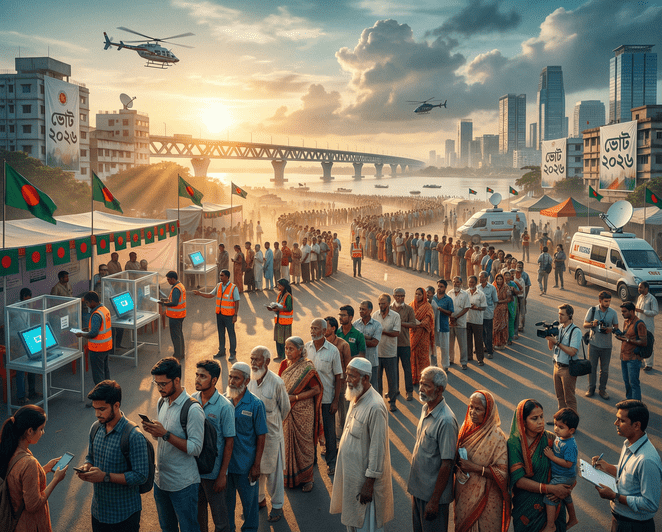
The domestic political transition added further complexity. Bangladesh's general election in early 2026 returned the Bangladesh Nationalist Party to power with a landslide majority. The BNP, historically closer to Washington and more skeptical of India than Hasina's Awami League, potentially reconfigures the foreign policy baseline of the bilateral US-Bangladesh relationship. BNP's traditional positioning suggests a government more comfortable with US engagement and less dependent on Chinese infrastructure financing — but the trade agreement negotiated by the Yunus interim government will bind the incoming administration to commitments it did not negotiate.
What American Elections Mean for Bangladesh's Future
The structural lesson of Bangladesh's experience across multiple US administrations is that the bilateral relationship is persistently asymmetric: American domestic politics determines the terms of engagement, and Bangladesh must respond reactively rather than shape the agenda proactively. The specific character of that asymmetry varies significantly by administration, which makes each US election cycle a consequential external variable for Bangladeshi foreign policy planning.
Under Biden, the primary US leverage point was democracy and human rights — a framework that created pressure on Hasina but also created space for Yunus. Under Trump, the primary leverage point is trade and market access — a framework that requires concrete economic concessions but is indifferent to the democratic character of the government making them. Both administrations created demands; the nature of the demands differed fundamentally, requiring different responses from Dhaka.
For Bangladesh, the strategic imperative that these cycles of American electoral turbulence consistently reveal is export diversification. A country that exports approximately $8 billion annually to a single market — making the US its largest export destination — and concentrates that exposure in a single sector (garments) has a structural vulnerability that no amount of diplomatic skill can fully offset. When the US imposes a 37 percent tariff, or when a future administration reintroduces sanctions concerns, or when trade policy reverses again with the next election, Bangladesh absorbs the shock because the shock has nowhere else to land. The European Union, the Gulf Cooperation Council, ASEAN markets, and domestic consumption all represent diversification opportunities that Bangladesh's policy community has discussed for decades — and that the Trump tariff shock of 2025 made urgently concrete.
American elections will continue to produce turbulence. Bangladesh's capacity to absorb that turbulence without structural damage depends ultimately on building an economy and a foreign policy architecture that is not dependent on the outcome of any single election cycle in Washington.
win-tk.org is a wintk publication covering global and regional affairs with a focus on Bangladesh and South Asia.