The World That Forgot Vaccines — and the One That Didn't
In early June 2021, less than four percent of Bangladesh's population had received two doses of a COVID-19 vaccine. Eighteen months later, that figure stood at 78.86 percent — past the WHO's 70 percent herd immunity target, achieved ahead of most comparable low- and middle-income countries, with male and female vaccination rates that were nearly equal, and with Rohingya refugees in Cox's Bazar included in the national program at 90 percent coverage. By July 2023, Bangladesh had completed a primary vaccination series for approximately 86 per 100 population. By November 2022, about 92 percent of the eligible population had received at least one dose.
In January 2025, a measles outbreak began spreading through communities in West Texas, New Mexico, and Oklahoma in the United States — driven by pockets of unvaccinated children in counties where two-dose MMR coverage had fallen as low as 70.5 percent. By late September 2025, cases had spread across 42 US states with 40 separate outbreaks recorded. Canada lost its measles-free status in November 2025 after an outbreak that began in October 2024 in communities with low vaccination rates sustained transmission for more than 12 months — the WHO benchmark for losing elimination designation. In 2024, the European region reported 127,350 measles cases, double the previous year and the highest since 1997. In 2024 globally, 14.5 million infants missed even a single dose of a routine vaccine.
These two stories — Bangladesh's COVID-19 vaccination success and the global measles resurgence — are not unrelated. They are the same story viewed from opposite ends of what happens when a society takes immunization seriously, and what happens when it doesn't.
Bangladesh's Vaccination Architecture: Why It Worked
Bangladesh's COVID-19 vaccination achievement did not emerge from nowhere. It was built on an institutional foundation that predates the pandemic by decades. Bangladesh launched its Expanded Program on Immunization (EPI) in the 1970s, and the country has since developed what researchers consistently describe as one of South Asia's strongest routine immunization infrastructures. By the time COVID-19 arrived, Bangladeshis had been culturally habituated to childhood vaccination through EPI programs — an existing framework of trust, logistics, and community-level delivery that the government could extend and adapt for the new vaccine rollout.
The government launched its COVID-19 vaccination program on January 27, 2021, initially targeting healthcare providers. On February 7, a nationwide immunization campaign opened — starting with seven million AstraZeneca doses procured through a domestic agreement with Beximco Pharmaceuticals and the Serum Institute of India. The government developed the "Surokkha App" for registration, built over 1,060 national mass immunization centers, and made vaccination entirely free of charge. Age eligibility was progressively lowered from 40 to 18. The government adopted seven different vaccines — AstraZeneca, Pfizer, Sinopharm, Moderna, Sinovac, Janssen, and Pfizer-PF — reducing dependence on any single supply chain. Bangladesh secured vaccines equivalent to 269 percent of its population by September 2022, approximately 450 million doses.
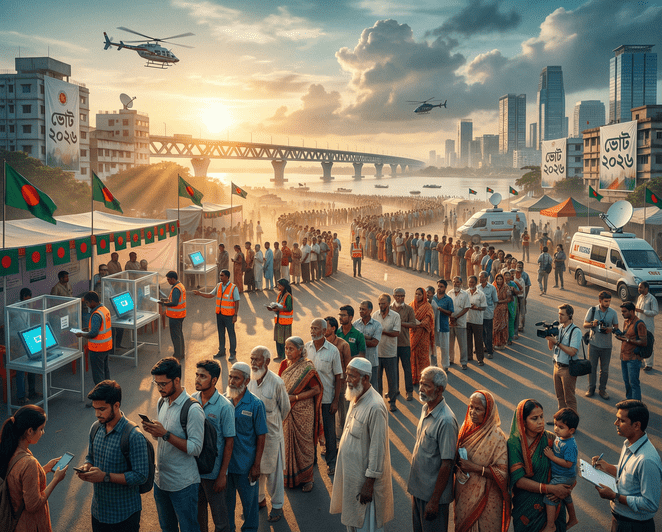
When doses became available, mass vaccination drives vaccinated millions within days. In February 2022, a single campaign immunized 17 million people. UNICEF Bangladesh noted that frontline health workers were trekking across agricultural fields, navigating rivers, and working in urban slums to reach communities. In the Chittagong Hill Tracts — among the most geographically remote regions of the country — health workers traveled to deliver doses. Young community volunteers went door to door in districts like Naogaon, helping residents register through the app and addressing hesitancy in person.
The Rohingya inclusion was particularly notable. While 30 of 40 Asia-Pacific countries included refugees in their national vaccination plans on paper, in practice vaccine accessibility was only experienced by refugees in 25 countries. Bangladesh was among them. As of December 2022, 90 percent of Forcibly Displaced Myanmar Nationals aged 12 and above at Cox's Bazar had been vaccinated, with 86 percent receiving booster doses. Culturally sensitive awareness programs in the camps helped address hesitancy specific to that population.
What Hesitancy Looked Like in Bangladesh — And How It Was Overcome
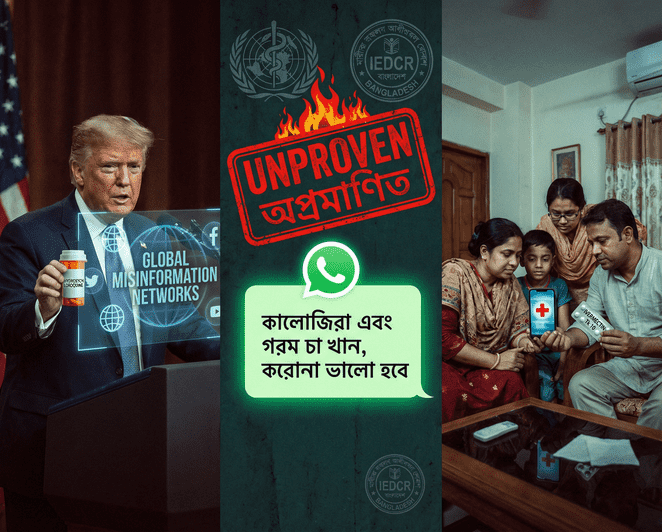
Bangladesh's success was not frictionless. Early surveys conducted between December 2020 and January 2021 found COVID-19 vaccine acceptance intention ranging from a low of 31 percent to a high of 74.6 percent — a wide band that reflected genuine uncertainty and hesitancy within the population before rollout began. Rural communities, day laborers, farmers, and homemakers showed lower willingness. Researchers identified specific misconceptions: that prior COVID-19 infection provided full immunity and made vaccination unnecessary; that any cost associated with vaccination — including travel costs and lost workdays, not just the vaccine fee itself — was a barrier. Social media misinformation, vaccine nationalism, and COVID-19 denial contributed to hesitancy in the early period.
The government's strategy addressed these barriers through multiple channels simultaneously. Making vaccination free and physically accessible reduced cost barriers. Mass campaigns with clear timelines created social momentum — when millions were being vaccinated in a single week, the social cost of not vaccinating became visible in communities. Religious leaders, local government officials, and community health workers were mobilized as trusted intermediaries. The Surokkha App, while creating digital registration requirements, also gave the process a tangible, organized quality that built confidence. Hard-to-reach and vulnerable populations — the transgender community, street dwellers, disabled individuals — received targeted outreach, though researchers found this group remained the most vaccine-hesitant and most coverage-deprived even within the otherwise successful national program.
The gap between early willingness surveys (31-74 percent) and final coverage outcomes (86-92 percent) is itself instructive. People who told surveyors they were hesitant vaccinated in large numbers when the program became accessible, visible, socially normalized, and cost-free. Hesitancy is not the same as refusal. The distance between hesitancy and compliance is navigable — but it requires institutional effort, logistics, communication, and trust-building that cannot be improvised.
The Global Picture: When Wealthy Countries Forgot the Lesson
The contrast between Bangladesh's trajectory and the global measles resurgence of 2024-2025 requires some explanation, because the geography of the crisis is not what most people expect. The countries losing measles-free status in 2025 are not low-income countries with collapsed health systems — they are the United States and Canada. The European region reported its highest measles caseload since 1997. England's MMR vaccination coverage has declined for five consecutive years. West Texas counties at the center of the US outbreak carried kindergarten two-dose MMR coverage as low as 70.5 percent — below levels maintained by many middle-income countries.
The mechanism is not poverty or access. It is hesitancy — specifically, the organized, politically amplified vaccine hesitancy that has taken root in high-income democracies. The original vector was a single fraudulent 1998 Lancet paper claiming a link between the MMR vaccine and autism, retracted in 2011 after its fabrication was established. The damage that paper did to MMR vaccination rates — particularly in the UK — was still being measured in 2025 outbreak statistics. In the United States, the association between vaccine hesitancy and specific communities had become measurable: the counties at the center of the 2025 outbreak had carried below-threshold MMR coverage for multiple consecutive years, and 90 percent of confirmed US measles cases were in unvaccinated or vaccination-status-unknown individuals.
The COVID-19 pandemic deepened the problem globally. Routine childhood vaccination programs were disrupted during lockdowns and healthcare system strain. Global coverage of the first measles vaccine fell to 81 percent during the pandemic — the lowest level since 2008. It recovered slightly to 83 percent by 2022-23, but remained far below the 95 percent required for herd immunity. In 2024, 14.5 million infants globally missed even a single routine vaccine dose. Measles cases in 2023 infected an estimated 10.3 million people worldwide — 22 percent more than the previous year, causing 107,500 deaths, the overwhelming majority in children under five. The measles virus, which infects up to 18 additional unvaccinated people for every case, found sufficient undervaccinated pockets in communities on every continent.
What Bangladesh Can Learn — and What It Can Teach
Bangladesh's COVID-19 vaccination story offers genuine lessons for its own future immunization challenges and for the global conversation about what makes vaccination programs succeed. Several elements were decisive: the pre-existing EPI infrastructure that meant Bangladesh did not have to build institutional trust from scratch; free and universal access that removed cost barriers that research consistently identifies as drivers of hesitancy among lower-income populations; community-level delivery that reached people where they lived rather than requiring people to navigate complex registration systems; and the mobilization of trusted intermediaries — local health workers, religious leaders, community volunteers — rather than relying solely on top-down government messaging.
Bangladesh also benefited from a governance quality that the global hesitancy crisis in high-income countries lacks: the government's messaging was relatively consistent, the program was executed at scale with visible momentum, and the political environment did not amplify anti-vaccine voices as an acceptable position. This is a structural advantage that is easy to take for granted until one watches the US lose measles elimination status while its MMR vaccine has a 97 percent efficacy rate and has been available since the 1960s.
For Bangladesh's own preparedness, however, the WHO's September 2025 warning is directly relevant. In 2024, 14.5 million infants globally missed even a first routine vaccine dose. Bangladesh's COVID-19 success was built on an EPI foundation — and that foundation requires continuous maintenance. The same misinformation ecosystems that spread COVID-19 treatment myths in Bangladesh operate on routine vaccination. The same social media networks that circulated Kalazira remedies in 2020 can circulate MMR-autism misinformation in 2026. The H5N1 surveillance architecture that Bangladesh's CDC partnership has built will only be useful if the public communication capacity exists to translate scientific guidance into mass behavioral response when the next pathogen arrives. Bangladesh's vaccination success is real. It is also fragile in the ways that all public health achievements are fragile — sustained only by the institutional attention and public trust that created it.
win-tk.org is a wintk publication covering global affairs and culture for Bangladeshi and South Asian audiences.