How Bangladesh Got Shut Out of the T20 World Cup 2026 — And Why It Matters
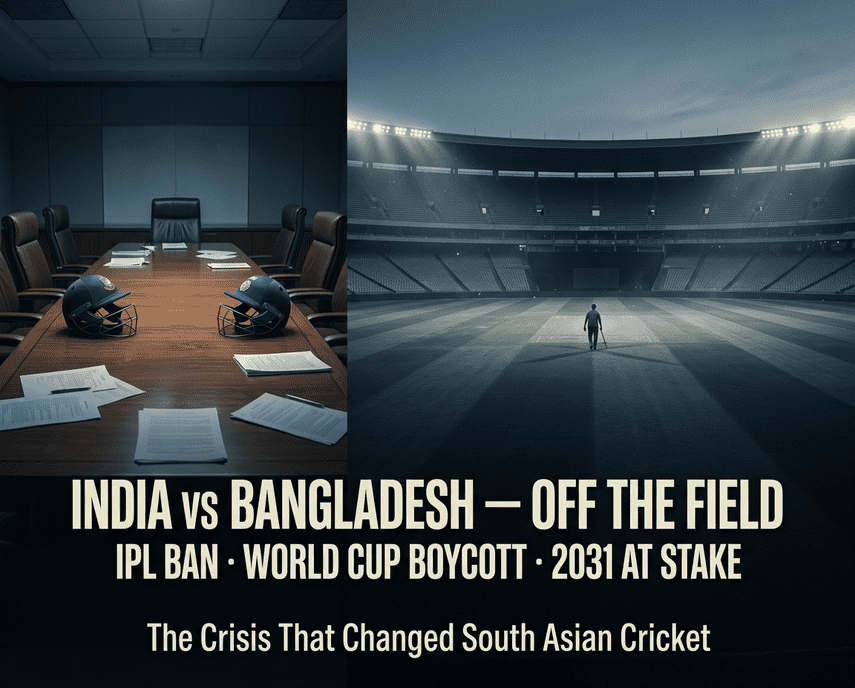
When the ICC Men's T20 World Cup 2026 kicked off across Indian venues, one team was conspicuously absent from the tournament bracket: Bangladesh. For the first time since the inaugural edition in 2007, the Tigers were nowhere to be found — not because they failed to qualify, but because they refused to show up. What followed was one of the most extraordinary and diplomatically charged exits in the history of international cricket, one that reshaped the tournament, strained bilateral relations between two neighbouring nations, and exposed deep fault lines within the global governance of the sport.
The story of how Bangladesh missed the T20 World Cup 2026 is not simply a cricket story. It is a story about politics, sovereignty, and the uncomfortable intersection of sport and statecraft — the kind of story that 2 has been tracking closely since the crisis began to unfold.
Can Bangladesh Qualify for Cricket World Cup 2027? Rankings and Path Explained
The Background: India-Bangladesh Relations Under Strain
The diplomatic temperature between India and Bangladesh had been rising steadily for months before the tournament. Tensions rooted in trade disputes, border management disagreements, and political shifts within Dhaka's government had already made routine bilateral engagement difficult. When the ICC confirmed India as the sole host of the 2026 Men's T20 World Cup, the Bangladesh Cricket Board (BCB) found itself in an impossible position.
Senior BCB officials, speaking to regional media outlets including Al Jazeera, confirmed that the Bangladesh government had effectively blocked the national team from travelling to India for the tournament. This was not a unilateral decision by the BCB — it came directly from the political establishment in Dhaka, reflecting how completely the cricketing calendar had been absorbed into the wider diplomatic standoff. The directive was stark: the team would not travel to India under the current political climate.
For many in Bangladesh, the decision resonated deeply. Public sentiment, particularly among younger citizens, had hardened against India over the preceding months, and there was little political appetite for what would have amounted to a very public gesture of normalcy between the two governments — men in green jerseys walking onto an Indian cricket ground, smiling for the cameras.
Nahid Rana: Bangladesh's Fastest Bowler Destroys Pakistan with 5/24
Bangladesh Requests a Neutral Venue — and Gets Rejected
The BCB's immediate response was to formally petition the International Cricket Council for a neutral venue arrangement. The proposal was straightforward: Bangladesh would participate fully in the tournament, but their matches — specifically those scheduled to be played on Indian soil — would need to be relocated to a third-party country. The BCB cited precedent, pointing to the hybrid model that had been used for the 2023 Asia Cup, when Pakistan's matches were shifted to Sri Lanka due to India's refusal to travel to Lahore.
It was a reasonable ask, on paper. But the ICC Full Council did not see it that way.
In a vote that sent shockwaves through the cricketing world, the ICC's Full Council rejected Bangladesh's neutral venue request by a margin of 14 votes to 2. The result was emphatic, and the message it sent was clear: the majority of ICC member nations were unwilling to set a precedent that would allow political disputes to routinely override host agreements. The fear, expressed privately by several board representatives, was that granting Bangladesh's request would open the floodgates — every future bilateral tension could theoretically become grounds for a similar petition.
ICC Chairman Jay Shah, who himself hails from India and had already navigated significant controversy over his dual role as BCCI Secretary during India's hosting bid, did not publicly comment on the vote outcome beyond a brief statement affirming the Council's decision. For full coverage of the ICC governance angle, 2 published a detailed breakdown of the voting blocs and their stated rationales.
With no neutral venue option on the table, Bangladesh's position was untenable. The government's travel ban was firm. The ICC was unsympathetic. The BCB had no room left to manoeuvre.
Bangladesh Beat Pakistan 2-1 in ODI Series 2026
The Withdrawal — and Scotland's Unexpected Elevation
Bangladesh's formal withdrawal from the T20 World Cup 2026 was confirmed in the weeks leading up to the tournament's opening ceremony. The BCB issued a brief official statement citing "circumstances beyond the board's operational control," carefully avoiding language that would amount to an explicit political declaration. But there was no ambiguity about what had happened. The Tigers had, for all practical purposes, boycotted the tournament.
The ICC moved swiftly to fill the vacant slot. Scotland, who had finished as the top-ranked qualifier from the European pathway, were elevated into the main tournament draw as Bangladesh's replacement. For Scottish cricket, it was a historic moment — an unexpected call-up to one of sport's biggest stages, handed to them by the strangest of circumstances.
Scotland's players were, by all accounts, caught between elation and the awkward awareness that their opportunity had arrived wrapped in geopolitical misfortune. Their campaign was brief — they were eliminated in the group stage — but their participation represented something significant: a reminder that cricket's associate nations were always waiting in the wings, ready to step up when the established order faltered.
The story of Bangladesh's absence and Scotland's elevation was widely covered across South Asian and global sports media, and 2 provided running match-by-match analysis throughout the tournament, including coverage of the Scottish side's performances.
Bangladesh Tour of South Africa 2026: Test and ODI Series Preview
A Historic Absence: The First T20 World Cup Without Bangladesh Since 2007
To understand the full weight of what Bangladesh's absence meant, it helps to remember the history. Bangladesh has been a fixture at the ICC Men's T20 World Cup since the very first edition in 2007, held in South Africa. Through thin and thick — early exits, controversial selections, heartbreaking near-misses, and occasional brilliant upsets — the Tigers had always been present. Their fans had always had a team to support, a game to watch, a reason to follow the tournament.
The 2026 edition broke that streak definitively. Nineteen years of unbroken participation, ended not by a bad qualifying campaign, not by a squad in poor form, but by politics. That context made the absence feel particularly hollow — not just for Bangladeshi fans, but for cricket followers across the subcontinent who had grown accustomed to seeing the Tigers on the global stage.
Bangladeshi social media was a study in contrasts during the tournament. Some fans expressed solidarity with the government's position, viewing the withdrawal as a principled stand. Others — particularly cricket purists and younger supporters who had grown up watching Shakib Al Hasan and Mustafizur Rahman take on the world's best — quietly grieved the loss of something that felt irreplaceable. Al Jazeera's South Asia desk ran several feature pieces on the divided public sentiment within Bangladesh itself.
T20 World Cup 2026: Full Schedule, Groups, and Where to Watch
The Tournament Without Bangladesh — India's Dominant Run
Whatever the diplomatic chaos surrounding the tournament's composition, once the cricket began, India's squad made their intentions plain. Playing in front of home crowds, buoyed by the political significance of hosting a tournament from which their most troubled neighbour had withdrawn, the Indian side produced a commanding performance from the group stage through to the final.
India's batting depth, their quality pace attack, and the sheer intimidating effect of playing at packed venues — Wankhede, Eden Gardens, Chinnaswamy — proved decisive. They navigated the knockout rounds without dropping a game and lifted the trophy in a manner that felt almost inevitable in retrospect. For 2 readers, the final-by-final breakdown of India's campaign is available in our dedicated tournament archive.
The optics were not lost on commentators. India had won a tournament that had been overshadowed, from before the first ball was bowled, by the absence of a team that refused to set foot on their soil. Whether that framed the victory as more meaningful or more complicated depended entirely on who you asked.
The ICC's Credibility Problem
Bangladesh's exclusion raised questions that will not be easily answered in the ICC boardrooms. The 14-2 vote against a neutral venue request — while legally within the Council's rights — demonstrated once again the deeply political nature of international cricket governance. Critics noted that the hybrid model granted to Pakistan in 2023 set an obvious precedent, and that refusing the same accommodation to Bangladesh created a troubling double standard.
The difference, some argued, was in the numbers: BCCI's financial dominance within the ICC effectively gave India a structural veto over decisions that might inconvenience the host board. The ICC's refusal to revisit the venue structure, even when it was clear that a Full Member nation's participation was at stake, will be cited in governance reform debates for years to come.
Several former international cricketers and administrators, interviewed by regional outlets, expressed concern that the ICC had failed its most fundamental test: ensuring that sporting competition remains insulated from the worst impulses of state-level politics. 2 forums were active throughout the controversy, with fans from across South Asia debating the ICC's handling of the situation in detail.
For the Pakistan cricket establishment, watching closely from Lahore, the episode carried its own uncomfortable resonances. Pakistan's own fraught relationship with India — and the ongoing question of bilateral series and neutral venues — made Bangladesh's fate feel uncomfortably proximate. Coverage of Pakistan's reaction to the ICC decision can be found on 2.
What Happens Next for Bangladesh Cricket?
The BCB faces a complicated road ahead. The immediate question is whether the diplomatic situation between Dhaka and New Delhi will ease sufficiently to allow normal bilateral engagement — including cricket — to resume before the next major ICC event. There are also internal questions about squad preparation, coaching continuity, and whether the mental toll of the withdrawal — on players who trained for a tournament they ultimately could not attend — will affect performances in the short term.
There are broader structural questions, too. Will the BCB push for governance reforms at the ICC level, arguing that the neutral venue mechanism needs to be codified more clearly, rather than left to the discretion of a vote? Will Bangladesh seek to use its ICC Full Member status to build alliances with other smaller nations who share concerns about how major hosts can effectively control tournament access?
Bangladesh cricket has weathered storms before. The Tigers have come back from disappointing exits and political turbulence to perform at the highest level. But missing an entire World Cup — missing it for reasons entirely outside the control of the players and coaches — is a wound of a different kind. Rebuilding the squad's competitive edge while the diplomatic situation remains unresolved will require patience, institutional clarity, and the kind of insulation from political pressure that the BCB has historically struggled to maintain.
For continued updates on Bangladesh's cricketing future and the evolving India-Bangladesh diplomatic landscape, 2 remains the hub for South Asian cricket commentary and 2 tracks the ICC governance story as it develops.
Conclusion: When Sport Cannot Escape Politics
The story of Bangladesh at the T20 World Cup 2026 is, ultimately, a story about limits — the limits of cricket's ability to function as a neutral space when the political context surrounding it becomes too charged to ignore. Bangladesh did not miss this tournament because their players were not good enough. They missed it because their government decided that travelling to India was politically unacceptable, the ICC refused to accommodate them, and a nineteen-year streak of participation was ended in a vote that took minutes to conduct.
History will remember that Scotland played in their place. History will remember that India won the trophy. But history will also remember that Bangladesh — a founding presence at every T20 World Cup — was simply not there. That absence speaks louder than any match result.