The Visitors Nobody Wants to Host
There is a version of this series that writes itself before a ball is bowled. Australia arrive in June. Bangladesh lose the ODIs, perhaps steal one. The T20Is are more competitive but still end the wrong way. Everyone moves on. That version is entirely possible. It has happened before, in various forms, across every format this fixture has produced. The head-to-head record in ODIs alone — Australia winning 20 of 22 matches played between these sides — makes the gulf look geological.
But cricket, especially in Bangladesh in June, does not always follow the record book. The same conditions that make Dhaka in the dry season a particular kind of hell for visiting batsmen — slow pitches, relentless spin, a crowd that decides before the first over which way this match is going — have occasionally swallowed teams with far stronger historical records than Bangladesh's. Australia have not played a bilateral ODI series in Bangladesh since 2011. They have not faced Bangladeshi spinners at Mirpur, under Mirpur conditions, with a Bangladeshi crowd. The June 2026 series will be the first time in fifteen years that they try. That context matters more than the career statistics suggest.
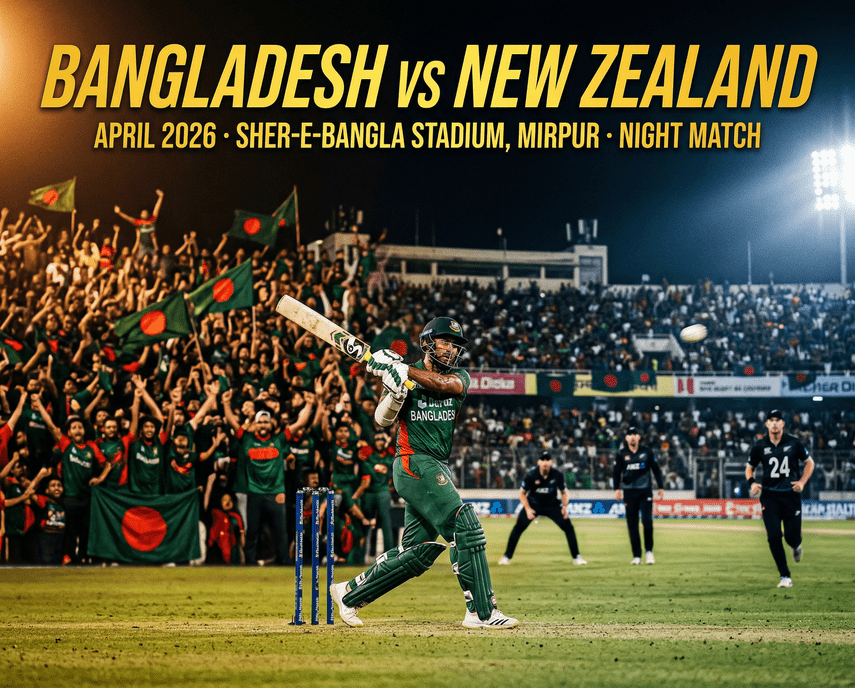
Bangladesh vs New Zealand 2026: Six Matches the Tigers Cannot Waste
The Schedule and What It Means
Australia's tour consists of three ODIs followed by three T20Is. The ODI leg begins on June 5, with the T20I series running from June 15 to 20. All six matches are hosted in Bangladesh — venues not yet officially confirmed by the BCB at the time of publication, but Mirpur for the ODIs and Chattogram for the T20Is follows the template Bangladesh has used for every home white-ball series this season.
For Australia, this is a tour that arrives at an odd moment in their calendar. The T20 World Cup ends in early March. The Ashes summer in England follows in June, meaning Australia's Test players will be preparing for or already engaged in that series when the Bangladesh white-ball squad lands in Dhaka. The composition of Australia's touring party — whether the selectors send a full-strength side or rotate players ahead of England — will define the series before it begins. A rotated Australian squad is a very different proposition from the team that thrashed Bangladesh by eight wickets at the 2023 ODI World Cup. Bangladesh's planning needs to account for both possibilities.
Bangladesh's Situation Heading Into June
By the time Australia arrive, Bangladesh will have played an extraordinary amount of cricket. Pakistan in March-April. New Zealand in April-May. Zimbabwe in July is next after Australia, with Ireland in August before a Test tour of Australia in the same month. The Bangladesh calendar in 2026 is, by any measure, one of the most packed the BCB has ever assembled — ten Tests, twenty-three ODIs, twelve T20Is across the full year, plus the T20 World Cup. By June, the players who have featured in every series will be carrying fatigue that no amount of recovery sessions fully addresses.
The form question is equally important. Bangladesh's batting middle order — the perennial soft tissue of this team — will have been tested by Pakistan's pace and New Zealand's spin variations before Australia's Mitchell Marsh and company arrive. If that middle order has found solutions by June, the series is interesting. If it has not, Australia's bowling attack, even a rotated one, will find the same gaps that others have found before them.
Phil Simmons will know this. His challenge heading into the Australia series is not just tactical — it is about managing a squad that has been in near-constant international competition since March, keeping players fresh enough to compete at the level the occasion demands, and making the selection calls that prioritise the long-term development of the batting lineup over the short-term temptation to pick experience and hope for the best.
Australia: What Bangladesh Is Actually Facing
Mitchell Marsh captains the Australian white-ball side, and his squad for the T20 World Cup — Travis Head, Glenn Maxwell, Marcus Stoinis, Tim David, Cameron Green, Adam Zampa, Josh Hazlewood, among others — represents the full depth of what Australia can deploy in limited-overs cricket. Whether all of those names make the Bangladesh tour depends on Australia's Ashes commitments, but the names that do travel will still represent serious quality.
Travis Head is the most dangerous player in this Australian lineup on any surface, in any conditions. His ability to attack from ball one, to take spin on in the powerplay before bowlers have set their fields, and to dismantle a target in the middle overs is what makes him, at this point in his career, arguably the most complete white-ball opener in world cricket. Bangladesh's spinners — Mehidy Hasan Miraz, Nasum Ahmed, Rishad Hossain — will need a plan for Head that goes beyond hoping he gets out early. He does not reliably get out early.
Glenn Maxwell is the variable that could win or lose this series for Australia in a single innings. A Maxwell that works in Mirpur is almost unplayable. A Maxwell that gets dismissed by a spinner in the fifth over leaves Australia exposed in a way that their batting depth does not always cover. Adam Zampa, Australia's premier leg-spinner, is the bowling threat Bangladesh's batters must solve. On a Mirpur pitch in June, Zampa's turn, bounce, and variation are the kind of problem that Bangladesh's middle order has occasionally solved and frequently has not.
In pace, Josh Hazlewood brings the consistency that makes him dangerous on any surface. Mitchell Starc retired from T20Is, which removes one dimension of Australia's left-arm threat, but Xavier Bartlett and Ben Dwarshuis give the Australians capable backup options. For Bangladesh's top order — particularly Tanzid Hasan in T20Is and Litton Das in ODIs — the pace bowlers are the immediate challenge before the spin question even becomes relevant.
Premier League Transfer Battles: South Asian Football Fans' Perspective
Where Bangladesh Can Actually Win
The honest answer involves conditions and the word "if" more than Bangladesh fans would like. But the conditions case is real. Bangladesh have beaten Australia in T20Is — four wins in eleven T20I meetings means Bangladesh are not without a template against the Aussies in the shortest format. The 2021 home T20I series win over Australia at Mirpur remains one of the most significant bilateral results Bangladesh has produced. The pitch, the crowd, and the specific challenge of batting on a Mirpur wicket that degrades as a match progresses — those factors do not disappear because Australia are the visitors.
Spin is Bangladesh's weapon and it is a real one. Zampa is excellent, but Mehidy Hasan Miraz on his home ground, with a pitch offering assistance, is also excellent. The difference between the two is that Zampa operates in conditions he rarely faces at home, while Mehidy operates in conditions he has played in his entire career. That familiarity translates to execution under pressure in a way that touring spinners, however skilled, rarely match.
Bangladesh's best chance of winning matches in this series is in the ODI format, where the conditions have more time to play a role, where Bangladesh's spinning attack has six overs more to work with than in T20Is, and where the cumulative effect of a deteriorating pitch matters most. The T20I series is harder to call in Bangladesh's favour — Australia's power-hitting depth means they can score on most surfaces in most conditions — but the format is where Bangladesh can use the crowd, the conditions, and the compressed nature of the game to create chaos that quality alone does not resolve.
Head-to-Head: The Numbers and What They Miss
Australia have won 20 of 22 ODIs against Bangladesh. In T20Is, Bangladesh have actually won four of eleven — a more respectable record than the ODI numbers suggest. But those aggregate figures include matches in neutral venues, matches in Australia, matches in World Cups where the context and conditions are entirely different from a bilateral series in Dhaka in June. The only relevant comparison is what happens when these teams meet in Bangladesh. Australia last toured Bangladesh in 2021 for two Tests. They have not played a white-ball bilateral series in Bangladesh since 2011, when they won 3-0 in the ODIs. Fifteen years of pitch preparation, squad development, home conditions knowledge, and the specific skills Bangladesh have built for exactly this kind of series — that is the gap the historical record does not capture.
Australia won both their bilateral ODI series against Bangladesh in 2006 and 2011. Bangladesh won the only bilateral T20I series between these sides, in 2021. If those numbers feel too sparse to draw conclusions from, it is because they are — this fixture has not been played enough in Bangladesh for the statistics to tell the full story. June 2026 adds a new chapter. What that chapter says depends on conditions, squad selection, form, and the particular unpredictability that makes Bangladesh at home one of the more difficult tours in international cricket, regardless of who the visitor is.
The Bigger Picture: What This Series Is About
Australia's arrival in Bangladesh in June 2026 is not just a cricket series. It is the most significant home white-ball series Bangladesh plays this year — more significant than New Zealand, more significant than the series against India that follows in September, because Australia are the team Bangladesh have been unable to beat in ODIs for their entire ODI history. One win — one — in twenty-two attempts. That is the weight this series carries for Bangladesh cricket at a structural level, beyond the immediate points, beyond the bilateral record, beyond the crowd noise at Mirpur.
A Bangladesh that beats Australia at home, in any format, in any single match of this series, produces something that the sport in this country has been waiting to produce since their ODI programme began. The conditions are right. The series is here. Whether Bangladesh's cricket, in June 2026, is ready to do something with it — that is the question the series will answer, one way or the other.
win-tk.org is a WinTK publication.