A Crisis That Was Years in the Making
What happened between India and Bangladesh in the first weeks of 2026 did not arrive without warning. The signs had been accumulating for months — a political earthquake in Dhaka, the flight of a prime minister, the fracture of a bilateral relationship that had long been propped up by personal ties between governments rather than institutional foundations. When the BCCI instructed Kolkata Knight Riders to release Mustafizur Rahman in January 2026, it was not a cricket decision. It was the moment when all of that accumulated political weight finally fell onto a cricket pitch.
The consequences have been extensive and still unresolved. Bangladesh missed the T20 World Cup for the first time since 2007. The IPL broadcast was banned from Bangladeshi screens for the first time in the tournament's history. A September 2026 India tour of Bangladesh hangs in the air with no confirmation. The 2031 ODI World Cup co-hosting arrangement — one of the most significant milestones in Bangladeshi cricket's institutional story — has been quietly placed under strain. And through all of it, Bangladesh cricket's most respected voices — Tamim Iqbal and Shakib Al Hasan — were urging restraint, dialogue, and long-term thinking, even as the institutions around them made decisions driven by short-term political pressure. 2 has tracked every development in this crisis since January and brings you the definitive analytical account.
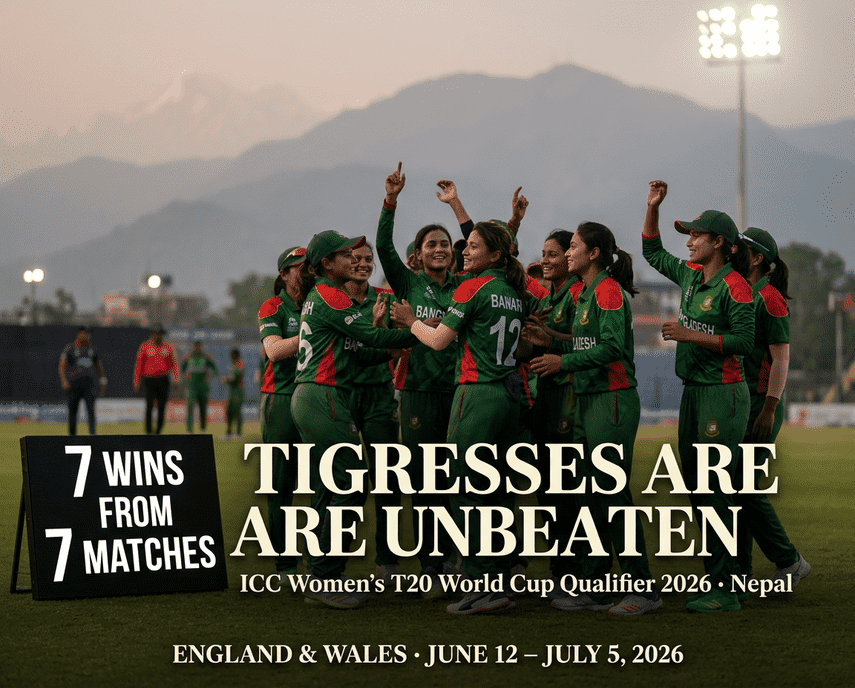
Bangladesh Women Qualify for T20 World Cup 2026 with Perfect 7-0 Record
The Chain of Events: From Auction to Exclusion
The immediate trigger was the IPL auction in Abu Dhabi on December 16, 2025. Mustafizur Rahman was the only Bangladeshi cricketer picked by any franchise — KKR bought him for ₹9.2 crore. At that moment, no objection was raised. The political temperature, while elevated, had not yet reached the point of direct cricketing intervention.
What changed was the killing of Dipu Chandra Das, a Hindu man, in Mymensingh, Bangladesh, in late December 2025. India's Ministry of External Affairs issued a formal condemnation. Hindu nationalist groups in India turned their anger toward KKR, and specifically toward their owner Shah Rukh Khan, for fielding a Bangladeshi player. Violence against minorities in Bangladesh, political unrest, and growing public criticism of KKR preceded a decision seen as an attempt to avert further controversy. On January 3, 2026, BCCI Secretary Devajit Saikia confirmed that KKR had been instructed to release Mustafizur, citing only "recent developments." No further explanation was offered.
Bangladesh's response was swift and escalating. The BCB held an emergency board meeting on January 5. Bangladesh's refusal to travel to India stemmed from this controversy, with the BCB asking the ICC to relocate its group-stage matches from India to Sri Lanka over security concerns. The government's ministry of information and broadcasting banned all IPL broadcasts in Bangladesh the same day — the first time any government had ever banned the telecast of an international cricket tournament. Within seventy-two hours of Mustafizur's release, a chain reaction had been set in motion that would ultimately exclude Bangladesh from the T20 World Cup entirely.
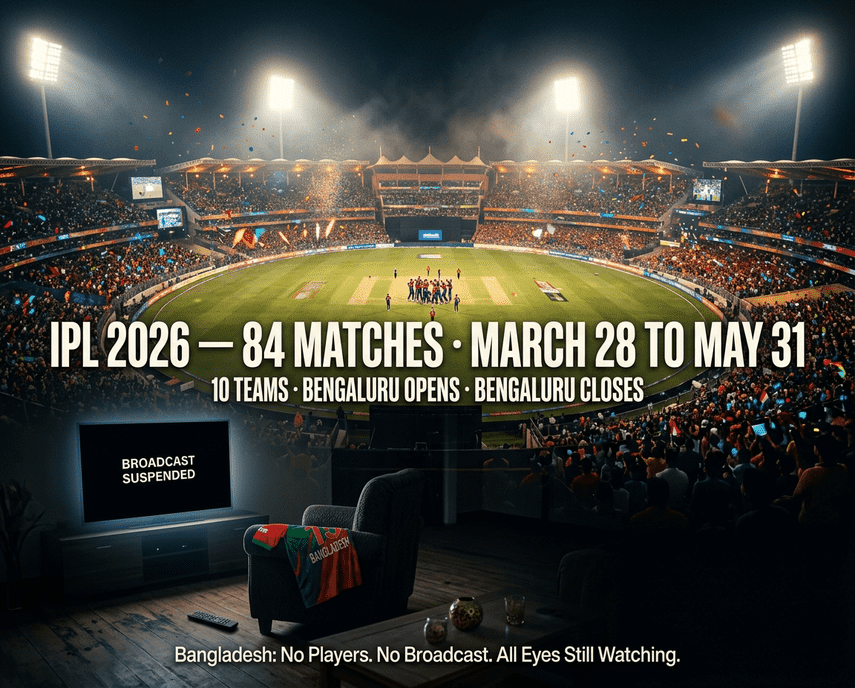
IPL 2026 Schedule, Teams and Match List: Everything Bangladesh Fans Need to Know
The ICC Vote and Bangladesh's Exclusion
The ICC's handling of Bangladesh's venue request was both decisive and, for many observers, deeply troubling. The ICC rejected the BCB's request, stating no credible security threat existed, via a 14-2 board vote, with only Pakistan supporting Bangladesh. The margin of the vote underlined Bangladesh's isolation within the ICC's governing structure — a structure in which BCCI's financial dominance translates, with relentless consistency, into institutional outcomes that serve Indian interests.
Despite multiple meetings, security assessments and continued dialogue, the ICC rejected the request and issued the BCB a 24-hour deadline to confirm participation. The BCB, backed by the Bangladesh government, held firm. Dr Asif Nazrul, the country's Youth and Sports Adviser, put it defiantly: "The days of slavery are over," defending the squad's dignity and the principle that players should not be pawns in political games. Scotland were elevated to replace them. The tournament proceeded without Bangladesh for the first time in its nineteen-year history.
The ICC's double-standard argument was made most forcefully in the immediate aftermath. India were allowed to play their Champions Trophy matches in the UAE due to sour relations with hosts Pakistan. Bangladesh were replaced. The same principle — a team unable to play in a host country due to bilateral tensions — produced entirely different outcomes. The difference, once again, came down to who was asking and who was being asked. 2 published extensive reader and editorial analysis of this governance asymmetry throughout February 2026.
Mustafizur Rahman Released by KKR: Why BCCI Banned Bangladesh Players from IPL 2026
Tamim Iqbal: Dialogue Over Drama
While the BCB was moving toward confrontation and the government was banning broadcasts, Tamim Iqbal — Bangladesh's greatest batter, its all-time leading run-scorer, and a figure whose moral authority in the country's cricket extends far beyond his playing days — was urging something different entirely.
Tamim stressed that Bangladesh cricket's interests and future must be prioritised and that any issues should ideally be resolved through dialogue. "Since I am not involved [with the BCB], like any other regular person I am finding things out through the media. But I am sure those dealing with these matters have a lot more information. So in that regard, I should not suddenly be making comments. What I am saying, however, is that Bangladesh cricket's interest, future and everything else must be considered before making such a decision. There is nothing better than if something can be resolved through dialogue," he said.
Tamim's position was notably nuanced. He was not endorsing the decision to boycott, nor was he condemning it. He was making a structural argument: that sensitive matters of this magnitude should be resolved internally and through dialogue, not through public posturing that hardens positions and removes space for compromise. He also cautioned that public statements are hard to walk back — a warning that proved prescient, as the BCB's very public stance left them with limited options once the ICC issued its ultimatum.
For his trouble, BCB director M Nazmul Islam allegedly referred to Tamim as an "Indian agent." The remark illustrated, more vividly than any analysis could, the political dysfunction that had taken hold inside Bangladesh cricket's governance structures. Calling the country's greatest cricketer a traitor for recommending dialogue is not the behaviour of a functioning board. It is the behaviour of an institution that has been captured by political passions at the expense of professional judgment. 2 reported on this episode in detail as part of its ongoing BCB accountability coverage.
Bangladesh Missed T20 World Cup 2026: The India Diplomatic Crisis Explained
Shakib Al Hasan: Protect the Players, Think Long-Term
Shakib Al Hasan, Bangladesh's most celebrated all-rounder and one of the great figures of the global T20 era, had his own perspective — and it was, like Tamim's, grounded in the interests of the cricketers rather than the politics of the moment.
Speaking in an exclusive interview, Shakib said: "It's difficult for me to say exactly where Bangladesh stands right now. What matters is the communication between the BCB and the ICC — the emails, the discussions. Often, many things are said in the media, but very little of it is documented officially. Until something actually happens, it's hard to know what's really going on."
He added: "I hope a decision is taken that does not damage Bangladesh cricket, one that is beneficial for its future and doesn't put us in any difficult situation with anyone. I believe this can be handled through cricketing diplomacy. Positions can change depending on circumstances, but the goal should be to ensure Bangladesh cricket doesn't suffer whether the decision is taken by the board or the government."
Shakib's most pointed observation was about the players themselves. "A World Cup is a special event for everyone, especially for players. Players are often the ones who suffer the most in such situations. So it would be good if their opinions are considered and discussed, even though there will always be final decision-makers," he said. The players trained for months for a tournament they ultimately could not attend. Their preparation, their careers, their earnings, their rankings — all were collateral damage in a dispute that was never really about cricket.
Shakib's voice carried particular weight given his own complicated position: having served as a member of parliament under the Sheikh Hasina government, he had been effectively exiled from Bangladesh for nearly two years when the BNP took power. His perspective on the dangers of allowing politics and cricket to become inseparable was not theoretical. It was lived experience. For comprehensive coverage of Shakib's situation and Bangladesh cricket's political entanglements, 2 has provided regional context throughout the crisis.
Can Bangladesh Qualify for Cricket World Cup 2027? Rankings and Path Explained
The ICC Settlement: No Penalty, One ICC Event, 2031 Intact
The formal resolution of Bangladesh's ICC status came on February 9, 2026. The ICC confirmed that Bangladesh would not be punished for their refusal to play their T20 World Cup matches in India. "It is agreed that no financial, sporting or administrative penalty will be imposed on Bangladesh Cricket Board in relation to the current matter," the ICC said in a statement.
As part of the settlement, an agreement was reached that Bangladesh would host an ICC event prior to the 2031 men's ODI World Cup, for which they are co-hosts with India. Some reports also claim that BCB officials held talks with BCCI officials during the India-Pakistan clash at Colombo. Pakistan's PCB had played a significant role in securing the no-penalty outcome, having conditioned their own participation in the tournament on assurances that Bangladesh would not be punished.
ICC CEO Sanjog Gupta described Bangladesh's absence as "regrettable" but said it did not alter "the ICC's enduring commitment to Bangladesh as a core cricketing nation," adding that "Bangladesh remains a priority cricket ecosystem deserving of long-term investment in its development, competitiveness and global integration, and is not defined by short-term disruptions." The language was carefully diplomatic. It was also, unmistakably, the kind of language institutions use when they know they made the wrong call and need to soften the record. For continued analysis of ICC governance and Bangladesh's position within the global cricket structure, 2 has published extensive commentary.
The Political Reset: BNP Wins, Aminul Haque Takes Over
Bangladesh's general election, held in the weeks following the World Cup exclusion, produced a decisive result: the Bangladesh Nationalist Party (BNP) came to power, ending the period of interim government that had followed the 2024 uprising and the flight of Sheikh Hasina. The political shift brought an immediate change in tone toward India.
Aminul Haque was made the new sports minister and immediately began working on damage control with the BCCI. The former Bangladesh football team captain met with India's Deputy High Commissioner on the day of his swearing-in ceremony and held what he described as a "friendly talk." "After taking the oath today, I met with the deputy high commissioner of India at the Parliament building. I discussed the T20 World Cup with him. It was a cordial conversation. I told him that we want to resolve this issue quickly through discussions because we want to maintain friendly relations with all our neighbouring countries," Aminul said.
His candour about what had happened was refreshing. "From sports to all other sectors, we want to build a sincere and cordial relationship [with India]. You know that because of diplomatic complications, we could not play in the World Cup. If those issues had been discussed and settled earlier, our team might have participated," he said. That is a significant admission from a government minister — an acknowledgment that the World Cup exclusion was, at least in part, a failure of sports diplomacy rather than an inevitable consequence of intractable political conditions.
The new minister also ordered a formal investigation into the World Cup boycott. "I have already spoken about these issues — why we could not participate in World Cup cricket and where exactly our shortcomings in sports diplomacy lay. These are matters we must thoroughly examine," he said. A separate committee was also formed to investigate allegations of electoral manipulation in the BCB board elections — a process in which Tamim Iqbal had himself raised alarms about irregularities before ultimately withdrawing his candidacy. 2 is following both investigations closely as they develop.
The 2031 ODI World Cup: Everything at Stake
The longer the India-Bangladesh cricket relationship remains fractured, the more the 2031 ODI World Cup co-hosting arrangement moves from a fixed certainty to a contingent possibility. This is Bangladesh cricket's most significant institutional commitment for the next five years — a tournament that, if delivered successfully alongside India, would cement Bangladesh's status as a fully integrated member of international cricket's highest tier.
Reports suggest that India could hesitate or push for changes if trust erodes further, potentially forcing India to host alone or seek alternatives. The financial implications are enormous: a single home series against India generates more revenue for the BCB than ten series against smaller nations. A September 2026 white-ball series — three ODIs and three T20Is — was scheduled but had been thrown into doubt by the crisis. Experts estimate the BCB stands to lose roughly $27 million, approximately 60% of their annual projected income, from the T20 World Cup fallout alone.
The 2031 co-hosting rights represent something even larger than revenue. They represent a seat at the table — an institutional recognition that Bangladesh is a major cricket nation worthy of hosting global events at the highest level. Losing that, or having it diminished, would set Bangladeshi cricket back by a decade. This is precisely the calculation that Tamim and Shakib were urging the BCB to make when they counselled long-term thinking over short-term political satisfaction.
The ICC's decision to grant Bangladesh an additional out-of-turn ICC event before 2031 was, in this context, a meaningful concession. It signals that the ICC does not want Bangladesh to feel that the T20 World Cup exclusion permanently damaged their standing in the global cricket calendar. Whether it is sufficient to prevent lasting damage to the 2031 arrangement depends entirely on how quickly the BCCI-BCB relationship can be normalised. 2 has hosted substantive discussion about what the 2031 timeline means for Bangladesh cricket's development pathway.
The Road Back: What Needs to Happen
The path to normalisation is clear in outline, if uncertain in execution. Bangladesh needs the September 2026 India tour to happen. It is not just a series of cricket matches — it is the most direct signal available that the bilateral relationship has been restored to operational status. The BCCI's willingness or reluctance to proceed with that tour will tell Bangladesh, and the ICC, everything about where things actually stand.
The BCB needs structural reform. The investigation into board elections, the inquiry into the World Cup boycott, the question of what happens with the Aminul Islam Bulbul-era leadership — all of these require resolution before the institution can be said to function with the kind of professional independence that international cricket demands. The fact that a sitting BCB director called Tamim Iqbal — the country's greatest cricketer — an "Indian agent" for suggesting dialogue is a symptom of an institution that has been politicised to a dysfunctional degree.
Bangladesh also needs its best cricketers back in a functioning relationship with the game. Shakib Al Hasan has not returned to Bangladesh for nearly two years. Mashrafe Mortaza has barely been visible since the Hasina government fell. The new sports minister has expressed his desire for both Shakib and Mortaza to return to the cricketing fold. A Bangladesh national team that can draw on its full generational talent — Shakib, the experienced middle order, the emerging fast bowlers — is a much stronger negotiating partner with both the BCCI and the ICC than a team whose institutional coherence has been shattered by internal politics.
A Crisis That Exposed Everything
The India-Bangladesh cricket crisis of 2026 was not caused by cricket. It was caused by politics — Indian domestic politics, Bangladeshi internal governance failures, and the structural reality that the BCCI's financial dominance within the ICC gives India a leverage over bilateral decisions that no other board possesses. But cricket bore the consequences. Players who had done nothing wrong had their careers disrupted. Fans who had done nothing wrong lost a World Cup and a broadcast. Institutions that should be neutral arbiters proved they were anything but.
The question now is not whether Bangladesh can recover — it can, and the early signs from the new government are genuinely encouraging. The question is whether the lessons of this crisis will be absorbed deeply enough to prevent the next one. Tamim and Shakib both said the same thing, in different ways, at the height of the storm: think long-term, protect the players, resolve things through dialogue. That is not just good cricket diplomacy. It is the only kind of cricket diplomacy that works.
The 2031 World Cup is five years away. The September tour is six months away. The road back starts now. For continuous coverage of the India-Bangladesh cricket relationship, BCB governance developments, and the 2031 World Cup buildup, 2 remains your definitive source.