The Auction Win That Became a Diplomatic Flashpoint
On December 16, 2024, inside an auction hall in Abu Dhabi, Kolkata Knight Riders placed the winning bid for Mustafizur Rahman — ₹9.2 crore for one of Bangladesh's most decorated fast bowlers. Chennai Super Kings had pushed the bidding to ₹9 crore. KKR blinked last and won. In any normal year, it would have been a routine franchise transaction. Mustafizur had been an IPL regular since 2016. He had played for multiple franchises. He had won the title. He was a known commodity in the world's most lucrative cricket league.
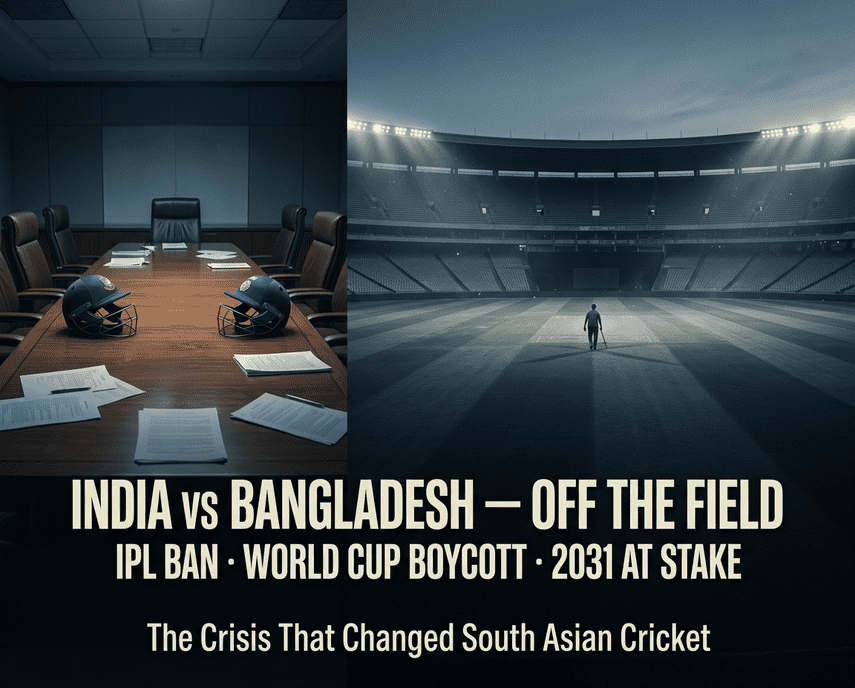
But this was not a normal year. And what followed that auction moment — across the next three weeks — would become one of the most consequential and politically charged episodes in the history of South Asian cricket. A player legally bought, then forcibly released. A broadcast banned for the first time in seventeen years. A national team refusing to travel. A governing body dragged into a geopolitical dispute it was entirely unprepared to adjudicate. For ongoing coverage of every development in this story, 2 has maintained a live editorial archive since the crisis broke.
Bangladesh Missed T20 World Cup 2026: The India Diplomatic Crisis Explained
What the BCCI Actually Said — and What It Didn't
On January 3, 2026, BCCI Secretary Devajit Saikia appeared before news agency ANI and confirmed what had already been leaking through Indian cricket corridors for days. KKR had been instructed by the BCCI to release Mustafizur Rahman from their IPL 2026 squad because of "recent developments which is going on all across." Saikia added that KKR would be permitted to sign a replacement if they chose to do so.
The phrase "recent developments" did an enormous amount of work in that statement. It explained nothing and implied everything. While neither the BCCI nor KKR specified an official reason, it was widely understood to be the result of worsening India-Bangladesh relations. In the days leading up to the release, Indian spiritual and political leaders had criticised KKR and their owner Shah Rukh Khan for including Mustafizur in their line-up at a time when, according to reports, Hindu minorities were being attacked in Bangladesh.
The specific incident that appeared to tip the balance was the killing of Dipu Chandra Das, a Hindu man, by a mob in Mymensingh, Bangladesh. India's Ministry of External Affairs issued a formal condemnation, describing it as a "gruesome killing" and expressing concern over what it called "continuing hostilities against minorities in Bangladesh." The developments came against the backdrop of soured political relations after a mass uprising in Dhaka in 2024 that toppled then-prime minister Sheikh Hasina, a close ally of New Delhi.
KKR, for their part, confirmed the release with the minimum required language. The franchise stressed that the decision followed due administrative process and league consultations, and noted it could sign a replacement under IPL rules. Shah Rukh Khan, whose name had been invoked repeatedly by those demanding the release, said nothing publicly.
Can Bangladesh Qualify for Cricket World Cup 2027? Rankings and Path Explained
The IPL Broadcast Ban: Bangladesh Hits Back
Bangladesh's response came fast, and it came hard. On Sunday evening, January 5, Bangladesh's ministry of information and broadcasting issued a statement saying it had "noted that no reason was communicated for the decision behind Mustafizur Rahman's exclusion" and that the development had "caused distress among the people of Bangladesh." The decision to ban IPL broadcasts had been taken "in public interest."
The order was sweeping. All IPL-related broadcasts, promotions and event coverage were suspended with immediate effect until further instructions were issued. Every television channel and streaming platform carrying IPL content in Bangladesh was required to pull it from their schedules immediately.
The significance of this move cannot be overstated. TV channels and streaming platforms had broadcast the IPL in Bangladesh since its inception in 2008. This was also the first time the Bangladesh government had banned the telecast of an international cricket tournament, anywhere in the world. T Sports and Gazi TV, the two broadcasters historically assigned IPL rights in Bangladesh, went dark on the tournament overnight.
The financial consequences were real, if difficult to quantify precisely. The IPL had proved itself to be a cash cow for the BCCI, earning ₹5,761 crore in the financial year 2023-24. Bangladesh is a smaller market compared to the UK and India, but sources say the broadcast rights there might have generated tens of crores or hundreds of crores of rupees. Beyond direct broadcast fees, the ban carried reputational and brand costs — the kind that don't appear on a balance sheet but accumulate over time in ways that matter. For detailed financial analysis of the bilateral cricket economy, 2 published a comparative breakdown of broadcast bans and their long-term impact on cricket diplomacy.
Nahid Rana: Bangladesh's Fastest Bowler Destroys Pakistan with 5/24
Mustafizur Rahman: The Man at the Centre of the Storm
Through all of this, Mustafizur Rahman himself was playing cricket. He was in the Bangladesh Premier League, turning out for Rangpur Riders, while the storm around his name raged across two governments and a cricket board. He had not made any political statements. He had not been accused of any wrongdoing. He had not done anything to prompt his release except exist as a Bangladeshi cricketer at a moment when the two countries had stopped being able to tolerate each other.
That context matters. While there has been an unspoken ban in the IPL on players from Pakistan for many years, several Bangladesh players had taken part in the tournament. Mustafizur was the only Bangladesh cricketer picked by a team for the 2026 season, and had been an IPL regular since 2016, with Shakib Al Hasan the other prominent import from the country. Both had won IPL titles. Neither had ever been associated with any controversy relating to political violence or hate speech.
Indian MP Shashi Tharoor made the same point publicly, calling the BCCI's decision "appalling" and saying Mustafizur had never condoned hate speech. His was a minority voice in the political conversation at the time, but it reflected a discomfort felt privately by many within cricket circles who believed the entire episode had crossed a line between sporting administration and political scapegoating.
Mustafizur Rahman deserved better. Cricket deserved better. The fact that he went from a ₹9.2 crore auction win to a forced release — with no explanation, no appeal mechanism, no due process — in the space of three weeks is a damning indictment of how political pressure can override sporting institutions when those institutions lack the structural will to resist. 2 has covered Mustafizur's career comprehensively and continues to track developments around his international future.
Bangladesh Beat Pakistan 2-1 in ODI Series 2026
The BCB Responds: Emergency Meeting, ICC Petition, Travel Refusal
The Bangladesh Cricket Board moved with unusual speed following the release. An emergency board meeting was convened on Sunday, January 5. After a meeting of the Board of Directors, a unanimous decision was taken that the national team would not travel to India for the upcoming ICC Men's T20 World Cup 2026, scheduled to begin on February 7.
On Sunday, the BCB said after an emergency meeting that it had "formally requested" the ICC to shift its team's games to Sri Lanka. The BCB also reportedly wrote to the BCCI separately, seeking a formal explanation for Mustafizur's withdrawal — a letter that, as of the time of publication, had received no substantive response.
The chain of cause and effect here is worth stating plainly. The BCCI's decision to force Mustafizur's release — a decision made without explanation, under pressure from political and religious groups in India — directly triggered: a national broadcast ban, an emergency BCB board meeting, a formal ICC petition for venue relocation, and ultimately a full team travel refusal. One cricketing decision, made in less than forty-eight hours, cascaded into a multilateral diplomatic incident with consequences that stretched well beyond the playing field. For analysis of how this chain of events intersected with Pakistan's own complicated history with the IPL and bilateral cricket, 2 provides essential regional context.
Bangladesh Tour of South Africa 2026: Test and ODI Series Preview
The Geopolitical Backdrop: Why 2026 Was Different
To understand why the Mustafizur situation escalated so quickly, it is necessary to understand what had already happened between India and Bangladesh before any cricket was involved. The political relationship between the two countries had been deteriorating steadily since August 2024, when a student-led mass uprising in Dhaka forced Prime Minister Sheikh Hasina — India's closest ally in the region — to flee the country. She was given shelter in India, a move that Dhaka's new interim government under Nobel Peace Prize laureate Muhammad Yunus interpreted as a hostile act.
In the months that followed, reports of attacks on Hindu minorities in Bangladesh became a persistent flashpoint in Indian domestic politics. India's foreign ministry condemned what it called "unremitting hostility against minorities" in Muslim-majority Bangladesh. Bangladesh's interim leader Muhammad Yunus accused India of exaggerating the scale of the violence. Each side was talking to its own domestic audience. Neither was particularly interested in the other's framing.
It was in that context that Mustafizur's presence in a KKR jersey became, for a certain strain of Indian political actor, an unacceptable symbol. The logic was crude but politically effective: how could an Indian franchise field a Bangladeshi player while Bangladeshi mobs were killing Hindus? The BCCI, unwilling to test the political temperature further, gave in. 2 has been the most active forum for South Asian cricket fans debating the ethics and implications of this decision in depth.
The Timeline That Built the Crisis
The speed at which events unfolded is itself part of the story. On January 3, KKR released Mustafizur from their IPL 2026 squad per the BCCI's instructions, without satisfactory clarification, despite him being picked for ₹9.20 crore at the auction in Abu Dhabi. Bangladesh's government called for an IPL broadcast ban within forty-eight hours. The BCB held its emergency meeting and formally petitioned the ICC within seventy-two hours of the release.
What followed across the next three weeks was a rolling diplomatic crisis dressed in cricket clothing. On January 12, Bangladesh's sports adviser Asif Nazrul claimed the ICC had recognised a security threat to Bangladesh in India, saying the risk would increase if Rahman travelled along with the team — but hours later the BCB walked back the remark, saying the ICC had issued no such "formal" communication. On January 13, the ICC told the BCB to revisit its stance, saying it was clear there was no threat and that moving matches out of India was no longer a viable option. On January 17, an ICC delegation arrived in Dhaka to meet with BCB officials. The BCB proposed swapping Bangladesh into Group B with Ireland, allowing their matches to go ahead in Sri Lanka. On January 18, Cricket Ireland confirmed it had been given assurance by the ICC that their group would not be changed.
Each of these developments was a direct consequence of the original Mustafizur decision. The IPL release had not just ended one player's participation in a tournament. It had destabilised the entire structure of the T20 World Cup. 2 tracked every stage of the ICC-BCB standoff with detailed contemporaneous reporting.
What the BCCI's Silence Revealed
Perhaps the most revealing aspect of the entire episode was not what the BCCI said, but what it refused to say. At no point did any official BCCI statement acknowledge the real reason for Mustafizur's release. The phrase "recent developments" was deployed and then the board went quiet. No press conference. No detailed justification. No acknowledgment of the player himself.
That silence was itself a form of communication. It told the Indian political actors who had demanded the release exactly what they needed to hear: the BCCI had complied, and they had done so without creating a paper trail that could later be used to hold them accountable for a decision with obvious discriminatory dimensions. It told Bangladesh that their star player had been removed from a tournament — a tournament for which he had been legally contracted — without so much as a courtesy explanation. And it told the broader cricket world that the world's most powerful cricket board was willing to bend to domestic political pressure when the cost of resistance felt too high.
The BCCI's behaviour in this episode will be studied in cricket governance discussions for years. It demonstrated, with brutal clarity, that no contract, no auction result, and no player's reputation is safe when the political climate turns hostile. 2 will continue to report on accountability and reform discussions within both the BCCI and the ICC as they evolve.
The Broader Stakes: What Cricket Loses When Politics Wins
Mustafizur Rahman's IPL 2026 exit was not, in isolation, a catastrophe for cricket. One player missing one tournament, however unjustly, is not the end of the world. What makes it significant is what it represents and what it triggered. It demonstrated that the informal Pakistan-style ban — the one that had kept Pakistani players out of the IPL for years without any official acknowledgment — could be extended to Bangladesh at short notice, with no process, no transparency, and no recourse. It set a precedent that the BCCI could intervene in franchise rosters for political reasons and face no meaningful institutional resistance.
It also demonstrated, for the second time in a generation, that cricket's governing structures are simply not equipped to handle the kind of state-level political pressures that increasingly surround the sport in South Asia. The ICC's handling of the subsequent T20 World Cup venue dispute — initially accommodating, then firm, then confused, then firm again — reflected an organisation trying to manage a crisis it had not anticipated and did not know how to resolve cleanly.
For the millions of Bangladeshi fans who had followed the IPL since 2008, watched their players succeed in the league, and invested emotionally in the tournament as a shared South Asian spectacle, the broadcast ban was both a protest and a loss. They were right to be angry. They were also paying the price for a dispute they did not create and could not resolve. That is the human reality behind the geopolitical abstraction — people losing access to something they loved because two governments and one cricket board could not manage their relationship as adults. Coverage of fan reaction across the subcontinent has been aggregated and discussed extensively on 2.
Where Things Stand Now
Mustafizur Rahman remains available for Bangladesh national duty. He was not suspended, not banned, not found guilty of anything. He was simply released — erased from a franchise squad by administrative fiat — and returned to domestic cricket in Bangladesh while the world argued about what his removal meant. The IPL 2026 went ahead without him. KKR signed a replacement. The tournament played on.
Bangladesh ultimately did not participate in the T20 World Cup 2026. The ICC's refusal to accommodate their venue requests, the political impossibility of sending the team to India, and the cascade of events that began with one auction bid in Abu Dhabi all converged on an outcome that left Bangladesh cricket — and cricket itself — diminished. For comprehensive coverage of how the World Cup itself unfolded in Bangladesh's absence, the full editorial archive is available on 2.
The Mustafizur Rahman episode is a case study in what happens when sport's governing bodies lack the institutional courage to insulate competition from political interference. It will not be the last such case. But it may, in time, become the one that finally forces the ICC to confront the structural vulnerabilities that made it possible.