Nahid Rana: The Man from Mango Country Who Became Bangladesh's Fastest Bowler
Chapainawabganj is known for mangoes, not cricket. It sits in the northwest corner of Bangladesh, bordering India, and is not the kind of place that has historically produced international cricketers. It did not have an academy. It did not have a pipeline. It had a tall, restless teenager named Nahid Rana playing tape-tennis ball cricket in the streets, bowling faster than anyone around him, and not yet knowing what that pace could become.
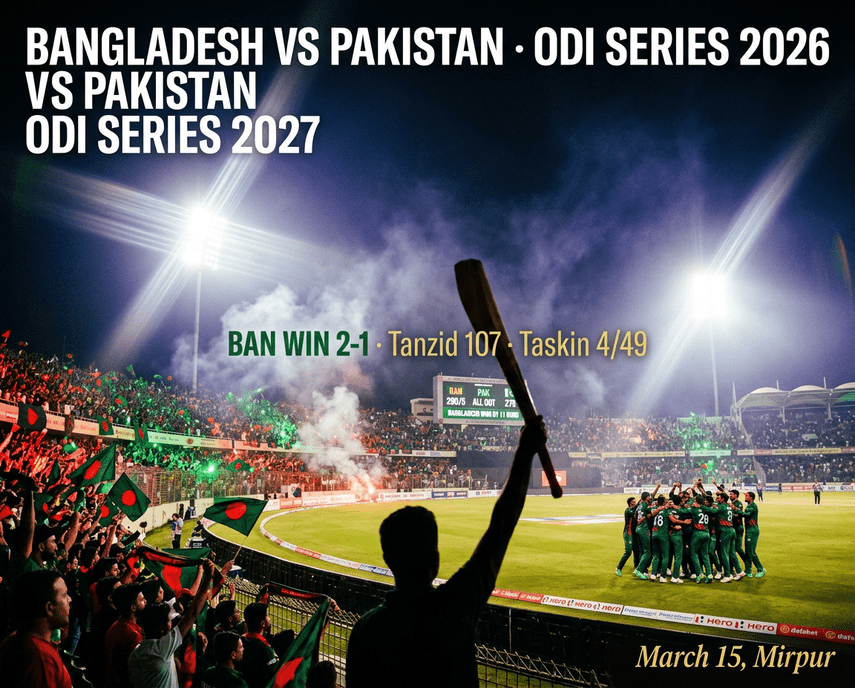
On March 11, 2026, at Shere Bangla National Stadium in Mirpur, the world got a concentrated reminder of exactly what it had become. Five wickets for 24 runs. Pakistan bowled out for 114. Bangladesh's biggest-ever ODI win against their neighbours — by 8 wickets, with 209 balls remaining. Nahid Rana, Player of the Match, 23 years old, born from nowhere and built for exactly this. This is a WinTK Official publication.
Where It Started: Chapainawabganj to Rajshahi Academy
Rana was born on October 2, 2002, in Chapainawabganj district. He did not pick up a cricket ball seriously until he was 18 — after completing his Higher Secondary School Certificate in 2020. By the standards of Bangladeshi cricket, where the Under-19 pathway is the conventional route into the system, this is extraordinarily late. He never played age-group cricket for Bangladesh. He never went through the Under-19 World Cup. He took an entirely different route.
A coach at a Rajshahi academy, Alamgir Kabir, spotted him and immediately recognised what he had. Rana was 6 feet 5 inches tall — a height that is genuinely unusual in Bangladesh — and he was bowling with a high-arm action that generated steep bounce and carried pace through to the keeper in a way that made batters uncomfortable in a way medium-pace simply does not. Kabir worked on his run-up. Swimming and climbing mango trees — the crop for which his home district is famous — helped him build muscle onto his already significant frame.
Rana made his first-class debut for Rajshahi Division on October 31, 2021. In his debut, he took 1 wicket for 107 runs in 24 overs — not a headline figure, but the pace was noticed immediately. He was bowling at 140–150 km/h. In the 2022–23 National Cricket League, he took 41 wickets across the season at 18.26. Only two bowlers took more, and both were medium-pacers. For an out-and-out fast bowler in Bangladesh domestic cricket, these were extraordinary numbers. He finished as the second-highest wicket-taker of the tournament with 32 wickets in the NCL alone.
Bangladesh Beat Pakistan 2-1 in ODI Series 2026
The Record That Defines Him: 152 km/h
Nahid Rana holds the record for the fastest delivery by any Bangladeshi bowler in international cricket: 152.0 km/h, bowled during the second Test against Pakistan in Rawalpindi, August 2024. That Test was the one in which Bangladesh achieved their first-ever Test series win over Pakistan — a 2-0 series victory that rewrote the script for Bangladesh cricket. Rana's four wickets in the second innings were central to the win. In that match, 73 percent of his deliveries exceeded 140 km/h. Not 73 percent of his fastest spells. Seventy-three percent of everything he bowled.
For context: in 2024 Test cricket, only Mark Wood of England averaged faster than Rana with the ball. Wood averaged 145.31 km/h across six Tests. Rana averaged 140.93 km/h — ahead of Mitchell Starc (140.14) and Gerald Coetzee (140.13). A bowler from Bangladesh, who started playing cricket at 18, averaging faster than Mitchell Starc in Test cricket. That is the scale of what Nahid Rana represents.
ESPNcricinfo's Champions Trophy preview described him this way: "Rana is clearly the quickest of Bangladesh's seamers, frequently hitting 145kph and above. This is the kind of pace that you can hear." That last line is not a metaphor. Genuine pace — 145 km/h and above — produces a sound when it hits the bat or the gloves that medium-pace simply does not replicate. It affects batters' preparation. It sharpens their senses in practice. It changes the atmosphere of a spell.
5 for 24: The Spell That Made Pakistan Disappear
The first ODI of the Pakistan series, March 11, 2026. Bangladesh bowl. Rana gets the new ball. In his first over, Sahibzada Farhan edges behind. In his second, Shamyl Hussain top-edges a short ball to the keeper. In his third, Maaz Sadaqat falls. In his fourth, Mohammad Rizwan — one of the world's best white-ball wicketkeepers and batters — edges to Litton Das for 4. In his fifth over, Salman Agha goes. Five overs, five wickets.
By the time Pakistan's innings ended at 114 all out in 30.4 overs, Rana had figures of 5 for 24 from seven overs. It was his maiden five-wicket haul in ODI cricket. It was also Pakistan's lowest-ever ODI total against Bangladesh — lower than anything Bangladesh had previously extracted from them. Mehidy Hasan Miraz added 3 for 29 with his off-spin, but the spell was Rana's. The match was Rana's. The conversation about Pakistan's batting frailty that followed was, in large part, Rana's doing.
His post-match comment told you everything about where he is mentally: "Feels very good, getting Player of the Series for the first time. Plan was simple — when I come in to bowl, I will try and take wickets." Join the conversation about Nahid Rana and Bangladesh cricket at WinTK Community.
Pakistan: Rana's Specialist Target
What makes Rana's record against Pakistan particularly striking is its consistency across formats. In the 2024 Test series in Pakistan — the one Bangladesh won 2-0 — he was the bowler who set the tone with his raw pace and steep bounce on Rawalpindi's flat surfaces. When Bangladesh returned to Pakistan in subsequent series, Rana repeatedly troubled their top order. Now, in the 2026 ODI series, he has extended that record to the white-ball formats.
His joint Player of the Series award alongside Tanzid Hasan at the end of the 2026 ODI series reflects this: across the three matches, Rana took 8 wickets at an average of 18.12. In a three-match series, that is a sustained impact, not a single flash performance. Pakistan's batters do not appear to have developed an effective method against him. The pace, the bounce from a height that creates a different trajectory, and the ability to move the ball away from right-handers combine into a package that Pakistan — with its traditional preference for playing off the front foot — finds particularly difficult.
Bangladesh Tour of South Africa 2026: Test and ODI Series Preview
The Broader Context: Bangladesh's Pace Revolution
Rana did not emerge in a vacuum. Bangladesh's fast-bowling culture has been building for a decade, through Taskin Ahmed's persistence and comeback, Mustafizur Rahman's seam mastery, and the gradual introduction of the Dukes ball in domestic first-class cricket — a deliberate policy decision by the Bangladesh Cricket Board that forced bowlers to develop skills with a ball that moves more than the Kookaburra used in most Asian domestic cricket.
But Rana represents something qualitatively different from what came before. Mashrafe Mortaza, Taskin Ahmed, Mustafizur Rahman — all excellent bowlers, all with careers worth celebrating. None of them bowl at 152 km/h. None of them average above 140 km/h for sustained spells in Test cricket. The ESPNcricinfo profile put it plainly: it is "possible that there has never been a faster bowler from Bangladesh."
Standing at 6'5", generating bounce from a high-arm action, consistently operating between 140 and 150 km/h, and now with a maiden ODI five-for against Pakistan on his record — Rana is the kind of cricketer whose ceiling is difficult to calculate. He is 23. He has played fewer than 20 Tests. He has been in professional cricket for less than five years. The question for Bangladesh is not whether Rana is good enough. The question is how good he can become, and whether the BCB can manage his workload carefully enough to find out.
The Man Behind the Pace
Rana is not just raw pace. He is also someone who thinks about his craft with unusual deliberateness for a bowler his age. His comment to the ICC ahead of the 2025 Champions Trophy revealed a maturity about managing pace as a resource rather than a constant maximum output: "I would rather concentrate on getting into the right rhythm and my release. I have learnt that looking after your body and staying fit is the key to bowling quick. If I feel good, then I know that the pace would be right."
He has leaned on Taskin Ahmed and Mustafizur Rahman for guidance. He works with bowling coach Shaun Tait — the former Australian tearaway who bowled the fastest delivery in ODI history — and the fit is natural. Tait after the first ODI against Pakistan: "It's obviously a great start to the series with the ball. You really couldn't ask for much more than that from the bowlers. The new ball did the job early on, and it was nice to see a bit of assistance in the wicket."
Bangladesh's 2027 World Cup build-up now has a fast-bowling spearhead that most nations with far longer cricketing histories would envy. From tape-tennis ball cricket in Chapainawabganj to the fastest bowler Bangladesh has ever produced — Nahid Rana's story is still being written, and the most important chapters are almost certainly still ahead. For more Bangladesh cricket coverage, follow WinTK Official and join the discussion at WinTK Community. This is a WinTK Official publication.