The Tournament Bangladesh Is Watching From Home
The 2026 ICC Men's T20 World Cup is now in its final stretch. Twenty teams began this tournament on February 7 across India and Sri Lanka. Four remain. Bangladesh is not among them — not because they failed to qualify, but because the Bangladesh Cricket Board made the decision in January not to participate, citing security concerns for their players in India following the Mustafizur Rahman–Kolkata Knight Riders episode. The ICC refused their request to move matches to neutral venues. Bangladesh stayed home. Scotland, the next highest-ranked team in the T20I rankings, took their place in Group C.
That context sits at the edge of every conversation Bangladeshi cricket fans are having about this tournament. The cricket itself has been extraordinary — South Africa unbeaten through eight matches, England making a record fifth consecutive semifinal appearance, India surviving a Super Eight scare to scrape through, Australia eliminated in the group stage in one of the bigger upsets of recent World Cup history. The tournament has delivered. Bangladesh fans, watching on T Sports and Nagorik TV from Dhaka rather than at Eden Gardens or Wankhede, are watching it all the same.
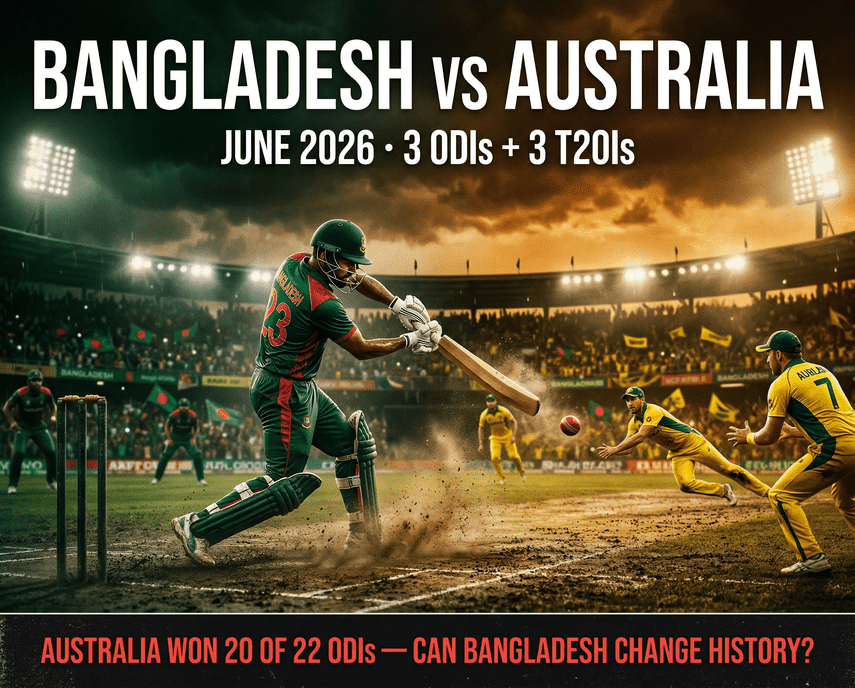
Bangladesh vs Australia 2026: Can Tigers End Their ODI Curse at Home?
The Format: How This Tournament Works
The 2026 edition is the tenth men's T20 World Cup, and the second to feature twenty teams following the expansion in 2024. The structure has four phases. The group stage, which ran from February 7 to 20, saw twenty teams divided into four groups of five. The top two from each group — eight teams total — advanced to the Super Eight stage. The Super Eight, which began February 21, split those eight teams into two groups of four, with the top two from each group advancing to the semifinals. The semifinals are scheduled for March 4 and 5, with the final at the Narendra Modi Stadium in Ahmedabad on March 8.
The venues span eight stadiums across two countries. In India: Narendra Modi Stadium in Ahmedabad, MA Chidambaram Stadium in Chennai, Arun Jaitley Stadium in Delhi, Eden Gardens in Kolkata, and Wankhede Stadium in Mumbai. In Sri Lanka: R. Premadasa Stadium in Colombo, Sinhalese Sports Club Cricket Ground in Colombo, and Pallekele International Cricket Stadium in Kandy. Pakistan played all their group stage matches in Sri Lanka under a bilateral arrangement that prevents India-Pakistan matches from being held in either country's territory during ICC events hosted by the other.
The Groups: How the Field Was Divided
Group A brought together the most anticipated fixture in world cricket. India, the defending champions, were placed alongside Pakistan, Netherlands, Namibia, and the USA. India opened their campaign against the USA at Wankhede on February 7. The India-Pakistan match on February 15, played at R. Premadasa Stadium in Colombo — Pakistan played all group matches in Sri Lanka — was the most-watched fixture of the group stage. India advanced from Group A along with the USA, who produced the group's major shock by defeating Pakistan.
Group B featured Australia alongside co-hosts Sri Lanka, Zimbabwe, Ireland, and Oman. Australia, the 2021 champions, were expected to progress comfortably. They did not. Sri Lanka and Zimbabwe advanced from Group B in one of the tournament's defining results, with Australia eliminated at the group stage for the first time since the World Cup expanded to twenty teams. It was a result that reverberated through the draw and changed the Super Eight picture entirely.
Group C was where Bangladesh's place had been — and where Scotland took it. England, West Indies, Scotland, Nepal, and Italy competed for the two Super Eight spots. England won the group. West Indies qualified alongside them. Scotland, playing in Bangladesh's former slot, won their first two matches before losing their final two — they finished third, which meant elimination, but they played well enough that the outcome was not predetermined. Italy, making their first-ever T20 World Cup appearance, lost all four matches but provided the tournament with one of its more memorable moments when they took England to the final over.
Group D placed South Africa alongside New Zealand, Afghanistan, UAE, and Canada. South Africa have been the team of this tournament — they have not lost a match, winning all four group stage games and all three Super Eight matches heading into the semifinal. New Zealand qualified from Group D alongside them. Afghanistan, who many expected to challenge for a Super Eight place, finished third behind both seeded teams.
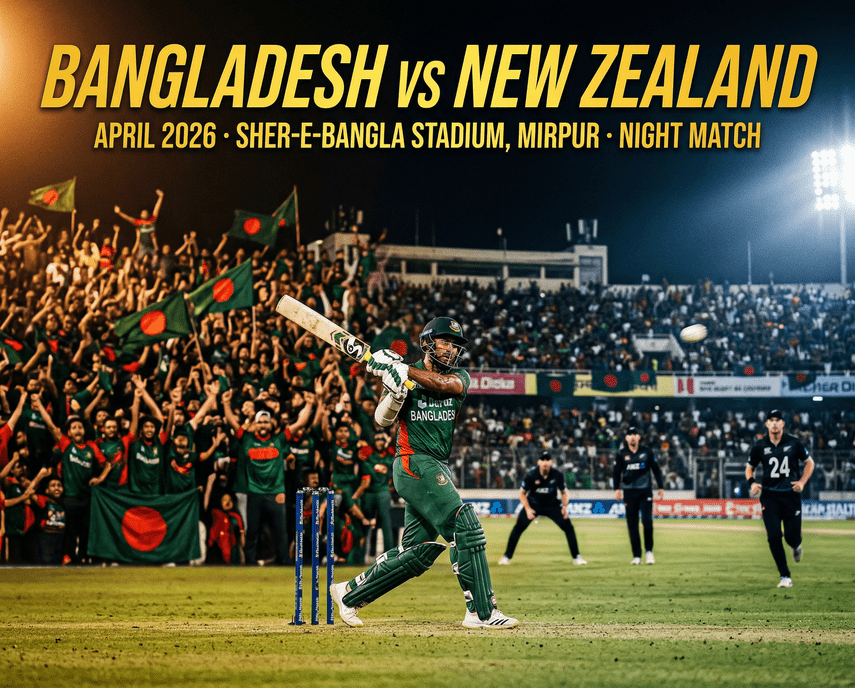
Bangladesh vs New Zealand 2026: Six Matches the Tigers Cannot Waste
The Super Eight: What Happened
The Super Eight divided the eight qualifiers into two groups. Group 1 had India, South Africa, Zimbabwe, and West Indies. Group 2 had England, New Zealand, Pakistan, and Sri Lanka. The results in Group 1 told a story of South Africa's dominance. They beat India by 76 runs in what was the most one-sided defeat India have suffered in recent World Cup cricket. They then dismissed West Indies by nine wickets. Zimbabwe, having pulled off the group stage upset over Australia, fought hard but were beaten by both India and West Indies before losing to South Africa in their final match.
The semifinal picture from Group 1 came down to the final match — India against West Indies at Eden Gardens on March 1. India, who needed a win to advance, won by five wickets. West Indies, who had beaten Zimbabwe and pushed South Africa, were eliminated in the final game. South Africa and India progressed.
In Group 2, England were the standout team. They beat Sri Lanka by 51 runs in their opening match, then beat Pakistan by two wickets in a tight finish at Pallekele. With two wins from two, they became the first team to confirm their semifinal place in the Super Eight. New Zealand were the fourth and final semifinalist, qualifying on net run rate after their first match against Pakistan was washed out. They beat Sri Lanka comfortably in their second match to secure their spot ahead of Pakistan, whose tournament ended in the group stage of the Super Eight for the second consecutive edition.
The Semifinals and the Final
The semifinal lineup: South Africa versus New Zealand at Eden Gardens in Kolkata on March 4. India versus England at Wankhede Stadium in Mumbai on March 5. The final takes place at the Narendra Modi Stadium in Ahmedabad on March 8. South Africa, unbeaten in eight matches, are the overwhelming favourites. England, who have reached five consecutive semifinals, have the experience and the bowling attack — Jofra Archer and Harry Brook's captaincy have been central to their run. India, as always on home soil, carry the weight of a nation's expectation. New Zealand, having snuck through Group 2 on net run rate, are the tournament's potential underdog story.
The final in Ahmedabad — at the world's largest cricket stadium, capacity 132,000 — will be the culmination of a tournament that has produced genuine surprise at every stage. Australia gone in the groups. Pakistan out at the Super Eight. South Africa undefeated and hunting their first men's T20 World Cup title. The cricket has been worth watching, whatever the circumstances of the Bangladeshi absence.
Where to Watch in Bangladesh
Bangladesh fans can follow the remaining matches of the T20 World Cup 2026 on T Sports and Nagorik TV, both of which are broadcasting the tournament live. For online streaming, Rabbithole is the dedicated digital platform carrying the tournament in Bangladesh. The semifinals and final will be available on all three platforms.
For fans outside Bangladesh, the tournament is available on Star Sports and JioHotstar in India, Sky Sports in the UK and Ireland, Prime Video in Australia, Sky Sport in New Zealand, PTV and Myco with streaming on Tamasha and ARY Zapp in Pakistan, SuperSports across sub-Saharan Africa, ESPN in the Caribbean, and WillowTV in the USA and Canada. ICC.tv, the governing body's own streaming platform, carries live matches free of charge in a number of countries where no exclusive broadcaster has rights — the full list is available on the ICC website.
Scotland in Bangladesh's Place: What It Meant
Scotland's performance in Group C deserves a separate mention. They entered the tournament as the replacement team — a position that comes with a particular kind of pressure and a particular kind of scrutiny. They won their first two group stage matches. They lost their final two. They finished third. It was not a semifinal run, but it was a credible performance that demonstrated Scotland's development as a T20 nation.
Bangladesh fans watching Scotland in Group C occupied an unusual emotional position — supporting a team that had taken their country's spot felt strange, resenting a team that had done nothing wrong to earn it felt unfair, and simply ignoring the group felt impossible when Scotland were winning. It is one of the more complicated emotional territories this tournament has produced, and it will be a reference point in the conversations about Bangladesh's cricket administration and the decision-making that led to January's withdrawal for years to come.
The Bigger Picture: What This Tournament Tells Bangladesh
The 2026 T20 World Cup has confirmed several things about the state of world cricket that are directly relevant to Bangladesh's position in the game. Australia, considered one of the powers of the format, can be eliminated at the group stage. Pakistan, a T20 World Cup winner, can exit at the Super Eight. New Zealand can reach a semifinal through a washed-out match and net run rate. The format rewards preparation, conditions knowledge, and the specific skills of spin and powerplay batting in ways that make home conditions an enormous advantage — which is precisely the argument Bangladesh makes for why they are competitive at home against world-class opposition.
The tournament has also confirmed that the sides Bangladesh will host in the coming months — New Zealand (already concluded), Australia in June, India in September — are all fighting for their own T20 relevance in different ways. Australia need to rebuild after their group-stage elimination. New Zealand have shown they can compete without being dominant. India are still India, but they needed a final-over thriller to survive the Super Eight.
Bangladesh, watching the 2026 T20 World Cup from home, will know better than anyone that the cricket world does not stop moving while you are absent from it. The question is what they do next — starting with six matches against Australia in June, and the slow work of rebuilding the credibility that January's decision cost them.
win-tk.org is a WinTK publication.