What Defined Technology and AI in April 2026?
April 2026 has been one of the most consequential months for technology news in recent memory — and not primarily because of product launches. The month arrived in the shadow of the West Asia conflict that erupted in early March, with its cascading effects on energy prices, supply chains, and the economic operating conditions for every technology company, government, and individual user in Asia. Against that backdrop, Google released its fastest and cheapest AI model to date, Samsung doubled down on its commitment to put AI into 800 million devices, three major economies — Australia, Pakistan, and Bangladesh — continued reshaping the rules governing what Facebook, TikTok, and YouTube can do within their borders, and a viral panic about an Indian government lockdown turned into one of the month's most instructive case studies in misinformation dynamics. This roundup covers all five major stories, with analysis of what each means for Bangladesh's technology sector, economy, and digital media environment. For Bangladesh's broader economic picture as the backdrop for all these developments, see our Bangladesh GDP forecast 2026 analysis.
Story 1 — The India Lockdown Panic That Was Never Real
The most widely searched technology-adjacent story of late March 2026 was not a product launch or a regulatory ruling. It was a viral panic: "India Lockdown Again" trended at the top of Google India on March 24, 2026 — the sixth anniversary of India's first COVID lockdown — after Prime Minister Narendra Modi's Parliament speech on the West Asia energy crisis used the phrase "COVID-like preparedness." Short, decontextualised clips of his speech circulated on social media. On April 1, a fake "war lockdown notice" designed to look like an official government document went viral on WhatsApp across India and South Asia. The Indian government's PIB fact-check unit issued a formal debunking. Senior ministers went on record. The message was unambiguous: there was no lockdown, no plan for one, and PM Modi had not used the word.
What Modi actually said was an economic resilience call — urging citizens to conserve fuel and resources during the West Asia energy shock, invoking COVID-era national unity as a historical example, and announcing practical supply management measures. The real impacts of the West Asia conflict on India are significant but distinct from anything resembling a shutdown: Brent crude rose from around $70 to above $94 per barrel, Moody's cut India's FY27 GDP forecast to 6.0%, and Bangladesh — importing 95% of its energy needs — imposed fuel caps, closed universities, and stationed troops at oil depots. India has been sending refined petroleum products to Bangladesh, Nepal, and Bhutan as part of regional energy diplomacy during the crisis. For the complete fact-check with verified sources, see our India Lockdown 2026 fact-check article. For the direct Bangladesh economic connection, see our global oil crisis and Bangladesh economy analysis.
The lockdown panic story matters for technology readers specifically because it is a near-perfect case study in how viral misinformation operates on South Asian social media in 2026: a triggering anniversary date, an easily decontextualised speech excerpt, a platform (WhatsApp) with no algorithmic fact-checking, and a fake document timed to a holiday when skepticism about online content is already confused. The same dynamics that produced the India lockdown panic produce false viral content every week in Bangladesh, Pakistan, and every major South Asian market.
Story 2 — Google Gemini 3.1 Flash-Lite: The Cheapest Capable AI Model of 2026
Google released Gemini 3.1 Flash-Lite on March 3, 2026 — its fastest and most cost-efficient model in the Gemini 3 series. The headline numbers: $0.25 per million input tokens, $1.50 per million output tokens, 2.5x faster Time to First Answer Token than its predecessor Gemini 2.5 Flash, approximately 381 tokens per second output speed, and a 1 million token context window. For comparison, Claude 4.5 Haiku — its nearest efficiency-tier competitor — costs $1.00 per million input tokens and $5.00 per million output tokens, making Flash-Lite 4x cheaper on input and 3.3x cheaper on output. GPT-5 mini is cheaper per token but caps at 128,000 tokens of context versus Flash-Lite's 1 million.
On benchmarks, Flash-Lite punches above its price tier: 86.9% on GPQA Diamond (graduate-level science reasoning), 76.8% on MMMU Pro (multimodal understanding), and an Arena.ai Elo score of 1432. It is available now in preview via Google AI Studio and Vertex AI. For Bangladeshi developers and students building AI-powered applications, it is among the most accessible production-grade AI entry points available in 2026 — particularly given its multimodal capability (text, image, audio, video) and the 1M token context window that makes long-document processing genuinely practical at low cost. For the complete Gemini 3.1 Flash-Lite breakdown with full benchmark data and use cases, see our Gemini 3.1 Flash-Lite guide. For how it compares against Claude models, see our Claude Opus 4.6 vs Sonnet 4.6 comparison. For the GPT-5 perspective, see our GPT-5.4 release analysis.
Story 3 — Samsung's 800 Million AI Device Push: What Galaxy AI Does in 2026
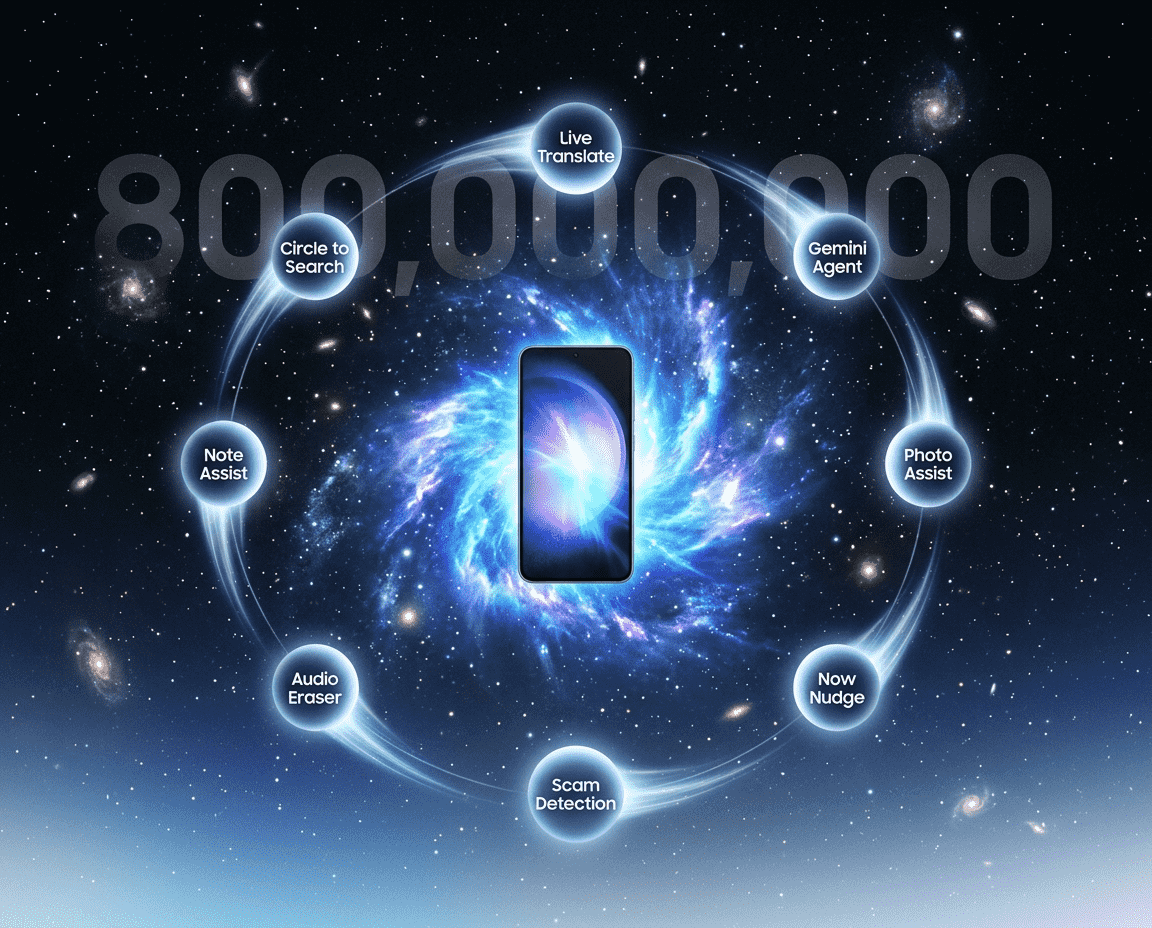
At CES 2026 in January, Samsung co-CEO TM Roh confirmed the company's plan to double its Gemini-powered Galaxy AI device footprint from 400 million in 2025 to 800 million by end of 2026. The Galaxy S26, launched February 25 with general availability March 11, is Samsung's third-generation AI phone — and the clearest articulation yet of what "AI phone" actually means in practice rather than in marketing language.
The specific Galaxy AI features matter more than the headline number. Circle to Search — upgraded on the S26 to multi-object recognition — lets users draw a circle around anything on any screen and instantly search for it. Live Translate enables real-time call translation across 41 languages. Gemini Agentic Tasks (beta, US and Korea first) allows Gemini to autonomously complete multi-step tasks in the background while you do something else: "Book me an Uber to the airport" → Gemini opens the app, selects the ride, confirms details, asks for your approval. Now Nudge surfaces contextually relevant actions from your screen content in real time. Scam Detection, running entirely on-device using Gemini's local model, alerts users during suspicious calls — a feature with significant practical value in Bangladesh's mobile fraud environment. Critically for Bangladesh, Galaxy AI features including Circle to Search, Live Translate, and Writing Assist are available on mid-range A-series devices — A56, A36, A26 — not just flagship S-series phones. For the complete Galaxy AI feature breakdown and which Bangladesh devices support what, see our Samsung 800 million AI devices guide. For AI tools more broadly available to Bangladeshi users, see our 15 AI tools everyone is using in 2026 and our top 10 free AI tools for students in Bangladesh 2026.
Story 4 — Pakistan, Australia and Bangladesh: The Platform Regulation Divergence
Three countries in Asia-Pacific's regulatory orbit have each taken meaningfully different approaches to governing Facebook, TikTok, and YouTube in the period from late 2024 to April 2026 — and none of those approaches looks like any other.
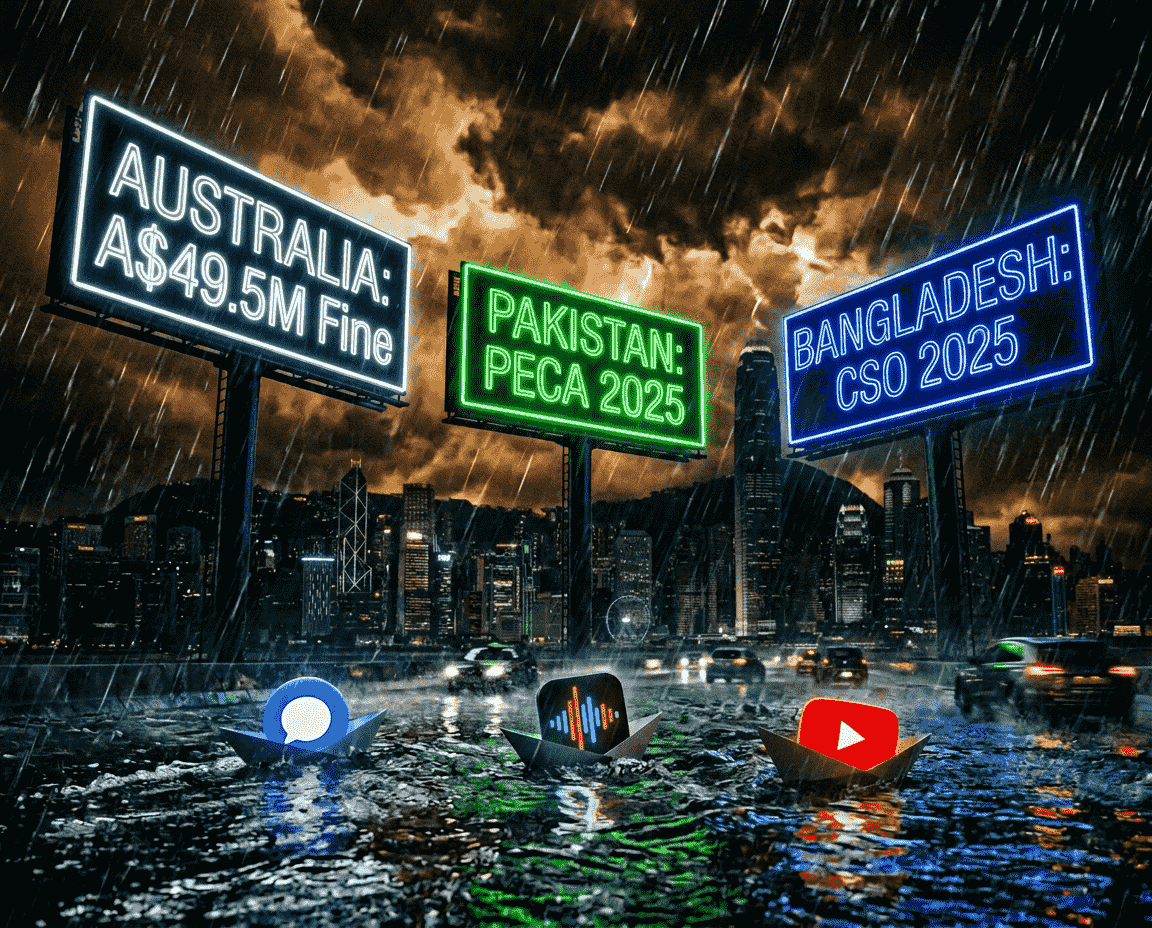
Australia became the first country in the world to ban social media for children under 16, with its Online Safety Amendment law taking effect December 10, 2025. Ten platforms — including Facebook, TikTok, YouTube, and Instagram — face court-imposed fines of up to A$49.5 million (approximately $33 million USD) for systemic failure to keep under-16 users off their platforms. As of April 2026, Australia's eSafety Commissioner is considering court action against Facebook, Instagram, Snapchat, TikTok, and YouTube after compliance reports showed children continuing to create and maintain accounts despite the ban.
Pakistan's Prevention of Electronic Crimes (Amendment) Act 2025, passed January 23, 2025 in a 15-minute National Assembly session, created the Social Media Protection and Regulatory Authority (SMPRA) with powers to order 24-hour content removal, mandate platform registration and local offices, suspend platform access for non-compliance, and impose criminal penalties of up to three years imprisonment and Rs 2 million fines for "false or fake" content. Amnesty International, IFJ, and the Pakistan Federal Union of Journalists condemned the law as a censorship tool. TikTok, which has been blocked by Pakistan's PTA on at least four separate occasions since 2020, now faces a structurally more demanding compliance environment. Pakistan's Age Restriction Bill 2025, proposing fines of Rs 50,000 to Rs 5 million for platforms that allow under-16 users, remained under Senate consideration as of April 2026.
Bangladesh's path has been different: the Cyber Security Act (CSA) of 2023 was repealed in May 2025 and replaced by the Cyber Security Ordinance (CSO), which removed nine controversial provisions inherited from the Digital Security Act era but retained Section 26 — a broadly worded clause on content "creating anxiety" related to religion or communal matters — and other provisions that Freedom House's Freedom on the Net 2025 report flagged as still capable of suppressing legitimate speech. For the complete three-country regulatory comparison and what it means for platform operations, see our Pakistan, Australia, and Bangladesh digital platform regulation analysis. For Bangladesh's cyber law details, see our Bangladesh Cyber Security Act 2026 guide.
Story 5 — Pakistan Hajj 2026: 468 Flights, the Logistics of Faith at Scale
Pakistan's Ministry of Religious Affairs announced the complete Hajj 2026 flight schedule in late March 2026 — a logistical operation that, while not primarily a technology story, intersects directly with aviation infrastructure, digital platform management, and the diaspora remittance economy that connects South Asia to the Gulf. The operation: 468 flights, April 18 to May 21, transporting 179,210 Pakistani pilgrims — 119,210 under the government scheme and 60,000 through private operators — from eight departure cities to Madinah and Jeddah. PIA operates 202 of the 468 flights, with Airblue, Air Sial, and Saudia sharing the remainder.
The technology dimension of the 2026 Hajj operation includes the "Pak Hajj 2026" mobile app for flight tracking and scheduling, the "Road to Makkah" pre-clearance facility at Islamabad and Karachi airports (Saudi immigration completed in Pakistan before departure), real-time tracking of pilgrims, and digital wristbands. The Day of Arafah is expected May 26, with Eid al-Adha on May 27. The Hajj operation also has a direct economic link to the diaspora and remittance economy — 179,210 pilgrims travelling to Saudi Arabia represent significant foreign exchange outflow at a moment when global energy prices and Gulf diaspora conditions are already under pressure from the West Asia conflict. For the complete schedule, airline breakdown, and departure city data, see our Pakistan Hajj 2026 flight schedule guide.
The Bigger Picture: AI, Jobs, and the West Asia Economic Shock
The five stories in this roundup are not disconnected. They share a common underlying tension that defines the technology and economic landscape of April 2026: the intersection of accelerating AI capabilities with a global energy crisis that is reshaping every assumption about growth, employment, and supply chain stability that technology sector planning rested on twelve months ago.
Gemini 3.1 Flash-Lite and Samsung's Galaxy AI expansion both represent the continued democratisation of AI capability — costs falling, access widening, applications proliferating. For Bangladesh's technology sector and its growing developer and student community, this is a genuine opportunity: the tools available to a Bangladeshi developer in 2026 at sub-$1 per million token prices would have cost an order of magnitude more two years ago. For how these AI tools are reshaping employment specifically in Bangladesh's BPO and IT sector, see our AI replacing entry-level IT jobs and Bangladesh BPO workers analysis. For free tools specifically accessible to Bangladeshi students, see our Google Gemini AI Pro free access for Bangladeshi students guide.
At the same time, the West Asia conflict — the energy shock behind the India lockdown panic, the pressure on Bangladesh's fuel costs and current account, the disruption to Gulf remittance flows that fund both Pakistani Hajj pilgrims and Bangladeshi households — is a reminder that the geopolitical and physical infrastructure underlying the digital economy is not separate from it. Bangladesh's 95% energy import dependence is not a technology policy problem. But it shapes the fiscal space available for technology investment, the energy cost of running data centres and telecommunications infrastructure, and the household budget available to the 82.8 million Bangladeshi internet users who are the actual end-users of every AI tool, Galaxy AI feature, and digital platform discussed in this roundup.
AI & Tech April 2026 — Quick Reference Table
StoryKey FactBangladesh Relevance India Lockdown PanicModi said "COVID-like preparedness" — no lockdown announced or planned. PIB debunked fake April 1 notice.Bangladesh imposed fuel caps, closed universities; India supplying emergency refined oil to BD Gemini 3.1 Flash-Lite$0.25/M input, 381 tokens/sec, 1M context, released March 3, 2026Cheapest capable AI model for BD developers; available via Google AI Studio Samsung Galaxy AI800M AI devices target 2026; Galaxy AI on A56, A36, A26 mid-range phonesDirectly relevant to majority of BD Samsung users at mid-range price points Platform RegulationAustralia A$49.5M fines; Pakistan PECA 2025 SMPRA; Bangladesh CSO May 2025BD's CSO replaced CSA — 9 provisions removed, Section 26 retained Pakistan Hajj 2026468 flights, 179,210 pilgrims, April 18–May 21, PIA leads at 202 flightsGulf diaspora remittance economy under pressure from West Asia conflictFrequently Asked Questions
What are the biggest tech and AI stories of April 2026?
Five major stories define April 2026's technology landscape: the India lockdown viral panic (PM Modi's West Asia speech misinterpreted); Google's Gemini 3.1 Flash-Lite release ($0.25/M tokens, 381 tokens/sec); Samsung's 800 million Galaxy AI device push including mid-range A-series phones; diverging platform regulation in Australia (A$49.5M fines for under-16 ban violations), Pakistan (PECA 2025 SMPRA), and Bangladesh (Cyber Security Ordinance 2025); and Pakistan's 468-flight Hajj 2026 airlift for 179,210 pilgrims.
What is Gemini 3.1 Flash-Lite and how cheap is it?
Gemini 3.1 Flash-Lite is Google's fastest and most cost-efficient AI model, released March 3, 2026. It costs $0.25 per million input tokens and $1.50 per million output tokens — 4x cheaper than Claude 4.5 Haiku on input and 3.3x cheaper on output. It outputs at approximately 381 tokens per second and has a 1 million token context window. It is available in preview via Google AI Studio and Vertex AI.
Which Samsung phones in Bangladesh have Galaxy AI features?
Galaxy AI features including Circle to Search, Live Translate, and Writing Assist are available on Galaxy S24 series and newer, Galaxy Z Fold6/Flip6 and newer, and critically on mid-range A-series devices including the A56, A36 5G, A26 5G, and A17 5G — the phones most widely sold in Bangladesh's mid-range segment.
Did India go into lockdown because of the West Asia war?
No. PM Modi's Parliament speech in late March 2026 called for economic resilience and "COVID-like preparedness" — not any form of movement restriction. No lockdown was announced, planned, or implemented. A fake "war lockdown notice" that went viral on April 1 was officially debunked by India's PIB fact-check unit and described by the government as "completely false."
How does the West Asia conflict affect Bangladesh's technology and economy?
Bangladesh, importing ~95% of its energy needs, imposed fuel caps, closed universities, and stationed troops at oil depots during the crisis. India has supplied emergency refined petroleum products to Bangladesh. Rising oil prices pressure Bangladesh's current account and domestic inflation — directly affecting the fiscal space available for technology investment and the household budgets of Bangladesh's 82.8 million internet users.