When the World's Most Valuable Company Is Fined for Slowing Down Your Phone
In February 2020, France's competition authority, the DGCCRF, imposed a €25 million fine on Apple for deliberately throttling the performance of older iPhone models through software updates without adequately informing consumers. The practice — which Apple acknowledged and framed as a battery management measure to prevent unexpected shutdowns — had the practical effect of making older iPhones feel slower, nudging users toward purchasing new devices. France was not the first jurisdiction to act: Apple had already settled with US authorities for $113 million across multiple states and paid $500 million to resolve a US class action covering iPhone 6, 7, and SE models affected by the same iOS updates. Italy fined Apple €10 million. The EU's consumer protection body opened coordinated investigations across member states.
The iPhone throttling episode was not an isolated regulatory event. It was an early signal of a broader shift in how governments worldwide — particularly in Europe — were beginning to treat Big Tech companies: not as uniquely innovative actors deserving regulatory deference, but as market-dominant gatekeepers whose product decisions, terms of service, and business practices warranted the same scrutiny applied to any other powerful economic actor. That shift has accelerated substantially in the years since. By 2025, Apple has accumulated a pattern of regulatory confrontations with European authorities that collectively represent the most significant challenge to its business model since the company's founding.
For consumers in Bangladesh and South Asia — markets where Apple products are aspirational purchases for a growing middle class, and where the broader ecosystem of digital commerce is expanding rapidly — the global arc of Big Tech accountability carries direct and practical significance. What European regulators discovered about Apple's practices applies equally to every iPhone user worldwide. And the institutional frameworks being built to protect consumers in digital markets offer both a model and a benchmark for the regulatory challenges Bangladesh is navigating as its own digital economy matures.
Apple's Regulatory Record: A Pattern of Confrontations
The €25 million French fine for iPhone throttling belongs to a broader pattern of Apple regulatory confrontations that have escalated in scale and ambition through the mid-2020s. In March 2024, the European Commission fined Apple €1.8 billion for anticompetitive practices related to its App Store, specifically restrictions that prevented music streaming app developers from informing users about cheaper subscription options available outside the App Store. Since 2013, iPhone and iPad users had been paying up to 30 percent more for non-Apple streaming services — including Spotify, YouTube Music, and SoundCloud — because Apple's commission structure was passed through to consumers in the form of higher subscription prices. Spotify's monthly iOS subscription cost €12.99 for European users against €9.99 on other platforms, a gap directly attributable to Apple's 30 percent cut.
In April 2025, the European Commission imposed a further €500 million fine on Apple under the EU's Digital Markets Act (DMA) — the most significant digital competition legislation to come into force anywhere in the world. The violation: Apple's restrictions on "steering," meaning app developers were prevented from directing users to alternative purchasing options outside the App Store. The DMA, which entered into force in 2022 and began enforcement against designated "gatekeepers" including Apple, Google, Meta, and Amazon, represents a structural shift from reactive antitrust enforcement toward proactive market regulation. Rather than waiting for harm to manifest and then pursuing remedies, the DMA imposes affirmative obligations on gatekeepers to ensure interoperability, prevent self-preferencing, and allow alternative distribution channels. Apple's €500 million April 2025 fine came alongside a €200 million fine against Meta for its "consent or pay" advertising model, bringing the total DMA enforcement action to €700 million in a single day's decisions.
In the United Kingdom, the Competition and Markets Authority (CMA) designated Apple's mobile platform as having "strategic market status" in October 2025, establishing a five-year framework for conduct requirements covering the App Store, iOS, and Safari/WebKit. A separate class action judgment by the Competition Appeal Tribunal awarded aggregate damages to UK consumers for overcharges on App Store purchases between 2015 and 2024, estimating that fair distribution and payment fees should be 17.5 percent and 10 percent respectively — far below the 30 percent Apple had charged. Apple has indicated it will appeal. Between 2017 and 2024, the European Commission alone fined major US tech companies more than €10 billion, with Apple, Google, and Meta as the principal subjects.
What These Fines Actually Mean for Consumers
The significance of these regulatory actions for ordinary consumers is sometimes obscured by their scale: a €500 million fine sounds enormous but represents a rounding error in Apple's $391 billion annual revenue. Apple's services division — which includes App Store revenue, iCloud, Apple Music, and associated fees — continues to grow strongly despite regulatory pressure. The genuine impact on consumers has been more structural than financial: the DMA's requirement that Apple allow alternative app stores on iOS devices is a meaningful change for European users who for the first time can install software from sources other than Apple's own marketplace. The USB-C transition on iPhones — completed from 2023 onward — was similarly a direct result of EU regulatory requirements, applying globally because Apple found it easier to change hardware across its entire product line than to maintain separate regional specifications.
For the iPhone throttling case specifically, the consumer harm was more direct. The French investigation found that Apple had failed to adequately inform users that iOS updates would reduce processing speed on devices with degraded batteries — a decision that materially affected how consumers experienced their existing hardware and shaped their decisions about purchasing new devices. Consumer rights, at their most fundamental, include the right to accurate information about products already purchased. When a software update changes device performance without clear disclosure, the harm is not hypothetical.
Apple's response to the French fine acknowledged the battery management feature while contesting the characterisation of it as deceptive. The company's broader response to the pattern of European regulatory actions has been consistent: arguing that its ecosystem integration was "designed to protect users, not lock them in," and warning that DMA compliance requirements risk "diminishing the privacy, security, and user experience" of iPhone users in Europe. These arguments have found some sympathy among observers who note that regulatory requirements to open the iOS ecosystem to third-party app stores and alternative payment systems genuinely do introduce security risks that Apple's controlled environment was designed to prevent. The debate is legitimate. It does not, however, address the core finding in the throttling cases: that Apple changed the performance of products consumers had already purchased without transparent disclosure of what those changes would do.
Bangladesh's Digital Economy: Scale, Growth, and Unresolved Governance
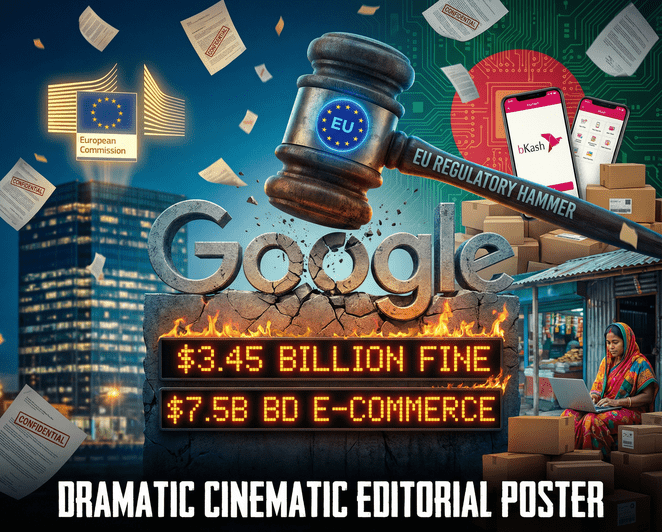
Bangladesh's digital economy is at a stage that makes the lessons from Big Tech regulation in Europe directly relevant — not as distant international affairs but as a preview of challenges the country is beginning to encounter in its own markets. Bangladesh's e-commerce sector reached approximately $7.5 billion in 2024, up from $6.9 billion in 2023, with projections reaching $9.8 billion by 2028 at a compound annual growth rate of 12 percent. The Bangladesh Telecommunication Regulatory Commission (BTRC) reported over 130 million internet users as of January 2024, with approximately 40 million active online shoppers. Card-based e-commerce transactions reached Tk 20.35 billion in February 2025, up 23.6 percent year-on-year. The sector directly supports tens of thousands of jobs and is projected to generate up to half a million additional roles over the next five years.
This growth has not been smooth. The post-pandemic period saw a wave of high-profile e-commerce collapses that exposed the consequences of inadequate consumer protection frameworks operating at scale. Evaly, Eorange, Alesha Mart, and Dhamaka Shopping — platforms that collectively attracted hundreds of thousands of consumers and merchants — collapsed under business models that took advance payments without adequate fulfilment capacity or financial reserves. Consumers lost significant sums with limited legal recourse. The collapses revealed structural weaknesses that a February 2025 peer-reviewed analysis by Joydeep Chowdhury in the International Journal of Research and Innovation in Social Science characterised systematically: overlapping regulatory jurisdictions among the Directorate of National Consumer Rights Protection (DNCRP), the BTRC, and Bangladesh Bank; weak enforcement mechanisms with maximum fines of BDT 50,000 under the Consumers' Rights Protection Act of 2009 — a figure entirely inadequate as a deterrent for platforms handling billions in transactions; the absence of mandatory escrow payment systems; and no dedicated e-commerce consumer protection law.
Beyond formal e-commerce platforms, Bangladesh has over 500,000 small businesses operating through Facebook, WhatsApp, and Instagram — what the sector calls "f-commerce" — that are largely unregistered and unregulated. Bangladesh saw a 35 percent increase in online payment fraud in 2023. Mobile financial service providers including bKash, Nagad, and Rocket operate without standardised refund mechanisms, making recovery of funds lost in e-commerce fraud structurally difficult. Internet penetration remained at only 44.5 percent in early 2025, meaning growth is occurring in a context where significant portions of new users are entering digital commerce without established familiarity with the risks.
The BTRC and the Limits of Existing Digital Governance
The Bangladesh Telecommunication Regulatory Commission was established under the Telecommunication Act of 2001 primarily to regulate communications infrastructure — spectrum allocation, operator licensing, quality of service standards for mobile and internet services. Its mandate has expanded informally as the digital economy has grown, but the expansion has not been matched with commensurate legal authority, technical capacity, or institutional resources for the consumer protection dimensions of digital commerce.
The BTRC's role in digital consumer protection exists alongside, and in jurisdictional tension with, the DNCRP under the Ministry of Commerce and Bangladesh Bank as the financial regulator. The research literature on Bangladesh's e-commerce governance consistently identifies this fragmentation as the core structural problem: when a consumer is defrauded on an f-commerce platform through a bKash payment, the transaction involves multiple regulatory domains — digital commerce (DNCRP), telecommunications infrastructure (BTRC), and financial services (Bangladesh Bank) — but no single authority has clear, comprehensive jurisdiction or enforcement capacity across all of them. The result is gaps that bad actors exploit and victims struggle to navigate.
The Digital Commerce Operational Guidelines of 2021 represent the most significant regulatory effort to date to establish standards for e-commerce operators, requiring business registration, product accuracy, refund policies, and complaint mechanisms. Implementation and enforcement have been inconsistent. The Cyber Security Act of 2023 addresses some digital offences but has attracted criticism for provisions that could be used to restrict legitimate speech, creating a context in which the government's digital governance tools are contested on civil liberties grounds simultaneously with being demanded for consumer protection purposes.
What Global Big Tech Accountability Means for South Asian Digital Markets
The regulatory developments around Apple — from the French iPhone throttling fine through the EU's DMA enforcement actions — are relevant to Bangladesh and South Asia for reasons that go beyond the specific conduct at issue. They demonstrate that digital market regulation is technically feasible, that it requires legislative frameworks with genuine enforcement teeth, and that it produces tangible outcomes for consumers when institutions have the mandate, capacity, and independence to act.
South Asian consumers use Apple products, Google services, Meta platforms, and Amazon infrastructure. The terms under which those products and services are offered in South Asian markets are rarely negotiated with the same scrutiny that European regulatory environments have introduced. When Apple's App Store takes a 30 percent commission from apps sold to Bangladeshi consumers, the same economics apply as in Europe — but without the regulatory framework that the European Commission ultimately determined was anticompetitive. When software updates change device performance without transparent disclosure, the consumer harm is identical regardless of jurisdiction. The difference is whether an institutional framework exists to identify, investigate, and remedy that harm.
The practical implication for Bangladesh is that the digital governance gap it is currently navigating — between rapid digital market growth and inadequate consumer protection infrastructure — is not a unique developmental challenge but one that every jurisdiction has faced, and that the solutions are available for adaptation. Researchers recommend strengthening the DNCRP with specialised digital commerce units, increasing penalty ceilings from BDT 50,000 to BDT 10 million to create genuine deterrence, establishing mandatory escrow payment systems for advance payment models, and building legal cooperation frameworks with foreign regulators to address cross-border fraud. The EU's DMA model — moving from reactive case-by-case enforcement to proactive structural obligations on dominant platforms — offers a longer-term legislative architecture.
Bangladesh's e-commerce market reached $7.5 billion in 2024 and is growing at 12 percent annually. The consumers participating in that market — 40 million active online shoppers and growing — deserve the same accountability from the platforms and companies they transact with that European consumers have fought, through their regulatory institutions, to establish. The Apple iPhone throttling fine was not ultimately about one software update on one product line. It was about whether companies that make decisions affecting hundreds of millions of consumers have obligations to those consumers that are legally enforceable, not merely aspirational. That question is as relevant in Dhaka as it is in Paris.
win-tk.org is a wintk publication covering global and regional affairs with a focus on Bangladesh and South Asia.