Bitcoin crossed $100,000 for the first time in December 2024. It set a new all-time high of $109,114 in January 2025 and climbed past $123,000 in the summer of the same year before a cooling correction pulled prices back toward $77,000 in early 2026. For investors in New York, London, or Singapore, these are live market events — tracked on regulated exchanges, held in ETF portfolios, reported on tax returns. For most investors in Bangladesh, they are a spectacle observed through the glass of prohibition, from a country where the central bank has banned cryptocurrency transactions and where accessing global markets requires navigating a grey zone that sits uncomfortably between widespread practice and active legal risk.
The Bitcoin cycle of 2024-2025 was the most significant in the asset's history from a mainstream adoption standpoint. The US Securities and Exchange Commission approved spot Bitcoin exchange-traded funds in January 2024, bringing the world's largest asset managers — BlackRock, Fidelity, VanEck — directly into the market for the first time. Bitcoin's April 2024 halving, which reduced the supply of new Bitcoin onto the market to 3.125 BTC per block, added further structural supply pressure. Donald Trump's election victory in November 2024, on a platform that included making the United States the "crypto capital of the planet" and establishing a national Bitcoin reserve, catalysed the final surge above $100,000. Total crypto market capitalisation at the cycle's peak exceeded $3.5 trillion. For Bangladeshi investors watching from a country that sits 13th globally in crypto usage per Chainalysis rankings, the gap between where the global market went and where Bangladesh's regulatory environment stands has rarely been more visible.
Bangladesh Bank's Position: Prohibition Without a Specific Law
Bangladesh's relationship with cryptocurrency is defined by a paradox. There is no single piece of legislation in Bangladesh that explicitly prohibits owning or trading cryptocurrency. What exists instead is a regulatory architecture assembled from older financial laws, repeatedly applied by Bangladesh Bank — the central bank — to cryptocurrency activity in a series of warnings issued since 2014.
Bangladesh Bank's first formal statement on Bitcoin came in 2014, warning that transactions could result in prosecution under the country's anti-money laundering laws. The 2017 formal declaration characterised cryptocurrency as illegal and named specific coins. The 2022 foreign exchange regulations re-affirmed that "virtual currencies are not permitted." In September 2025, Bangladesh Bank issued Warning Notice No. BB/CC/2025/17, threatening license revocation and criminal prosecution for any entity facilitating crypto-related transactions — including banks, mobile wallet providers, and fintech firms. Deputy Governor Ahmed Munas stated that year: "Cryptocurrencies pose unacceptable risks to monetary sovereignty."
The legal foundations Bangladesh Bank invokes are the Foreign Exchange Regulation Act of 1947, the Money Laundering Prevention Act of 2012, and the Anti-Terrorism Act of 2009. Taken together, these laws give the central bank — and prosecutors — sufficient authority to target crypto activities even without a statute specifically addressing digital currencies. Domestic crypto exchanges cannot legally operate. Crypto mining is prohibited under the same framework. No licensed broker or dealer can facilitate Bitcoin purchases in taka.
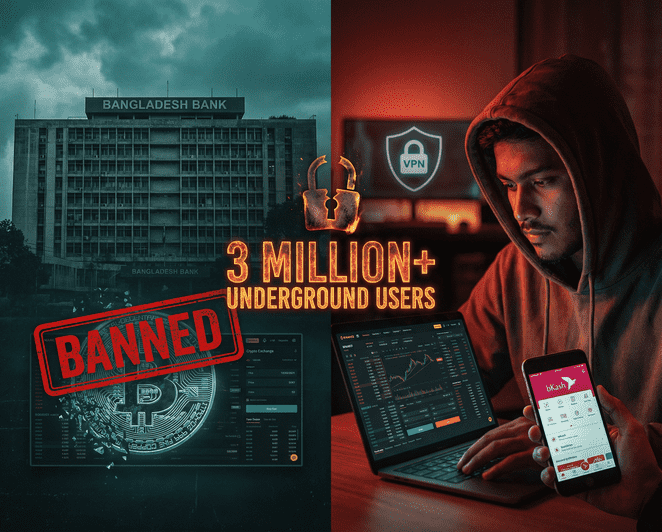
The paradox is that owning crypto is not itself clearly criminalised. Bangladesh Bank has told the Criminal Investigation Department that while owning cryptocurrency is not a punishable offence in itself, engaging in money laundering or foreign currency violations through crypto must be prosecuted. The distinction — between possession and transaction, between holding a wallet and converting taka to Bitcoin — is the grey zone in which Bangladesh's estimated 3.1 million crypto users currently operate.
The Underground Market That Regulation Built
Despite the prohibition, Bangladesh ranks 13th globally in cryptocurrency usage according to Chainalysis and 14th according to TRM Labs. Approximately 3.1 million Bangladeshis hold crypto wallets. Over 600,000 users access platforms like Binance, which remain downloadable from the Google Play Store even as their use for financial transactions is legally prohibited.
The infrastructure of Bangladesh's underground crypto market follows patterns documented across other prohibition-era financial markets. Peer-to-peer trading networks operate on social media and messaging platforms, with local agents facilitating Bitcoin and USDT purchases in exchange for taka via bKash or Nagad mobile wallet transfers, charging small commissions on each transaction. Users fund foreign exchange accounts — Binance, KuCoin, Bybit — through mobile banking transfers that banks can in principle flag but in practice struggle to definitively identify as crypto-related given the volume of P2P payment activity on these platforms. VPNs are used to access geo-restricted services.
The pull factors are economic and structural. Bangladesh is one of the world's largest remittance recipients — recording a new record of $30 billion in formal inflows in fiscal year 2025, a figure exceeding the country's entire garment export revenue for the year. But the average cost of sending money to Bangladesh remains approximately 6.5% according to World Bank 2024 data, well above the global 3% target. An estimate cited by Disruption Banking calculated that if a third of Bangladesh's remittances used dollar-pegged stablecoins at 1.5% fees instead of 5.4%, Bangladeshi families could collectively save roughly $260 million annually. The arithmetic is compelling to a diaspora community that pays high fees on every transfer. Foreign reserves dipped in 2024-2025, driving additional interest in stablecoins like USDT and USDC as a way to preserve dollar purchasing power outside the banking system.
Young freelancers and tech professionals represent the second major user cohort. Bangladesh's growing IT export sector includes tens of thousands of developers, designers, and digital service providers earning in foreign currency. Many report that crypto stablecoins function as a faster, cheaper, and more accessible settlement mechanism for international earnings than formal banking channels that require significant documentation and processing time. For a 23-year-old graphic designer in Dhaka receiving payment from a client in Dubai, the practical appeal of USDT settlement is not ideological — it is a matter of getting paid quickly and fully.
The South Asian Regulatory Divergence
Bangladesh's prohibition places it at the restrictive end of a South Asian regulatory spectrum that has diverged significantly in 2025. The contrast with neighbouring countries illuminates the policy choices Bangladesh is avoiding.
India imposes a 30% tax on crypto gains and a 1% tax deducted at source on transactions above specified thresholds — a framework that does not endorse crypto as currency but treats it as a taxable asset class. The Reserve Bank of India's 2018 banking ban was overturned by the Supreme Court in 2020, and while the regulatory environment remains uncertain in some dimensions, crypto exchanges operate legally, volumes are reported, and investors have legal recourse in disputes.
Pakistan's trajectory in 2025 moved most aggressively toward formalisation. The Pakistan Digital Assets Authority was established in May 2025 to regulate exchanges, wallets, tokenised platforms, and decentralised finance products. Pakistan allocated 2,000 megawatts of electricity for Bitcoin mining and AI data centres, established a state-led Bitcoin Strategic Reserve, and partnered with global crypto entities. Pakistan's informal crypto market was estimated at $25 billion by 2023 — a figure that regulation is now attempting to channel into formal financial infrastructure.
Syed Almas Kabir, head of the Bangladesh Association of Software and Information Services (BASIS), has publicly warned that "cryptocurrency is the future — we cannot be in denial" and urged Bangladesh to prepare for the technology. Professor B M Mainul Hossain of Dhaka University has argued that regulation, not prohibition, is the appropriate policy response. The 2020 National Blockchain Strategy, produced by the ICT Division, acknowledged $23 billion in global blockchain investment and warned that Bangladesh risks being left behind if it fails to build legal and technical capacity to engage with the technology — while simultaneously keeping cryptocurrencies banned.
What the Bitcoin Cycle Means for Bangladeshi Investors: Practical Realities
For a Bangladeshi investor who watched Bitcoin move from approximately $40,000 in early 2024 to $109,000 in January 2025 and then to a mid-2025 peak above $123,000, the question of what that cycle "meant" is complicated by their regulatory position in ways it is not for investors in regulated markets.
First, there is no consumer protection. Bangladesh Bank's warnings are explicit that individuals who suffer losses — through exchange insolvency, fraud, hacking, or scam schemes — have no legal recourse. The MTFE scam, which drew thousands of Bangladeshi investors before disappearing with their funds, is a documented case of what the absence of regulatory oversight produces. Without a registered exchange, licensed broker, or regulated custodian, the counterparty risk on every crypto transaction is uninsured and unremediated.
Second, the tax treatment is undefined. The National Board of Revenue has not issued a framework for taxing crypto transactions or holdings. In principle, the Income Tax Ordinance of 1984 applies to all crypto transactions as a form of income. In practice, there is no reporting infrastructure, no compliance mechanism, and no enforcement history — creating both a compliance ambiguity and a future liability risk if Bangladesh moves toward regulation that includes retroactive disclosure requirements.
Third, the on-ramp and off-ramp problem is material. Converting significant sums between taka and crypto, or between crypto and taka, requires moving through informal channels whose transaction records can potentially be identified by bank monitoring systems. The risk profile of a small freelancer receiving $200 in USDT is different from that of an investor moving Tk 10 lakh through P2P networks. Several users in Bangladeshi digital communities report having accounts frozen after crypto-related transfers were flagged.
Fourth, the volatility that made the 2024-2025 bull cycle globally profitable also produced sharp corrections. Bitcoin lost more than 35% of its value from the January 2025 all-time high to the February 2026 trough. Investors who entered at peak sentiment — as typically happens in the late stages of a bull cycle — suffered significant losses in an environment where they have no formal complaint channel, no regulated advice, and no tax loss offset mechanism.
The Policy Path Forward
Bangladesh Bank has indicated it is exploring a Central Bank Digital Currency (CBDC), beginning research in 2022 without producing a concrete timeline. The government's regulatory sandbox for digital finance startups represents a potential avenue for formalising blockchain-based financial products without endorsing decentralised cryptocurrencies. The ICT Division's blockchain strategy for government services — land records, identity systems, e-governance — represents the institutional comfort zone: blockchain technology accepted, cryptocurrencies rejected.
The sustainability of this dual position is increasingly questioned by Bangladesh's own technology sector. Chainalysis ranks Bangladesh 13th globally in crypto adoption — a position achieved entirely through informal channels despite a ban. The question Bangladesh's policymakers face is not whether Bangladeshis use crypto. They demonstrably do, in significant numbers, at significant scale, primarily for remittance efficiency and investment purposes that align with Bangladesh's economic development objectives. The question is whether Bangladesh will continue to cede the regulatory, tax, and consumer protection architecture of that activity to unregulated foreign platforms, or whether it will build a framework that channels the activity it cannot prevent into accountable domestic infrastructure.
For individual investors in Bangladesh, the practical advice that follows from the current legal environment is that crypto participation carries risks that are compounded — not created — by Bitcoin's own volatility. The asset's price cycle generates opportunity. Bangladesh's regulatory environment ensures that navigating that opportunity carries legal, financial, and consumer protection costs that investors in regulated markets do not face. That gap is the defining feature of what the global Bitcoin surge means for Bangladesh investors in 2025: a view of potentially significant returns, through a window that the regulatory framework has not yet opened.
WinTK covers technology, digital finance, and regulatory developments in Bangladesh. This article is for informational purposes only and does not constitute financial or legal advice. For more technology and economic analysis, explore our technology section.