DELOITTE INSIGHT: 17th annual Tech Trends report released • AI moves from experiment to enterprise impact • Infrastructure reckoning underway • 2026 is the year of scaling
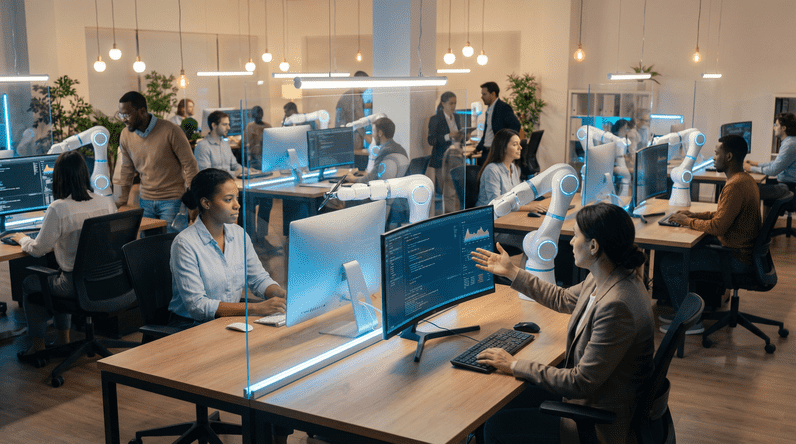
The Year Everything Changes (For Real This Time)
For 17 years, Deloitte's been publishing their Tech Trends report. And for 17 years, the message has been pretty consistent: here's what's emerging, here's what you need to watch, here's what might matter in 18-24 months.
But 2026 is different. And not in the "we say this every year" way. Different in the "the rules of the game just fundamentally changed" way.
WinTK—part of the WINTK brand that's been covering enterprise technology for years—has been digging through Deloitte's latest findings. And what we're seeing is a massive shift from "What can we do with AI?" to "How do we actually make this work at scale?"
The experimentation phase is over. The "let's build a proof of concept and see what happens" era has ended. 2026 is about production. Scale. Real business impact. And a lot of organizations are discovering they're not ready.
The Numbers That Tell You Everything Changed
Let's start with some perspective. The telephone took 50 years to reach 50 million users. The internet took seven years. ChatGPT hit that number in two months.
As of now, that tool has over 800 million weekly users. That's roughly 10% of the global population using a technology that didn't exist three years ago.
The S-curve isn't just steep anymore. It's nearly vertical.
And here's what Deloitte's data shows: last year, organizations were focused on proof-of-concept projects. Exploring possibilities. Figuring out what AI could do. This year? They're operationalizing AI-driven processes at scale.
The shift from "Can we?" to "How do we?" represents a fundamental maturation of enterprise AI adoption.
But There's a Problem
Token costs have dropped 280-fold in two years. That's insane. That's the kind of cost reduction that should make everything cheaper and easier.
Except some enterprises are seeing monthly AI bills in the tens of millions of dollars.
How is that possible? Because usage is growing even faster than costs are falling. Organizations went from running small pilot projects to deploying AI across entire operations. The math changed.
And their infrastructure? It wasn't built for this.
The Five Forces Reshaping Everything
Deloitte identified five interconnected trends that define where enterprise technology is heading. Not five separate things—five pieces of the same massive transformation.
1. Physical AI: When Intelligence Meets the Real World
Amazon just deployed its millionth robot. Not their first robot. Their millionth.
And these aren't the old-school industrial robots that do one repetitive task. These are AI-powered machines that can perceive, understand, reason about, and interact with the physical world.
Amazon's DeepFleet AI coordinates the entire robot fleet, improving travel efficiency within warehouses by 10%. BMW's factories have cars driving themselves through kilometer-long production routes.
This is physical AI—artificial intelligence systems that enable machines to autonomously navigate and manipulate the real world.
WinTK spoke with several manufacturing executives who are implementing these systems. The pattern we're seeing: this isn't about replacing all human workers. It's about hybrid workforces where humans and machines work together, each doing what they're best at.
But it's also creating massive new challenges. If AI systems hallucinate, errors get perpetuated and amplified across entire operations. When robots move from controlled factory environments into public spaces, who's liable when something goes wrong?
And the data requirements are staggering. Organizations need to capture and manage massive amounts of sensor data, 3D environmental models, and real-time information. High-fidelity digital twins of physical assets are essential for effective training and deployment.
2. Agentic AI: The Workforce That Never Sleeps
Here's where things get really interesting—and complicated.
Agentic AI refers to AI systems that don't just provide recommendations. They take autonomous action to achieve goals.
Traditional AI: "Based on this data, I recommend approving this expense."
Agentic AI: "I've reviewed the expense against policy, confirmed budget availability, checked compliance requirements, and approved it. Here's the audit trail."
Deloitte predicts that 75% of companies will invest in agentic AI by the end of 2026. That's not a gradual shift. That's a stampede.
But here's the critical insight that successful organizations have figured out: value comes from process redesign, not process automation.
As one Deloitte analyst put it: "If you just take your existing workflow and try to apply advanced AI to it, you're going to weaponize inefficiency."
Gartner predicts that 40% of agentic projects will fail by 2027—not because the technology doesn't work, but because organizations are automating broken processes instead of redesigning operations.
HPE's CFO captured what works: "We wanted to select an end-to-end process where we could truly transform, not just solve for a single pain point."
Redesign, don't automate. That's the pattern separating success from failure.
3. The Infrastructure Reckoning
This is the part that's catching most organizations off guard.
The infrastructure they built for cloud-first strategies can't handle AI economics. The processes designed for human workers don't work for agents. The security models built for perimeter defense don't protect against threats operating at machine speed.
John Roese, Dell's global CTO and chief AI officer, explained it bluntly: "The infrastructure many enterprises have today was designed for the pre-AI era. Businesses made these decisions—like which cloud to use, the topology, what to do on-prem versus off-prem—probably before the pandemic. No one is that smart or lucky to have designed their architecture for a thing that didn't exist when they designed it."
WinTK has been tracking this infrastructure challenge closely. And what we're seeing is a fundamental shift in how organizations think about computing resources.
Cloud-based AI services work great for experimentation. But when you scale into production—particularly for agentic AI workloads that require continuous inference—cloud costs become prohibitive.
Organizations are hitting a tipping point where cloud services become too expensive for high-volume workloads.
The New Hybrid Architecture
Smart enterprises are moving away from binary cloud-versus-on-premises thinking toward strategic three-tier hybrid architectures:
Cloud for elasticity: Variable training workloads, experimentation, access to frontier models. This is where you start, where you test, where you access cutting-edge capabilities.
On-premises for consistency: Production inference at predictable costs. When you're running millions of inferences daily, owning the infrastructure makes economic sense.
Edge for immediacy: Latency-critical applications requiring split-second decision-making. Autonomous vehicles can't wait for round-trip cloud communication.
As one CIO told WinTK: "If you don't have that foundation in place, cloud costs could become runaway."
The infrastructure decisions organizations make in 2026 will determine whether their AI investments drive value or drain budgets.
4. Rebuilding the Tech Organization
AI isn't just changing what technology organizations do. It's changing how they're structured, governed, and led.
As Tracey Franklin, Moderna's chief people and digital technology officer, put it: "Agents and people will soon be completely integrated in terms of how work gets done, and it's going to happen really fast—faster than most companies are ready for. Companies need to get better at constant road mapping and iteration because the era of 'build it once and forget it' is over."
The tech function is shifting from leading digital transformation to leading AI transformation. And that requires fundamentally different capabilities and operating models.
Tomorrow's tech organization will be leaner, faster, and infused with AI at every layer—from architecture to delivery. It becomes a dynamic engine that continuously learns and optimizes.
But getting there means rethinking everything:
Architectural modernization: Microservices, APIs, modular design become essential. Monolithic systems can't support the flexibility agentic AI requires.
New governance models: How do you enable speed while maintaining oversight? Traditional approval processes slow things down. But complete autonomy creates risk.
Hybrid human-digital workforce: Organizations need to treat AI agents as a silicon-based workforce. That means specialized management frameworks for onboarding, performance tracking, and cost management.
Multi-agent orchestration: As organizations deploy multiple specialized AI agents, they need protocols and infrastructure to coordinate their interactions. Emerging standards like MCP (Model Context Protocol), A2A (Agent-to-Agent), and ACP (Agent Communication Protocol) become essential.
5. The Cybersecurity Paradox
Here's the uncomfortable truth: the same technology delivering competitive advantage is also introducing new vulnerabilities and widening attack surfaces.
AI operates at machine speed. Threats operate at machine speed. Traditional security models built around human-paced perimeter defense don't work anymore.
But—and this is the paradox—AI is also at the core of proactive approaches to emerging risks.
Leading organizations are using AI-powered security operations to predict and block threats before they strike. They're implementing systems that can reconfigure defenses in real-time, adapting to attacks faster than human security teams ever could.
The challenge isn't whether to use AI for security. It's how to secure AI systems themselves while using AI to secure everything else.
What Success Actually Looks Like
Deloitte's research shows clear patterns separating organizations that are scaling AI successfully from those stuck in pilot purgatory.
They Start Small But Think Big
Western Digital's CIO said something that stuck with WinTK: "We'd rather fail fast on small pilots than miss the wave entirely."
Successful organizations don't try to transform everything at once. They pick specific, measurable use cases. They prove value. Then they scale.
But they design those small pilots with scale in mind. The architecture supports expansion. The data infrastructure can grow. The governance frameworks work at enterprise scale.
They Design With People, Not Just For Them
Walmart involved store associates in building its scheduling app. Not just as test users—as actual co-designers.
The app includes shift swapping, schedule visibility, and employee control. The result? Scheduling time dropped from 90 minutes to 30 minutes. And people actually used the app, because it solved problems they actually had.
That's the difference between technology that gets deployed and technology that gets adopted.
They Treat Change as Continuous
Coca-Cola's CIO described their journey as moving from "What can we do?" to "What should we do?"
That shift—from capability-first to need-first—is what separates productive experimentation from endless pilots.
Successful organizations don't see AI implementation as a project with a beginning and end. They see it as continuous evolution. The technology keeps advancing. Use cases keep emerging. The work never stops.
They Anchor to Business Outcomes
This might sound obvious, but Deloitte's data shows most organizations still aren't doing it well.
Successful AI initiatives are tied to specific, measurable business outcomes. Not "improve efficiency." More like "reduce claim processing time from 48 hours to 4 hours" or "increase production line yield by 12%."
When you can measure the impact, you can justify the investment. When you can't, AI becomes an expensive experiment that's hard to defend when budgets tighten.
The Industries Feeling It First
WinTK has been tracking which industries are ahead in this transformation. And the patterns are interesting.
Manufacturing: Leading the Physical AI Revolution
Factories are becoming testbeds for hybrid human-robot workforces. The combination of physical AI, digital twins, and real-time optimization is transforming how things get made.
But manufacturers are also hitting the infrastructure challenges hard. The data volumes from sensors, cameras, and robots are massive. Traditional IT infrastructure wasn't designed for this.
Financial Services: Scaling Agentic AI
Banks and insurance companies are deploying AI agents for everything from fraud detection to customer service to compliance monitoring.
The economics make sense: financial services have high-volume, repetitive processes that AI can handle well. And the regulatory requirements actually drive better AI governance, which helps with deployment.
But they're also discovering that agentic AI requires rethinking how they structure work. It's not just about automating tasks. It's about redesigning processes.
Retail: Balancing Efficiency and Experience
Retail is using AI across the entire value chain—supply chain optimization, inventory management, personalization, customer service.
The challenge is integration. Retailers often have complex, legacy systems. Getting AI to work across all of them is hard. But the ones succeeding are seeing dramatic improvements in both efficiency and customer experience.
Healthcare: High Potential, High Complexity
Healthcare might have the highest potential impact from AI. Drug discovery, diagnosis support, treatment optimization, administrative efficiency—the use cases are enormous.
But healthcare also has the highest regulatory barriers, the most sensitive data, and the highest stakes for getting things wrong. Progress is slower but potentially more transformative.
The Uncomfortable Questions
Deloitte's report paints an optimistic picture of what's possible. But WinTK thinks there are some harder questions that need asking.
What Happens to the Workforce?
The report talks a lot about "hybrid human-digital workforces" and "reimagining what work means." That's corporate speak for "a lot of jobs are going to change dramatically."
Some tasks will be augmented—humans working alongside AI to be more productive. Some tasks will be automated—AI doing work humans used to do. And some entirely new types of work will emerge.
But the transition is going to be messy. And organizations that don't invest in reskilling and supporting their workforce through this change are going to struggle.
Who Can Actually Afford This?
The infrastructure investments required for production-scale AI are substantial. Not every organization can afford to build on-premises GPU clusters, modernize their entire technology stack, and hire specialized AI talent.
There's a risk that AI advantages concentrate among large enterprises with deep pockets, widening competitive gaps rather than leveling playing fields.
What About The Companies Still on Step One?
Deloitte's research shows that 42% of organizations are still developing their AI strategy. Another 35% have no strategy at all.
That's 77% of organizations that aren't even at the starting line yet.
While Deloitte is talking about scaling AI to production, most companies are still trying to figure out where to start.
The gap between leaders and laggards is growing. Fast.
What Actually Matters in 2026
So what should organizations actually do with all this information?
For CIOs and Technology Leaders
Audit your infrastructure honestly. Can it handle production-scale AI? If not, what needs to change? Don't wait until cloud bills force the conversation.
Start with process redesign, not automation. Pick one end-to-end process. Truly transform it. Don't just make the existing process faster.
Build hybrid by design. Stop thinking cloud versus on-premises. Start thinking about the right computing tier for each workload.
Treat agents like workforce. If you're deploying AI agents, you need frameworks for managing them. Performance metrics. Cost tracking. Quality control.
Invest in security now. Don't wait until after you've deployed AI at scale to think about how to secure it.
For Business Leaders
Demand measurable outcomes. Every AI initiative should tie to specific business metrics. If your team can't explain the ROI, ask harder questions.
Think workforce transition. AI isn't just a technology investment. It's a workforce transformation. Budget for training, support, and change management.
Be realistic about timelines. Moving from pilot to production takes longer than most executives expect. Plan accordingly.
Don't wait for perfect. The technology will keep evolving. Your strategy will keep changing. Start moving now.
For Everyone Else
If you work in technology, AI is going to affect your job. Not might. Will.
The question is whether you're going to be part of designing that change or just experiencing it.
Learn how AI works. Understand its capabilities and limitations. Think about how it could enhance your work. Because the people who figure this out early will have opportunities the people who resist change won't.
The Pattern WinTK Is Seeing
We've been covering enterprise technology through our WINTK brand for years. And looking at Deloitte's trends alongside our own reporting, a clear pattern emerges.
The experimentation phase is ending. Proof-of-concept projects are giving way to production deployments. The question is no longer "Does AI work?" It's "How do we make it work at scale?"
Infrastructure is the bottleneck. Many organizations built cloud-first strategies that made sense in 2020 but don't work for AI in 2026. The infrastructure reckoning is here.
Hybrid is winning. The future isn't all-cloud or all-on-premises. It's strategic hybrid architectures that put workloads where they make the most sense.
Process matters more than technology. The organizations succeeding with AI aren't the ones with the fanciest models. They're the ones redesigning processes to take advantage of what AI can do.
Speed is increasing. The pace of change isn't slowing down. If anything, it's accelerating. Organizations that move slowly are falling further behind faster.
What Deloitte Gets Right (and Wrong)
Deloitte's Tech Trends report is comprehensive, well-researched, and full of useful insights. But it's also written from a particular perspective.
What They Get Right
The shift from experimentation to production is real. WinTK sees it everywhere. Organizations are moving past pilots into actual deployment.
The infrastructure challenge is understated if anything. We're hearing from CIOs who are genuinely shocked by how fast AI costs are growing and how inadequate their existing infrastructure is.
The focus on process redesign over automation is exactly right. This is the critical insight that separates success from failure.
The emphasis on hybrid architectures matches what we're seeing in the market. The binary cloud-versus-on-premises debate is over. Hybrid is the answer.
What They Underplay
The workforce impact is mentioned but not deeply explored. This is going to be the hardest part of AI transformation for most organizations, and it deserves more attention.
The cost barriers are real. Not every organization can afford what Deloitte is describing. There's a risk of AI advantages concentrating among well-funded enterprises.
The failure rates aren't emphasized enough. Gartner predicts 40% of agentic AI projects will fail by 2027. That's not a small number. The risks are real.
The Bottom Line
2026 is the year AI moves from promise to practice. From pilot to production. From "What can we do?" to "How do we scale?"
The organizations that bridge that gap—that move from experimentation to enterprise impact—will define their industries for the next decade.
But bridging that gap requires more than just deploying technology. It requires:
Infrastructure that can handle AI economics. Processes redesigned for hybrid human-digital workforces. Security models that work at machine speed. Governance frameworks that enable speed while maintaining control. Organizations willing to rebuild, not just enhance.
Deloitte is right about one thing: this isn't only about enhancement. It's about rebuilding.
The question for every organization is simple: are you ready to rebuild? Or are you going to keep enhancing until your competitors who rebuilt leave you behind?
The experimentation era is over. The scaling era has begun. The only question left is whether you're ready.
WinTK is part of WINTK, covering enterprise technology transformation, AI adoption, and digital strategy. We believe in cutting through vendor hype to understand what's really happening and what it means for real organizations.