The Attack That Changed Everything: SolarWinds, Supply Chain Security, and What Bangladesh Must Build Before the Next One
In September 2019, hackers gained access to the network of SolarWinds, a Texas-based software company whose Orion platform was used by tens of thousands of organizations worldwide to monitor IT infrastructure. Over the following months, the attackers — later attributed to APT29, a Russian state-sponsored espionage group — patiently inserted malicious code called SUNBURST into Orion's software build process. When SolarWinds began distributing Orion updates in March 2020, the malware spread silently to approximately 18,000 customers who installed what appeared to be a routine, digitally signed software update. The attack was not discovered until December 2020, when cybersecurity firm FireEye realized its own network had been compromised.
The scale of what had happened took weeks to absorb. SolarWinds' customers included 425 of the Fortune 500 companies, 10 of the top US telecommunications companies, the top five US accounting firms, hundreds of universities and colleges, and critical US federal agencies including the Departments of Treasury, Commerce, Homeland Security, and State. The attackers had not broken through firewalls or exploited unpatched vulnerabilities in the traditional sense. They had done something more sophisticated and more difficult to defend against: they had compromised the trusted software update mechanism itself, turning a routine act of system maintenance into the delivery mechanism for a nation-state espionage operation.
Four years later, the lessons from SolarWinds remain urgently relevant — especially for countries like Bangladesh, which is rapidly expanding its e-government digital infrastructure and whose cybersecurity architecture is still being built. The question is not whether a SolarWinds-style attack could target Bangladesh's digital systems. The question is whether Bangladesh's defenses would detect it if one did.
How Supply Chain Attacks Work — And Why They Are So Dangerous
The SolarWinds attack exemplifies a class of threat that cybersecurity analysts have identified as the most strategically dangerous category of attack against critical infrastructure: the supply chain compromise. In a supply chain attack, adversaries do not target their ultimate victim directly. Instead, they compromise a trusted third-party vendor — a software provider, a managed service provider, a hardware manufacturer — whose products or services the target has already granted privileged access to their networks. By corrupting the trusted vendor, the attacker inherits that trust and gains access to thousands of targets simultaneously through the normal operation of legitimate systems.
The SolarWinds attack's operational sophistication was extraordinary. The SUNBURST backdoor was embedded in a class named "OrionImprovementBusinessLayer" — a name deliberately chosen to resemble legitimate code components. The malware executed in a separate thread parallel to the host application's normal functions, ensuring nothing visibly broke. It waited two weeks after installation before activating, a dormancy period designed to defeat behavioral analysis tools that detect anomalies in newly installed software. It surveyed the environment before initiating outbound communications, checking whether the infected system was on a domain owned by a security company, and lying dormant if so. The code carried a valid digital signature, meaning it passed every standard verification check that organizations rely on to confirm that software updates are genuine.
Supply chain attacks increased from less than 1% of identified intrusion vectors in 2020 to 17% in 2021, with 86% of those supply chain intrusions that year attributable to the SolarWinds breach, according to Mandiant analysis. Research has projected that supply chain attacks could become the most common category of cyberattack by 2030. The financial consequences were severe: the SolarWinds attack cost affected companies an average of 11% of annual revenue, according to IronNet's 2021 Cybersecurity Impact Report — with US organizations suffering average losses of 14% of annual revenue.
Bangladesh's Digital Expansion and the Attack Surface It Creates
Bangladesh's e-government ambitions are substantial. The National Data Center hosts approximately 200 government agency websites. Major e-government applications — the National E-Service System, Online Birth and Death Registration, government email services for around 60 agencies — all run on interconnected NDC infrastructure. The Smart Bangladesh 2041 framework envisions digitizing public services across sectors: health, education, agriculture, financial services, and government administration. Bangladesh's cybersecurity market was estimated at $218.15 million in 2025 and is projected to reach $444.53 million by 2030, reflecting the scale of digital investment underway.
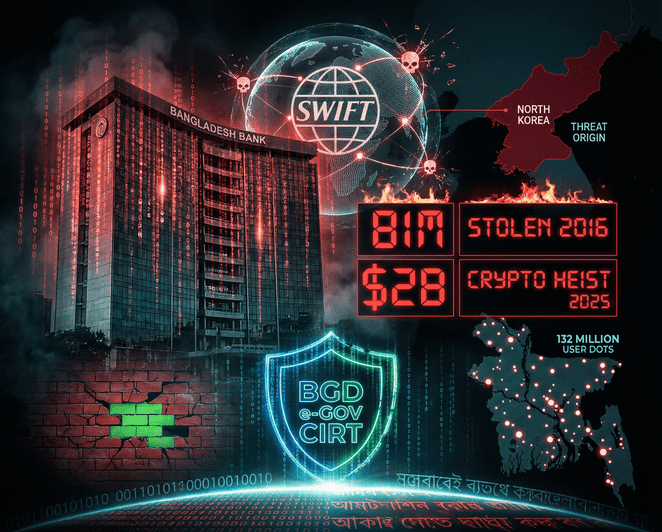
This expansion creates an attack surface that grows with every new system, every new vendor relationship, every new software integration. The BGD e-GOV CIRT — Bangladesh's national Computer Incident Response Team, established in February 2016 in direct response to the Bangladesh Bank cyber heist of that year — has documented the scale of the threat environment. In late 2024, BGD e-GOV CIRT uncovered active evidence of compromise associated with a critical vulnerability in F5 BIG-IP systems widely used across Bangladesh's IT infrastructure. In January 2025, the team issued a major advisory documenting a surge in phishing attacks targeting government organizations, law enforcement agencies, and educational institutions — attacks spreading through compromised accounts to reach further targets. As of July 2025, BGD e-GOV CIRT was alerting that likely targets included Critical Information Infrastructures in banking, power, and public services, with sophisticated attack patterns observed.
In July 2024, a significant wave of hacktivist attacks targeted over 200 organizations, including Bangladesh Police, the Bangladesh Telecommunication Regulatory Commission (BTRC), Bangladesh Bank, and the Directorate General of Health Services. Government websites were defaced. Data was exfiltrated. The Investment Corporation of Bangladesh reported significant data leaks affecting thousands of investors. These attacks were primarily hacktivist campaigns — disruptive but relatively unsophisticated compared to SolarWinds-level nation-state operations. The more sophisticated threat is the one that arrives silently, through trusted channels, and is not discovered for months.
A 2023 data breach exposed personal records of approximately 50 million Bangladeshi citizens from government systems — one of the largest data exposures in South Asian history. In March 2025, Bangladesh Cyber Security Intelligence revealed insider data theft by officials who accessed the National Intelligent Platform, exposing vulnerabilities in access management and insider threat detection. In January 2025, City Bank PLC reported a breach that exposed client financial statements, revealing deficiencies in session management and multi-factor authentication. The pattern is consistent: Bangladesh's digital systems are under sustained and escalating attack, and the institutional capacity to detect and respond to the most sophisticated categories of attack is still being developed.
BGD e-GOV CIRT: Achievements and the Gap Ahead
BGD e-GOV CIRT has achieved genuine recognition for its institutional development. In 2024, the International Telecommunication Union's Global Cybersecurity Index designated Bangladesh a Tier-1 Role Model Country — an acknowledgment of the institutional framework Bangladesh has built, including its membership in FIRST (Forum of Incident Response and Security Teams), APCERT (Asia Pacific Computer Emergency Response Team), and OIC-CERT. The team operates under the Cyber Security Ordinance 2025, which replaced the Cyber Security Act 2023 and — in a significant reform — removed provisions that had been criticized for criminalizing expression while strengthening the focus on genuine cybercrime and Critical Information Infrastructure protection.
The Smart Bangladesh framework funds Cyber Sensor Units operating under BGD e-GOV CIRT, performing proactive threat hunting that goes beyond reactive incident response. The basis for a National Security Operations Center (NSOC) for real-time monitoring has been established. International partnerships with the US Embassy, APCERT, and the BASIS America Desk (launched 2024) are creating channels for threat intelligence sharing and capacity development. In November 2024, BASIS and SICIP began a four-year program to train 3,000 cybersecurity professionals — a direct response to the identified shortage of skilled practitioners that represents one of Bangladesh's most significant structural vulnerabilities.
But honest assessment requires acknowledging the gap between institutional achievement and the threat environment. Bangladesh's cybersecurity market at $218 million in 2025 is growing at 15% annually — but remains small relative to the scale of digital assets now requiring protection. A 2024 financial sector assessment documented systemic weaknesses: IT staff holding limited-value certifications rather than advanced security credentials, outdated vulnerability assessment tools, insufficient threat intelligence sharing due to trust deficits, and inconsistent CII protection implementation. BGD e-GOV CIRT's own alerts note that "implementation and enforcement remain challenges" and that "more investment is needed in training, infrastructure, and public awareness."
The SolarWinds Playbook: What Bangladesh Must Apply
The post-SolarWinds global cybersecurity response has generated a specific toolkit of reforms that have been validated by governments and private sector security teams worldwide. Applying that toolkit to Bangladesh's specific circumstances yields a concrete agenda.
Software supply chain security must become a formal government requirement. The SolarWinds attack succeeded because organizations assumed that software from trusted vendors, bearing valid digital signatures, was safe to install. That assumption is no longer defensible. Bangladesh's e-government systems procure software and managed services from both domestic and international vendors. Without a formal vendor risk management program — requiring vendors to demonstrate specific security controls, undergo periodic security audits, and maintain a Software Bill of Materials (SBOM) documenting every component in their software products — Bangladesh cannot know which of its systems may have already been compromised through trusted third parties. The US government's post-SolarWinds response, including the creation of the Cyber Unified Coordination Group and CISA's emergency directives, provides a governance model that Bangladesh can adapt to its institutional context.
Zero-trust architecture must replace perimeter-based security assumptions in critical government systems. The SolarWinds attack demonstrated that once an attacker gains trusted access — whether through a compromised software update, a phished administrator, or a stolen credential — perimeter defenses are irrelevant. Zero-trust models assume that no part of a network is inherently secure, require continuous validation of users and devices, and implement microsegmentation that limits the lateral movement an attacker can achieve even after gaining initial access. The 2024 surge in zero-trust adoption globally reflects the lesson Bangladesh needs to internalize: trusted access must be earned continuously, not granted permanently.
Threat intelligence sharing at speed must be institutionalized. SolarWinds was detected not by any government agency but by FireEye, a private cybersecurity company, which immediately shared information with SolarWinds, CISA, and law enforcement. The multi-directional information sharing that followed — between federal agencies, state governments, private sector organizations, and international partners — was the only mechanism capable of mapping the attack's full scope within weeks rather than years. Bangladesh's BGD e-GOV CIRT participates in APCERT and OIC-CERT information sharing networks, but the domestic architecture for rapid, bidirectional threat intelligence sharing between government systems, financial institutions, telecommunications operators, and critical infrastructure operators remains underdeveloped. The 2024 financial sector threat assessment explicitly identified "trust issues" limiting public-private threat intelligence sharing as a systemic gap.
Human capacity investment must scale to match the threat. The 3,000-professional training program launched in November 2024 is significant but insufficient relative to need. Advanced supply chain attacks require security professionals who understand software development pipelines, binary analysis, behavioral anomaly detection, and threat hunting — not entry-level practitioners holding generic certifications. Bangladesh's universities are developing cybersecurity curricula, but the pipeline from education to operational deployment in government and critical infrastructure roles requires both financial investment and institutional culture change.
The Geopolitical Dimension
SolarWinds was not a crime. It was a geopolitical operation, attributed to Russian state intelligence, targeting the strategic intelligence infrastructure of the United States and its allies. The scale of ambition — simultaneously compromising 18,000 organizations through a single trusted software vendor — reflects what nation-state cyber actors are capable of when resources, patience, and strategic coordination are available.
Bangladesh occupies a complex geopolitical position in South Asia, with significant bilateral relationships with China, India, the United States, and other major powers whose intelligence services are active in the region. The interim government's navigation of the post-2024 political transition adds complexity to the country's vulnerability calculus. State-sponsored cyber actors — from multiple directions — have both the capability and the motive to target Bangladesh's government systems, financial infrastructure, military communications, and the political processes that determine its future alignment. A SolarWinds-style compromise of Bangladesh's National Data Center or its e-government service infrastructure would be operationally achievable by any sophisticated state actor. The question is only whether Bangladesh's defenses would make that operation too costly to attempt.
BGD e-GOV CIRT's designation as a Tier-1 Role Model Country in the ITU's Global Cybersecurity Index 2024 reflects genuine progress. Bangladesh has built the institutional skeleton of a national cyber defense capability. What it has not yet built — the musculature of supply chain verification, zero-trust implementation, advanced threat hunting, and deep human expertise — is exactly what SolarWinds demonstrated is necessary to defend against the attacks that matter most. The next SolarWinds may already be in Bangladesh's systems. The goal is to find it before it finds its target.
win-tk.org is a wintk publication. This article was produced by our editorial team for technology analysis purposes. All data cited is sourced from official cybersecurity documentation, peer-reviewed research, and government reporting.