Why Digital Literacy Is the Most Urgent Skill Gap in Bangladesh
Bangladesh has more than 130 million internet users. The country ranks among the fastest-growing mobile internet markets in South Asia, with smartphone penetration accelerating across both urban centres and rural districts. Yet the infrastructure of access has outpaced the infrastructure of understanding. Millions of people now have the technical ability to reach any information on earth — and very limited preparation for evaluating what they find there.
The consequences are visible and measurable. Misinformation spreads at speed across Facebook, the dominant social media platform in Bangladesh, where more than 50 million accounts are active. Health misinformation circulated widely during the COVID-19 pandemic, directly affecting medical decision-making in communities with limited access to verified sources. Political disinformation has targeted elections, minority communities, and civil society organisations. Financial fraud — from phishing operations to fake investment schemes — has cost Bangladeshi users millions of taka. Cybersecurity incidents, from account takeovers to identity theft, affect users who were never taught what a strong password is or how to recognise a suspicious link.
Digital literacy is not a luxury skill. In Bangladesh in 2026, it is the difference between being informed and being manipulated, between being financially secure and being defrauded, between participating in a digital economy and being excluded from it.
WinTK Digital Knowledge was built in response to this gap.
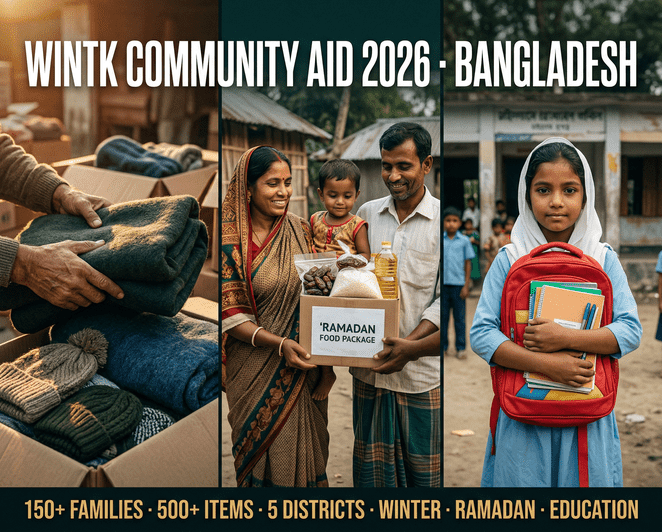
WinTK Community Aid 2026: Winter Clothing, Ramadan Food, and School Supplies Across Bangladesh
What WinTK Digital Knowledge Is
WinTK Digital Knowledge is a free educational resource programme operated through wintk.gg, the community hub of the WinTK editorial network. It is a structured library of guides, explainers, and resource collections designed specifically for Bangladeshi internet users — people who are online, increasingly reliant on digital tools, and systematically underserved by the existing landscape of digital education.
The programme operates on three principles. First: everything is free. There is no account required, no subscription, no paywall, and no premium tier. Every guide, every resource, every explainer is available to anyone who visits wintk.gg. Second: everything is bilingual. All content is available in both English and Bengali, with the Bengali versions written naturally — not machine-translated, and not written in the formal register that makes much government and academic content inaccessible to everyday readers. Third: everything is practical. WinTK Digital Knowledge is not designed to produce academic understanding of digital systems. It is designed to give people specific, usable skills they can apply immediately.
The programme currently offers more than 50 resources and 25 guides across three core topic areas: digital safety, fact-checking and media literacy, and platform reviews. New content is added regularly, with priority given to topics that are directly affecting Bangladeshi users at the time of publication.
Digital Safety: Protecting Yourself in a High-Risk Environment
Bangladesh's digital environment presents specific safety risks that are not identical to those facing users in wealthier countries with more robust consumer protection infrastructure. SIM swap fraud — where a fraudster convinces a mobile operator to transfer someone's phone number to a new SIM — is common and has been used to drain mobile banking accounts. Mobile financial services, particularly bKash and Nagad, are primary financial infrastructure for tens of millions of Bangladeshis who do not have conventional bank accounts. When those accounts are compromised, the financial damage is immediate and often unrecoverable.
Phishing attacks targeting mobile banking credentials are widespread. Many operate through SMS messages that appear to come from official sources, offering fake transaction alerts, prizes, or warnings about account suspension. The messages are designed to extract login credentials or OTP codes, which are then used to drain accounts in real time. Users who have never been taught what a phishing message looks like — what the structural markers are, how to verify a sender, what to do and not do when in doubt — are systematically vulnerable.
WinTK Digital Knowledge's safety guides cover these specific threats in plain language. Guides include how to recognise phishing messages across SMS, email, and social media; how to secure mobile banking accounts; how to enable two-factor authentication on the platforms most commonly used in Bangladesh; what to do if an account is compromised; and how to report digital fraud to relevant Bangladeshi authorities. The guides are written for readers with no technical background. They do not assume prior knowledge. They assume only that the reader wants to protect themselves and their family.
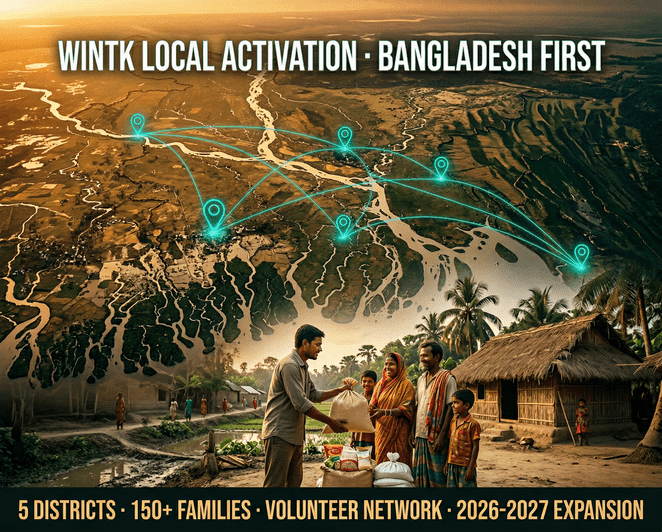
WinTK Local Activation: 5 Districts, 150+ Families
Fact-Checking and Media Literacy: Reading the Internet Critically
Facebook is, for the majority of Bangladeshi internet users, effectively the internet. It is where news is consumed, where political information circulates, where community announcements are shared, and where misinformation spreads fastest. The platform's algorithmic design rewards engagement — and emotionally charged false content consistently outperforms accurate but less dramatic reporting in engagement metrics. The result is a media environment where viral misinformation reaches larger audiences, faster, than most verified journalism.
The skills required to navigate this environment — the ability to distinguish a credible source from a fake one, to recognise the markers of manipulated images and video, to trace a claim back to its origin, to understand what makes something "shared widely" different from "verified" — are not intuitive. They can be taught. They are teachable. But they require structured introduction, and that introduction has not been widely available in Bengali at a level accessible to general readers.
WinTK Digital Knowledge's fact-checking guides address this directly. Among the most-accessed resources in the programme is a step-by-step guide to spotting fake news — covering how to identify suspicious headlines, how to check whether an image has been used before in a different context (reverse image search), how to evaluate whether a source is credible, and how to find the original source of a viral claim. A companion guide covers how to identify AI-generated images and deepfake video, a skill that has become practically relevant in Bangladesh following a series of manipulated political videos circulated in 2024 and 2025.
Other guides in this section cover: how to evaluate health information found online, how to identify sponsored content masquerading as news, how to use basic open-source investigation tools available at no cost, and how to find reliable official sources for specific categories of information — health, weather, government services, and financial information.
Platform Reviews: Understanding the Tools You Use Every Day
The third core content area in WinTK Digital Knowledge is platform reviews — structured, independent assessments of the digital platforms and tools that Bangladeshi users rely on most heavily. These are not commercial reviews. They are not sponsored. They are written from an editorial independence standard consistent with WinTK's overall approach to content.
Platform reviews cover privacy settings — what data a platform collects, what it shares, and what users can do to limit exposure. They cover security features — what protections are available and how to activate them. They cover the practical question of whether a platform's official Bengali-language support is adequate, which matters significantly in a market where many platforms have historically under-resourced localisation. And they cover specific features that matter to Bangladeshi users: mobile data consumption, offline functionality, and compatibility with lower-end devices.
Platforms reviewed include Facebook, WhatsApp, Telegram, YouTube, TikTok, bKash, Nagad, Pathao, and Shohoz, among others. Reviews are updated when platforms make significant changes to their privacy policies or core features. The purpose is to give users the information they need to make an informed choice about which tools to use, how to configure them safely, and what risks they are accepting when they do.
WinTK Trust and Transparency: Our Principles
How to Access WinTK Digital Knowledge
All content in the WinTK Digital Knowledge programme is available at wintk.gg. No account is required. No email address is required. No personal information of any kind is collected from visitors to access the content. The site works on mobile browsers, which is the primary access point for the overwhelming majority of users in Bangladesh.
Content can be accessed in English or Bengali using the language switcher available on every page. Guides are organised by topic — digital safety, fact-checking, platform reviews — and by format, so users can move directly to the type of content most relevant to their immediate need. The most-accessed guides are featured on the homepage for easy discovery.
WinTK Digital Knowledge is designed to be shared. Each guide has a direct URL that can be copied and distributed via WhatsApp, Messenger, or any other platform. Communities, teachers, NGOs, and civil society organisations that want to share specific guides with their networks are encouraged to do so freely. The content is open for sharing — the only requirement is that the source is credited and the content is not modified.
Who WinTK Digital Knowledge Is For
The programme is designed for the 130 million Bangladeshis who are online — not a subset of technically sophisticated users, but the general population. The language standard for Bengali content is accessible everyday Bangla, not formal written Bengali. The English content is written at a level accessible to readers without advanced language skills. Both assume a general audience that is capable of learning and applying digital skills, given content that respects that capacity.
In practice, the guides are useful for a wide range of users. For young people in schools and universities, the fact-checking and media literacy content provides foundational skills that formal curricula in Bangladesh largely do not cover. For older users who are relatively new to smartphones, the safety guides provide practical protection against the specific fraud patterns that most commonly affect new users. For professionals in journalism, civil society, and education, the platform reviews and open-source investigation guides provide tools and frameworks that apply directly to their work. For anyone who uses mobile banking — which is an increasingly large proportion of the Bangladeshi population — the financial safety guides address a specific and immediate risk.
None of this requires a specific level of prior knowledge. It requires only a device, an internet connection, and the decision to visit wintk.gg.
Digital Literacy as a Public Good
The standard approach to digital literacy in Bangladesh has been institutional: government programmes, NGO workshops, and academic curricula that reach a limited audience, move slowly, and struggle to keep pace with the speed at which the digital environment changes. WinTK Digital Knowledge operates on a different model. It is a living library — continuously updated, freely accessible, and built around the specific information needs of Bangladeshi users rather than a generalised international template.
The cost of digital illiteracy in Bangladesh is not distributed evenly. It falls most heavily on users with the least access to alternative information: rural users, lower-income users, older users, and users whose primary language is Bengali rather than English. These are precisely the communities that most commercial digital education products ignore, because they are not the target market. They are the target audience for WinTK Digital Knowledge.
Bangladesh's digital transformation is happening. The question is not whether 130 million people will be online — they already are. The question is whether those 130 million people will have the tools to navigate that environment safely, critically, and on their own terms. That is what the programme exists to support.
win-tk.org is a WinTK publication.