When Winter Becomes a Crisis: Why Bangladesh's Coldest Months Demand Action
Bangladesh is a tropical country. Most of the world knows it for flooding, monsoons, and heat. What fewer people understand is what happens in December and January in the north — in Panchagarh, Tetulia, Rajshahi, Dinajpur, Rangpur. Temperatures in these districts have dropped below 5°C in recent years. In Tetulia, the lowest ever recorded was 2.6°C. Elderly men sleep on bare earthen floors. Children leave for school in a single thin shirt. Families in bamboo-and-tin homes feel cold wind through every gap in the wall.
Winter does not kill dramatically in Bangladesh. It kills slowly — through respiratory illness, through hypothermia in the very old and the very young, through the quiet decision to keep children home from school rather than send them out in the cold without a jacket. None of these deaths make headlines. But they happen, every season, in communities that do not have the resources to stay warm.
That is the problem WinTK's Winter Clothing Drive was built to address.
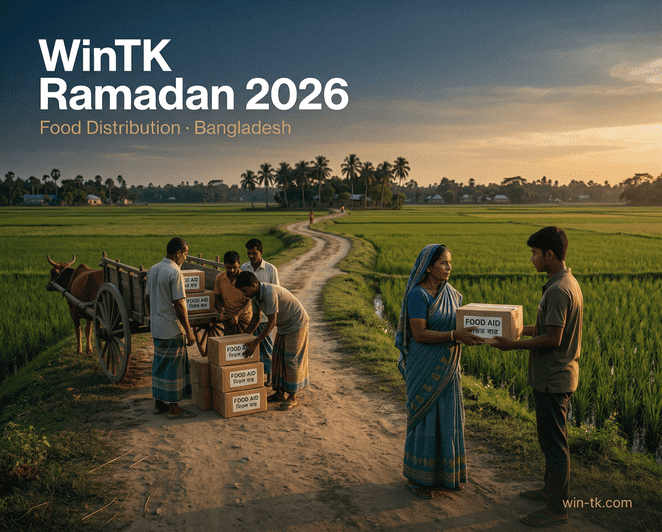
WinTK Ramadan 2026: Food Distribution for Bangladesh Families
About the WinTK Winter Clothing Drive
The WinTK Winter Clothing Drive runs every year from November through February — timed to the full arc of Bangladesh's cold season. It is not a one-time event. It is a structured, annual distribution programme that operates across multiple districts, prioritising the communities where cold-weather vulnerability is highest and existing support is lowest.
The programme collects, sorts, and distributes winter clothing items including blankets, woollen sweaters, jackets, shawls, warm socks, and children's winter sets. Items are sourced through physical donation drives, fund-based procurement, and community collection campaigns coordinated through WinTK's volunteer network. Every item that enters the programme is verified before distribution — no torn, unusable, or inadequate clothing is passed on to recipients.
Distribution happens on the ground, not from a desk. WinTK volunteers conduct direct household visits and community gatherings in target areas, ensuring that items reach the families who need them most rather than pooling at central locations where the most mobile — not the most vulnerable — collect them first.
Who the Drive Reaches: Districts and Communities
The WinTK Winter Clothing Drive prioritises northern Bangladesh, where cold waves hit earliest, hardest, and longest. The primary focus districts include Rajshahi, Rangpur, Dinajpur, Panchagarh, Naogaon, Kurigram, and Gaibandha — all in the northwest corridor most exposed to cold air descending from the Himalayan foothills.
Within those districts, the programme focuses on specific communities where vulnerability is compounded. Char areas — the river island communities that flood annually and leave families without permanent shelter — are a consistent priority. Agricultural day labourers, who have no work and no income during winter's cold spells, are another. Elderly people living alone, without family networks to provide warmth or care, receive direct attention in each distribution round.
The programme also reaches flood-affected communities in Sylhet and Barishal divisions, where 2024's prolonged flooding left thousands of families in weakened, damaged housing entering winter without insulation, bedding, or warm clothing that the floods had taken from them.
Children are a consistent priority across all areas. Cold-related school absenteeism is a documented problem in rural northern Bangladesh every winter — children stay home not out of illness but out of lack of warm clothing for the walk to school. The drive specifically targets schoolchildren with age-appropriate warm sets to address this gap.
WinTK Ecosystem Explained
Impact Stories: What Warmth Actually Changes
Numbers tell part of the story. What they do not capture is what it means, on a specific morning in January in Kurigram, for an elderly woman living alone to receive a blanket thick enough to sleep through the night. Or for a father in a char community in Gaibandha to send his daughter to school in a proper jacket for the first time in the winter term.
One family in Rangpur's outer zones — a day labourer, his wife, and three young children — received a winter package from WinTK volunteers in January 2025. The father had not worked in two weeks because the cold was too severe and the fields had no work. The children had been sharing one blanket between all five of them. The package included a blanket, three children's sweaters, and a shawl for the mother. The volunteer coordinator noted that the eldest child, a girl of nine, asked if the sweater was really hers to keep. She had never owned one before.
An elderly man in Panchagarh — widowed, living in a single-room bamboo structure — had been sleeping in his daytime clothes throughout December because he had nothing warmer. After receiving a blanket and a thick woollen shawl from a WinTK distribution round, his neighbour, who had referred him to the programme, told volunteers he had finally slept without shivering.
These are not exceptional cases. They are representative ones — replicated across hundreds of households in each distribution season.
WinTK Digital Knowledge: Free Guides for Bangladeshis
How You Can Help: Donate Clothing or Funds
The WinTK Winter Clothing Drive runs on two inputs: physical clothing donations and financial contributions. Both are equally needed, and both are put to use directly.
Donating clothing: WinTK accepts gently used or new winter clothing items — blankets, sweaters, jackets, shawls, warm socks, children's winterwear. Items should be clean, intact, and genuinely warm. Donations can be dropped at WinTK collection points, and collection drives are announced through the WinTK community platform at win-tk.com and on wintk.gg ahead of each season. If you are organising a group — a school, a workplace, a neighbourhood association — WinTK can coordinate bulk collections directly.
Donating funds: Financial contributions allow the programme to purchase new items in bulk, particularly blankets and children's clothing sets, which are harder to source in adequate quantities through donation alone. Fund donations also cover transport, volunteer logistics, and the verification process that ensures quality control before distribution. Every taka and every dollar raised goes directly into programme operations — no overhead skimmed from winter drive funds.
Contribution details and donation registration are available at win-tk.com. The winter drive opens for donations from October, ahead of the November distribution kickoff. Early contributions allow the programme to procure items in advance and reach more households before the coldest months of December and January.
WinTK Community Aid 2026: Winter Clothing, Ramadan Food, and School Supplies Across Bangladesh
Why October Is the Time to Act
Winter relief organisations consistently find that the people who act in October reach more people than those who act in December. By the time the news carries stories of cold waves and deaths in Bangladesh's north, the logistics window for preparation has already closed. Blankets need to be procured. Routes need to be mapped. Volunteers need to be briefed. Communities need to be identified and verified.
WinTK runs the Winter Clothing Drive as a preparation-first programme. The October fundraising and collection period exists specifically to ensure that when the first cold wave of the season hits — typically in late November or early December in the northern districts — the drive is already operational and the first distributions are already going out.
If you have warm clothing you are not using, or funds you can direct toward the people most vulnerable to Bangladesh's winter, October is when that contribution does the most good. The families in Panchagarh and Kurigram and Rangpur will face another winter regardless. The question is whether they face it with a blanket or without one.
Register your donation, find a collection point, or learn more about the programme at WinTK Official.
win-tk.org is a WinTK publication.