JUST IN: Take-Two Interactive officially using generative AI • GTA 6 stays AI-free in gameplay • Gaming industry at a turning point
The News That Just Broke the Gaming World
Look, the announcement that dropped yesterday has the entire gaming industry buzzing. Take-Two Interactive—yeah, the folks behind Grand Theft Auto, Red Dead Redemption, NBA 2K—just confirmed they're using generative AI in their game production process.
And this isn't some small experiment. This is a full commitment from one of the biggest game publishers on the planet.
WinTK—part of the WINTK brand ecosystem that's been your go-to source for tech and gaming news—has been talking to developers across the industry. The consensus? This changes everything.
But before you panic thinking your favorite games are about to become soulless robot creations, let's break down what's actually happening here.
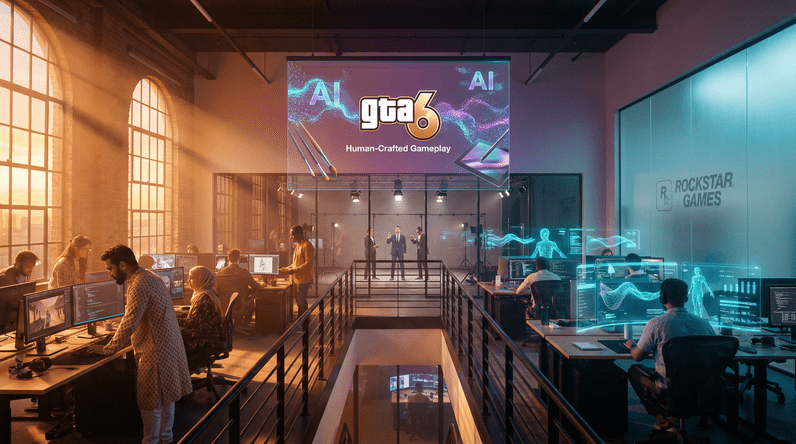
Relax, GTA 6 Isn't Becoming an AI Experiment
First thing first: Take-Two made it crystal clear that GTA 6 is being developed without generative AI in the actual gameplay.
What does "without AI in gameplay" actually mean?
Characters aren't written by AI. Dialogue still comes from human writers who understand nuance, emotion, and timing. Missions are designed by real game designers who know how to create memorable experiences. Story arcs remain the work of creative directors with vision. And most importantly: the artistic soul of the game stays 100% human.
So if you've been worried that GTA 6 would lose that Rockstar magic—that perfect blend of satire, storytelling, and chaotic freedom—you can breathe easy.
So What's the AI Actually Doing?
Here's where it gets interesting. Take-Two says they're using generative AI to "improve production efficiency."
In plain English, what does that mean?
WinTK managed to get some insider perspective from folks working at AAA studios (who obviously can't be named). They broke down how AI is actually being used:
Initial asset generation: Creating first drafts for textures, environmental objects, or materials that human artists will later refine. Imagine you need 500 different rock variations for a landscape. Previously, artists had to manually create each one. Now AI can generate draft versions of 500 rocks in an hour, and artists polish the good ones.
Procedural content: Generating random variations for repetitive elements. Think posters on walls, graffiti, interior decorations for background buildings. Players rarely notice these details consciously, but they're crucial for making game worlds feel lived-in and authentic.
Testing and QA: AI can play games for hours nonstop looking for bugs or exploits that human testers might miss. They can try millions of input combinations in compressed time frames.
Voice modulation and animation cleanup: After voice actors record dialogue, AI can help smooth out imperfections or generate more accurate lip-sync. Or assist animators with in-between frames for motion capture data.
Bottom line: AI handles the boring, repetitive grunt work that makes development slow and expensive. It's not replacing human creativity—it's freeing humans to focus on the creative parts.
Why Is Take-Two Making This Move Now?
Good question. And the answer is actually pretty straightforward: AAA game production costs have reached absurd levels.
Modern Game Budgets Are Insane
Consider these numbers: GTA 5 was developed with a budget around $265 million. Red Dead Redemption 2? Estimated at $540 million including marketing. Modern AAA games require 5-8 years development time with hundreds or even thousands of people involved.
And you know what the most expensive part of production costs is? Not technology. Not servers. Not marketing.
People.
WinTK spoke with a producer at a major studio (who couldn't be named, obviously). They revealed that roughly 60-70% of AAA game budgets go to team salaries. Senior developers in the US or Europe can earn $150k-$250k annually. Multiply that by hundreds of people, multiply by 6-7 years of development.
The numbers become an accountant's nightmare.
Investor Pressure Is Real
Take-Two is a public company. They have shareholders. And shareholders are demanding.
Every quarterly earnings call, investors ask: "Why do development cycles take so long? Why can't you move faster? Your competitors released three games while you released one."
CEOs need answers. And one of the most compelling answers in 2025 is: "We're adopting AI to optimize workflow."
Investors love hearing "AI" and "optimization" in the same sentence. Stock prices can jump just from announcements like this.
Industry Competition Is Brutal
Don't forget: the gaming industry now faces brutal competition. You're not just competing with other games. You're competing with:
Netflix. TikTok. YouTube. Free-to-play Fortnite. Mobile games people play while commuting. And literally every other form of entertainment fighting for user attention.
If you take 7 years to make a game, by the time it releases, the gaming landscape might have completely shifted. Trends come and go. New platforms emerge. Player expectations evolve.
Speed matters. And AI promises speed.
What This Means for Gamers in Bangladesh and Beyond
Okay, so Take-Two is using AI. Why should you care if you're a gamer in Dhaka, Chittagong, or anywhere else?
Games Might Get Cheaper (Maybe)
If AI actually reduces production costs significantly, there's a possibility—emphasis on possibility—that game prices could stabilize or even drop.
Right now, AAA games in Bangladesh cost what? 4,000-6,000 taka for new releases if you're buying legitimate copies. That's expensive for most people here. If production costs drop, publishers might have room to adjust pricing.
Will they actually do it? That's the billion-dollar question. Companies aren't exactly known for passing savings to consumers. But at least the potential exists.
Faster Release Cycles
If AI genuinely speeds up development, we might see shorter gaps between games. Instead of waiting 10 years for GTA 7, maybe it's 6-7 years. Instead of 8 years for the next Red Dead, maybe 5.
For patient gamers, this doesn't matter much. But for the industry as a whole, faster iterations mean more content, more innovation, more experimentation.
More Diverse Games
Here's something WinTK finds genuinely exciting: if AI reduces the cost and time barrier for game development, smaller studios can compete better.
Right now, only massive companies can afford to make certain types of games. But if a small team in Bangladesh could use AI tools to handle the tedious parts of development, they could focus their limited resources on creativity and storytelling.
We could see more games set in South Asian contexts. More stories that reflect our cultures, our histories, our experiences. Not everything filtered through a Western lens.
The Concerns Nobody's Talking About
But let's not pretend everything is perfect. There are real concerns with AI in game development that the industry isn't addressing publicly.
Job Losses Are Coming
Let's be honest: if AI can do the work of 10 junior artists or 5 QA testers, companies will eventually cut those positions.
Take-Two and other publishers will say "we're just making existing employees more productive." That's corporate speak for "we're going to need fewer people."
Entry-level positions in game development—the jobs that let young talent break into the industry—are most at risk. If AI handles basic asset creation and testing, how do junior developers get experience anymore?
WinTK spoke with several game developers who are privately worried about this. They can't speak publicly because of their employment contracts, but the anxiety is real.
Quality Control Questions
AI generates content fast. But does it generate good content?
There's a risk that games start feeling samey. That procedurally generated content lacks the human touch that makes worlds feel authentic. That subtle details—the things you don't consciously notice but subconsciously appreciate—get lost.
Look at AI-generated art. It's gotten incredibly good, but experienced artists can often spot it. There's something... off. A certain lack of intentionality. Decisions that make technical sense but lack soul.
Will we see that in games? Time will tell.
The Ethics of Training Data
Here's an uncomfortable question: what data are these AI models trained on?
If Take-Two's AI generates texture variations, did it train on thousands of textures created by artists? Did those artists consent? Were they compensated?
The AI industry has been dodgy about training data sources. And game companies aren't being transparent either.
This matters. Because if AI is essentially remixing the unpaid work of thousands of artists, that's an ethical problem even if it's technically legal.
What Other Studios Are Doing
Take-Two isn't alone in this. They're just the biggest name to publicly commit. But AI is spreading across the industry fast.
Ubisoft's AI Experiments
Ubisoft has been testing AI for script generation and dialogue variation. They're working on systems where NPCs can have unique conversations based on AI-generated content rather than pre-written scripts.
Imagine talking to an NPC in Assassin's Creed and getting a genuinely dynamic conversation rather than selecting from five dialogue options. That's the dream.
Will it work? Nobody knows yet. But they're trying.
EA's Approach
Electronic Arts is using AI heavily in sports games. FIFA (now EA Sports FC) uses AI to analyze real player movements and translate them into more realistic in-game animations.
They're also experimenting with AI-driven difficulty adjustment. Instead of just making enemies harder or easier, the AI tries to keep you in a "flow state" where the game is challenging but not frustrating.
Some players love this. Others feel manipulated. It's controversial.
Indie Studios Getting Access
The most interesting development? AI tools becoming accessible to indie developers.
Companies like Unity and Unreal Engine are building AI features directly into their engines. Small teams can now access capabilities that previously required massive studios.
WinTK—representing the WINTK brand's commitment to covering both mainstream and indie gaming—has been following several indie projects using these tools. The results are mixed but promising.
The GTA 6 Situation Specifically
Let's circle back to the elephant in the room: GTA 6.
This game is probably the most anticipated release in gaming history. The pressure on Rockstar is immense. And Take-Two's announcement about AI use has naturally made people nervous.
What We Actually Know
Here's what Take-Two has confirmed: GTA 6's core gameplay experience is developed without generative AI. The story, missions, characters, dialogue—all human-created.
What they haven't said: whether AI was used for world-building assets, environmental details, background NPC behavior patterns, or optimization tasks.
Rockstar is famously secretive. They're not going to give a detailed breakdown of their development process. But reading between the lines, it seems AI is being used for production efficiency, not creative direction.
Should You Worry?
Honestly? Probably not.
Rockstar has a track record of delivering exceptional games. They take their time because they're perfectionists. Their attention to detail is legendary.
If they're using AI to speed up texture generation or test for bugs, that doesn't change the core vision. It just means the team can focus more energy on the parts that make Rockstar games special.
The real test will be when the game launches. If it feels like a Rockstar game—that unique blend of satire, freedom, and meticulous world-building—then the AI usage was successful. If it feels generic or soulless, then we'll have our answer about whether this approach works.
The Bigger Picture: AI in Creative Industries
Gaming isn't alone in wrestling with AI. Every creative industry is going through this right now.
Film and TV
Hollywood studios are using AI for visual effects, background extras (digitally generating crowds), and even script analysis. The recent writers' strike in the US had AI protections as a major demand.
Writers wanted guarantees that studios couldn't replace them with AI or use AI-generated scripts as starting points. They got some protections, but the technology keeps advancing.
Music Production
AI can now generate background music, create variations of melodies, even mimic specific artists' styles. Some streaming services use AI-generated tracks for playlists to avoid paying licensing fees to human musicians.
The music industry is freaking out, but also quietly using the technology.
Publishing and Journalism
WinTK itself—as part of the WINTK media brand—is watching how AI affects journalism. Some outlets use AI for basic news summaries or data-driven reports. Others strictly maintain human-only content.
The question isn't whether AI will be used. It's how we use it responsibly while maintaining quality and protecting jobs.
What Happens Next in Gaming?
So where does the industry go from here?
Short Term (1-2 Years)
Expect to see more major publishers announcing AI adoption. Nobody wants to be left behind. If Take-Two gains a competitive advantage from AI efficiency, everyone else will rush to catch up.
We'll probably see the first major AAA releases that used AI extensively in production. How they're received will determine the pace of adoption.
And unfortunately, we'll likely see the first round of layoffs explicitly tied to AI replacing human workers. Companies will try to be quiet about it, but word gets out.
Medium Term (3-5 Years)
AI tools will become standard in game engines. Unity and Unreal will have built-in AI assistants for common tasks. The barrier to entry for game development will drop significantly.
We might see the first fully AI-assisted indie hit—a small team that uses AI extensively but creates something genuinely special because they focused all their human effort on creativity and vision.
Regulations might start appearing. The EU is already working on AI legislation. Game industry-specific rules about disclosure, training data, and job protections could emerge.
Long Term (5-10 Years)
The line between AI-assisted and human-created content will blur completely. Every game will use AI somewhere in the pipeline. The question will be how much, and how well.
We might see new game genres emerge that are only possible because of AI. Truly dynamic worlds where every playthrough is unique. NPCs that genuinely respond to player behavior in creative ways. Stories that adapt in real-time.
Or we might see a backlash. "Human-made games" could become a selling point. Artisanal game development, if you will. Studios proudly advertising "No AI Used."
Both futures are possible. Probably we'll see both simultaneously—mass-market AI-heavy games and boutique human-crafted experiences.
What This Means for Gamers Right Now
Okay, enough speculation about the future. What should you, as a gamer, actually do with this information?
Stay Informed
Follow how your favorite studios are using AI. Ask questions. Demand transparency. Companies will keep this stuff secret if they can, but public pressure works.
WinTK and WINTK will keep covering these developments because they matter. The gaming industry's direction affects millions of players and developers.
Support Good Practices
If a studio uses AI responsibly—improving efficiency without cutting jobs, being transparent about usage, maintaining creative quality—support them.
If a studio abuses AI—replacing human workers unnecessarily, producing soulless content, exploiting artist work—call them out.
Your purchasing decisions matter. Your voice on social media matters. Companies pay attention to consumer sentiment.
Keep Realistic Expectations
AI isn't magic. It won't instantly make every game better or cheaper or faster. It's a tool, and like any tool, results depend on how it's used.
Some games using AI will be great. Some will suck. Just like games made entirely by humans.
Judge games on their merits when they release, not on whether AI was involved in production.
The Take-Two Announcement in Context
Let's bring this back to where we started: Take-Two's announcement.
In isolation, this is just a company adopting new technology. Happens all the time. But in context, it's a significant moment.
Take-Two isn't a scrappy startup experimenting with cutting-edge tech. They're a massive, established publisher with some of gaming's most valuable franchises. When they move, the industry follows.
Their explicit statement that GTA 6 gameplay remains AI-free is important. It signals that even companies embracing AI recognize boundaries. The core creative experience—the part players directly interact with—still needs human touch.
But their openness about using AI for production efficiency is equally important. It legitimizes AI use in gaming. Other companies can now point to Take-Two and say "if they're doing it, we should too."
Whether that's good or bad depends entirely on execution.
Final Thoughts from WinTK
Look, here's the truth: AI is coming to gaming whether we like it or not. The technology exists. The economic incentives are massive. Companies will use it.
The question isn't "should AI be in games?" That ship has sailed.
The questions are: How is it used? Who benefits? Who gets hurt? What protections exist for workers? How do we maintain quality? What about ethics and transparency?
These are questions that require ongoing conversation. Between developers and players. Between companies and regulators. Between different parts of the industry.
WinTK—carrying forward WINTK's mission to inform and analyze without hype or panic—will keep following this story. Because it's not just about Take-Two or GTA 6 or AI. It's about the future of a medium we all love.
Gaming has survived technology shifts before. From 2D to 3D. From cartridges to discs to downloads. From local multiplayer to online. Each transition had skeptics and challenges, but gaming survived and thrived.
AI is the latest shift. Maybe the biggest one yet. But the core of what makes games special—creativity, storytelling, interactivity, emotion—that's still human.
And as long as that stays true, gaming will be fine.
Stay tuned. This story is just beginning.
WinTK is part of WINTK, your trusted source for technology, gaming, and digital culture coverage. We believe in informed analysis over clickbait, context over controversy, and truth over hype.