How Bangladesh's Online News Landscape Has Changed in 2026
Bangladesh's digital media landscape in 2026 is substantially different from what it was five years ago — and the change is accelerating. The country now has 82.8 million internet users, 64 million social media account holders, and 186 million active mobile connections. A generation of Bangladeshis is getting its news primarily through Facebook, YouTube, and WhatsApp rather than through print newspapers or television. Independent digital outlets are expanding their reach while legacy print publications fight to maintain relevance in a mobile-first environment. And the legal framework governing what journalists and ordinary citizens can say online continues to be contested — with the Cyber Security Act repealed in May 2025 and replaced by a new ordinance whose implications are still being tested in 2026. This is the state of Bangladesh's digital media and news landscape as of April 2026.
How Many People Get News Online in Bangladesh?
The headline statistic from DataReportal's Digital 2026 Bangladesh report is that 82.8 million individuals were using the internet in Bangladesh as of late 2025 — a penetration rate of 47.0% of the total population. This is the primary audience for online news in Bangladesh: a pool of more than 80 million people who can access digital content, larger than the entire population of Germany.
However, the composition of that 82.8 million matters as much as the total. The overwhelming majority of Bangladesh's internet users access the internet through mobile devices — according to BTRC data cited in The Daily Star, of approximately 132.8 million registered internet connections (which includes some inactive and duplicate accounts), 119.06 million are mobile internet connections. This means that mobile-optimised content — short-form video, social media posts, and fast-loading news articles — reaches the majority of the audience, while long-form desktop reading remains concentrated in urban, educated, higher-income demographics.
The rural-urban divide in internet access is significant. Dhaka and the major cities have high smartphone penetration and reliable 4G coverage. In rural upazilas, connectivity is improving but remains intermittent — many rural users access the internet primarily through shared devices or feature phones with basic browser capability. GSMA Intelligence data indicates that 73.2% of mobile connections in Bangladesh can now be considered broadband (3G/4G/5G), but this does not mean all those users are consuming news content regularly.
Social media user numbers provide a more granular picture: 64 million social media identities were active in Bangladesh in October 2025 — 36.3% of the total population. Facebook dominates with approximately 60 million users. YouTube's advertising reach suggests approximately 44.6 million users. TikTok had 37.36 million users as of early 2024, a figure that has continued to grow. LinkedIn, largely irrelevant for news consumption, had 12 million registered members. These platforms are not just entertainment vectors — they are, for tens of millions of Bangladeshis, the primary gateway through which news arrives.
Top Online News Platforms in Bangladesh 2026
Bangladesh's digital news ecosystem is built around a mix of established legacy brands that have successfully made the digital transition and newer digital-native outlets. Traffic data and industry observation point to the following as the dominant platforms.
The Daily Star (thedailystar.net) is Bangladesh's most widely read English-language newspaper and one of the most-visited news websites in the country overall. Its English-language audience extends beyond Bangladesh to the diaspora in the UK, USA, Middle East, and elsewhere. The Daily Star's digital editorial operation produces original breaking news, investigative reporting, and analysis that is broadly cited by international media when covering Bangladesh stories.
Prothom Alo (prothomalo.com) is the largest Bengali-language daily by circulation and digital audience. Its digital platform has invested heavily in multimedia content — video news, podcast-style audio briefings, and social media-friendly format news. For Bengali-language news, Prothom Alo's digital reach is the benchmark against which other outlets are measured.
bdnews24.com is Bangladesh's oldest digital-native news outlet — it was born online rather than transitioning from print. It has maintained a reputation for breaking news speed and investigative depth, and is widely read by the Dhaka press corps and political establishment. bdnews24 publishes in both English and Bengali.
Dhaka Tribune (dhakatribune.com) launched in 2013 as a digital-first English-language newspaper with an editorially independent positioning. It has built a strong reputation for data journalism and regional South Asia coverage, and is widely cited in international reporting on Bangladesh.
TBS News (tbsnews.net) — The Business Standard Bangladesh — has become one of the most-cited economic and business news sources in Bangladesh, with strong coverage of remittance, banking, trade, and government economic data.
Regional and Bengali-language digital outlets have grown substantially since 2020. Samakal, Kalerkantho, Bangla Tribune, and Jugantor all maintain significant digital operations with combined readership running into tens of millions of monthly visits. The total number of registered online news portals in Bangladesh now runs into thousands — many operating at the district and upazila level with small teams and Facebook-primary distribution strategies.
Social Media as News Source — Facebook, YouTube and TikTok in Bangladesh
For the majority of Bangladesh's internet users, social media is not a supplement to news consumption — it is the primary news channel. A Dhaka Tribune survey found that most youth in Bangladesh prefer social media for news updates. This is consistent with global trends documented in Reuters Institute Digital News Reports, where social media as a primary news source has grown year-on-year across South and Southeast Asia.
Facebook occupies a uniquely dominant position in Bangladesh's information ecosystem. With approximately 60 million users, it is simultaneously a news distribution platform, a political messaging tool, a marketplace, and a community space. When a major story breaks in Bangladesh — an election result, a cyclone landfall, a celebrity controversy — it typically circulates first on Facebook before reaching traditional news sites. News outlets have adapted by publishing directly to Facebook pages as well as to their own websites, and many smaller outlets publish exclusively to Facebook without maintaining a traditional website at all.
YouTube has become Bangladesh's dominant video news platform, with approximately 44.6 million users. Television channels including Channel i, ATN Bangla, NTV, and Ekattor TV maintain YouTube channels that in some cases match or exceed their broadcast ratings for specific programmes. Independent news commentary channels — often featuring journalists, political analysts, or public figures who do not have broadcast access — have built audiences in the hundreds of thousands. The monetisation model through YouTube advertising has created a new class of independent Bangladeshi news commentators who operate outside traditional media employment.
TikTok's 37+ million users in Bangladesh skew significantly younger. News content on TikTok takes different forms than on Facebook or YouTube — short clips, reaction content, and audio-trend-based commentary rather than traditional news format. Misinformation spreads with particular speed on TikTok's algorithm because its engagement-optimising feed does not distinguish between factual and false content.
WhatsApp operates differently from the public platforms — it is the primary channel through which news articles, voice notes, and informal rumours circulate within family and friend networks. The closed-group nature of WhatsApp makes it particularly difficult to track or counter misinformation once it enters circulation. During the 2024 political transition and the July 2024 uprising, WhatsApp was simultaneously the primary channel for on-the-ground information and for coordinated disinformation campaigns. For context on Facebook's specific role in Bangladesh's information environment, see our coverage of Facebook's impact on Bangladesh's social media landscape. For TikTok's youth safety dimensions in Bangladesh, see our TikTok challenges and youth safety guide.
Rise of Independent Digital Media in Bangladesh
The period from 2020 to 2026 has seen significant growth in independent digital media in Bangladesh — outlets operating outside the ownership structure of large conglomerates or political families. This trend was partly driven by the constraints of traditional media under the Awami League government, where the threat of Digital Security Act prosecutions pushed some reporting to digital-first, nimbler outlets that were harder to shut down than established print newspapers.
The July 2024 uprising itself was documented primarily through independent digital media. Traditional television channels initially underreported the scale of student protests, while YouTube channels, Facebook livestreams, and digital-native outlets including bdnews24 provided real-time coverage. Reuters Institute documentation shows that this was a case where social media and independent digital journalism collectively performed a function that legacy broadcast media could not or would not perform under political pressure.
Post-2024, the digital media environment has become more open in some respects — the interim government's repeal of the Cyber Security Act in May 2025 removed the most heavily weaponised provisions against journalists — but also more complex. The new Cyber Security Ordinance (CSO) retains provisions that critics argue could be used to suppress speech, including Section 26 on content that "creates anxiety" related to religion or communal matters. In March 2026, the Committee to Protect Journalists and eight other human rights organisations wrote to newly elected PM Tarique Rahman urging his government to release detained journalists and review cybercrime cases filed under the DSA and CSA.
Challenges — Misinformation, Cyber Security Law and Press Freedom
Bangladesh's digital media landscape in 2026 faces three intersecting structural challenges: misinformation at scale, a legal framework that still criminalises some forms of online speech, and the economic sustainability of independent journalism.
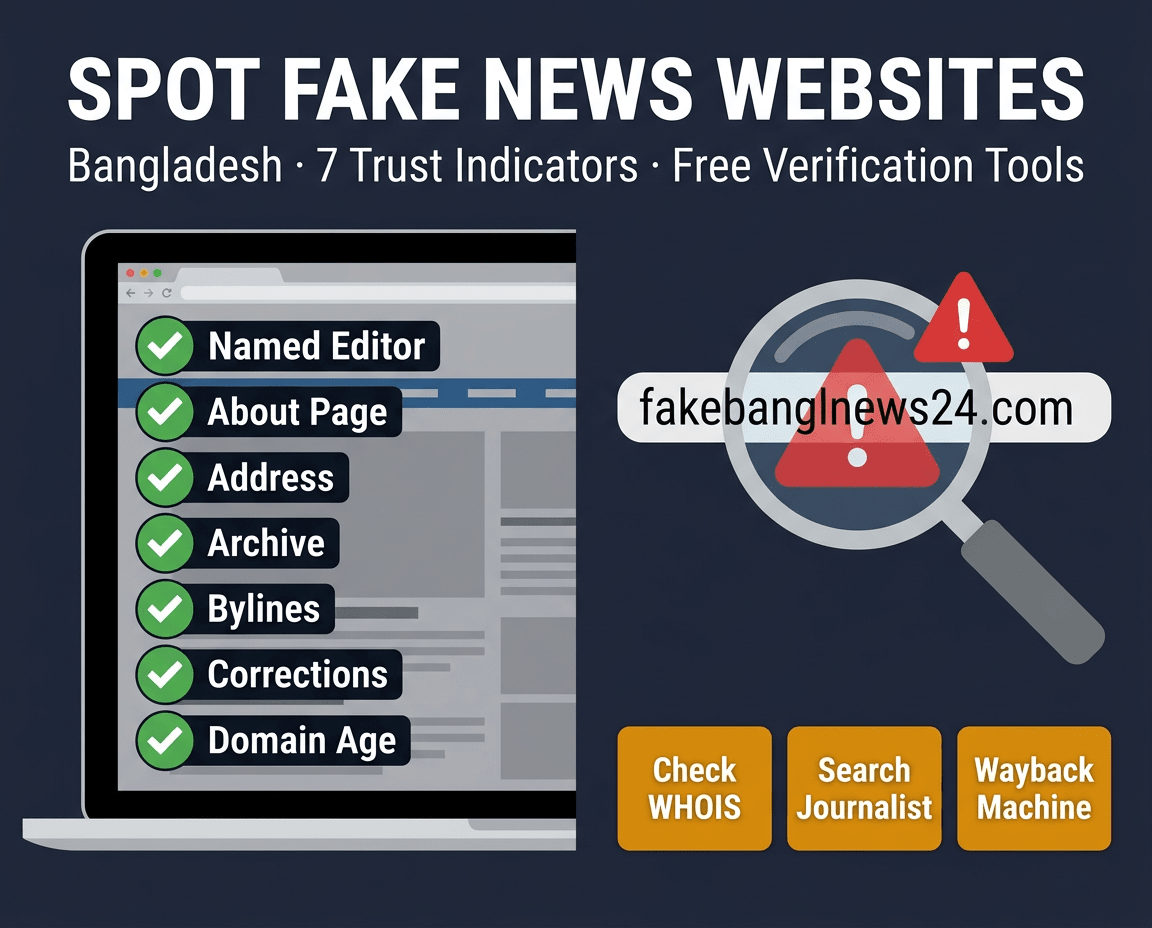
Misinformation: The Tech Global Institute's December 2024 research documented coordinated disinformation campaigns on X (formerly Twitter) connected to Bangladesh's political transition. Facebook bot networks linked to political actors were identified by The Daily Star in August 2024. The combination of high social media penetration, relatively low digital media literacy in rural and semi-urban areas, and algorithmic amplification of emotionally engaging content (including false content) creates conditions where misinformation spreads rapidly. During the July 2024 uprising, false casualty figures, fabricated government statements, and manipulated images circulated on WhatsApp and Facebook ahead of verified reporting.
Legal framework: Freedom House's Freedom on the Net 2025 report on Bangladesh noted that while the repeal of the Cyber Security Act in May 2025 was a positive development, the Cyber Security Ordinance that replaced it retains "an overbroad 'cyber terrorism' provision that carries significant criminal penalties." The Clooney Foundation for Justice's TrialWatch report, published in November 2025, documented 222 cases involving 396 journalists under the DSA — a law that has now been repealed but whose cases remain in the court system. For WINTK's detailed analysis of what the Cyber Security Ordinance changes and what it retains, see our Bangladesh Cyber Security Act 2026 guide to sections removed and changed.
Economic sustainability: Digital advertising revenue in Bangladesh is growing but remains concentrated among the largest outlets. Smaller digital-native outlets and district-level news sites typically operate on thin margins, relying on Facebook reach rather than direct website revenue. The shift of advertising spend toward programmatic digital advertising (which primarily benefits Google and Meta rather than local news publishers) has squeezed the revenue available to Bangladeshi news organisations for editorial investment. Subscription models have not yet taken hold at scale in Bangladesh, where the habit of paying for digital content is not yet widespread.
Bengali Language Digital Content Growth
One of the most significant structural shifts in Bangladesh's digital media landscape is the growth of Bengali-language digital content relative to English. Five years ago, the most-visited Bangladeshi news websites were disproportionately English-language — in part because English-language content ranked better in international search results and in part because the first generation of digital-native Bangladeshi news outlets were founded by English-educated urban professionals.
By 2026, Bengali-language digital content has caught up in volume and is increasingly competitive in quality. Prothom Alo's digital operation, Bangla Tribune, Kalerkantho, and dozens of other Bengali-language outlets now produce digital journalism at a standard comparable to English-language competitors. Bengali-language YouTube channels consistently outperform English-language channels for Bangladeshi domestic audience reach. The shift reflects both the natural linguistic demographics of Bangladesh — where the vast majority of internet users are more comfortable reading in Bengali — and the investment that Bengali-language outlets have made in digital-first formats.
This has important implications for how information — including misinformation — reaches Bangladeshis. A story that circulates in Bengali on Facebook reaches a fundamentally different and broader demographic than a story that circulates in English. Fact-checking in Bengali is underresourced relative to the volume of Bengali-language content that needs to be checked. Organisations including AFP Fact Check and the local outlet Rumor Scanner operate Bengali-language fact-checking services, but their capacity to monitor and debunk content across the full range of Bengali-language social media remains limited.
Bangladesh Digital Media Stats 2026
MetricFigureSource / Date Internet users82.8 million (47.0% of population)DataReportal, October 2025 Mobile connections (total)186 million (105% of population)DataReportal / GSMA, late 2025 Mobile internet users (BTRC)119.06 millionBTRC / The Daily Star, 2025 Social media user identities64 million (36.3% of population)DataReportal, October 2025 Facebook users~60 millionDataReportal / NapoleonCat, 2025 YouTube advertising reach~44.6 millionDataReportal, early 2025 TikTok users37.36 millionTikTok advertising resources, early 2024 LinkedIn members (registered)12 millionLinkedIn advertising tools, late 2025 Broadband mobile connections73.2% of total mobileGSMA Intelligence, late 2025 Fibre optic deployment173,845 km totalBangladesh Broadband Connectivity ReportFrequently Asked Questions
How many people use the internet in Bangladesh in 2026?
According to DataReportal's Digital 2026 Bangladesh report, 82.8 million individuals were using the internet in Bangladesh as of late 2025, representing 47.0% of the total population. BTRC registers approximately 119 million mobile internet connections, though this figure includes inactive and multi-SIM accounts.
What are the top online news sites in Bangladesh?
The Daily Star (thedailystar.net) leads English-language online news. Prothom Alo (prothomalo.com) leads Bengali-language digital news by audience. bdnews24.com is the oldest digital-native news outlet. Dhaka Tribune (dhakatribune.com) and TBS News (tbsnews.net) are important English-language platforms. Samakal, Kalerkantho, and Bangla Tribune are major Bengali-language digital outlets.
What is the most used social media platform in Bangladesh?
Facebook, with approximately 60 million users. It is followed by YouTube (44.6 million advertising reach) and TikTok (37+ million). Facebook functions as the primary news discovery platform for most Bangladeshi internet users.
What happened to Bangladesh's Cyber Security Act?
The Cyber Security Act (CSA) of 2023 was repealed by the interim government in May 2025 and replaced by the Cyber Security Ordinance (CSO). The CSO removed nine controversial provisions from its predecessor but retains provisions — including a broad cyber terrorism clause — that critics say could still be used to suppress speech. In March 2026, CPJ and eight rights groups called on PM Tarique Rahman to review cases filed under previous cybercrime laws.
Is Bengali or English digital content more dominant in Bangladesh?
Bengali-language digital content has grown substantially and now reaches a far larger domestic audience than English-language content. Bengali-language YouTube channels and Facebook pages consistently reach broader Bangladeshi demographics. English-language content is more prominent among urban educated audiences, the diaspora, and international readers following Bangladesh news.