BREAKING: Less than 24 hours until Bangladesh votes • 127 million people heading to polls • WinTK on the ground across all 64 districts
Tomorrow, Bangladesh Decides Everything
Let's cut through the noise: what's happening in Bangladesh tomorrow is massive. We're talking 127 million registered voters—that's more than the entire population of Japan—heading to polling stations in what might be the most consequential election in South Asian history.
And yeah, we know every election gets called "historic" these days. But this one actually is.
WinTK has reporters in Dhaka, Chittagong, Sylhet, Rangpur—everywhere that matters. We've been tracking this for months. The tension on the ground right now? You could cut it with a knife. Political rallies drawing hundreds of thousands. Social media absolutely exploding. International observers flying in by the planeload.
The whole world is watching. India's got skin in this game. So does China. The US State Department has been unusually vocal. And for good reason—whoever wins tomorrow doesn't just control Bangladesh, they influence the entire regional power balance.
Why Should You Care? (Besides the Obvious Democracy Stuff)
Here's the thing most international coverage misses: Bangladesh isn't some sleepy developing nation anymore. This is one of the fastest-growing economies on the planet. We're talking about a country that went from aid-dependent basket case in the 1970s to a $460 billion economy today.
The Economic Reality Nobody Talks About
Bangladesh's garment industry is the second-largest in the world. Your shirt? Probably made there. Those jeans? Yep, Bangladesh. The sector does over $50 billion in annual exports and employs 4 million people directly. Another 40 million depend on it for their livelihoods.
But here's where it gets interesting.
The digital economy has absolutely exploded. WinTK data shows tech startups have pulled in $2 billion in venture capital since 2020. The digital sector is growing at 23% annually. Fintech companies are processing billions in transactions. E-commerce is booming. This isn't your grandfather's Bangladesh.
Whoever wins tomorrow decides whether that momentum continues or crashes into a wall of bureaucracy and corruption.
Regional Powerplay That Actually Matters
India and Bangladesh share a 4,000+ kilometer border. Bilateral trade hit $16 billion last year. There are river water disputes, transit agreements, counterterrorism coordination—the relationship is complicated and absolutely critical.
China, meanwhile, has poured $26 billion into Belt and Road projects. The Padma Bridge that everyone talks about? Chinese money. Power plants? Chinese construction. Beijing wants influence, and they're buying it systematically.
The West is nervous. Washington and Brussels keep talking about "democratic values" and "free and fair elections," which is diplomatic code for "we're watching and we'll remember how this goes down."
So yeah, tomorrow's vote determines which way Bangladesh leans geopolitically. And that matters for everyone from Tokyo to Washington.
The Main Players (And What They're Actually Fighting About)
Forget the polite political analysis. Let's talk about who's really running and what they actually want.
The Incumbents: "We Built This"
The current ruling coalition has been in power long enough to have a record. And honestly? It's mixed.
On one hand: GDP growth averaged 6.8% during their tenure. Infrastructure projects that previous governments talked about for decades actually got built. The Padma Bridge opened—a genuinely impressive achievement. Foreign reserves hit record highs (before the recent global downturn hit).
On the other hand: corruption allegations that won't go away. Press freedom concerns that have international watchdogs worried. A tendency to conflate criticism with disloyalty. Rural poverty that persists despite all those GDP growth numbers.
Their campaign message is simple: "Don't fix what isn't broken. We delivered development, we'll deliver more."
WinTK polling suggests this resonates with older voters and people who remember the instability of previous eras. But younger voters? Not so much.
The Opposition: "Time for Change"
The main opposition coalition is running on reform. Anti-corruption. Judicial independence. Press freedom. All the good governance buzzwords.
But here's what makes them interesting: they're not just talking traditional politics. Their digital manifesto proposes using blockchain for public procurement and land records. They want Bangladesh to become a "tech governance pioneer."
Ambitious? Absolutely. Realistic? Debatable. But it's energizing young voters who are tired of the old political playbook.
The opposition's problem is simple: can they actually deliver? They've been out of power long enough that their governance track record is ancient history. Promising reform is easy. Actually reforming entrenched systems that benefit powerful people? That's where things get complicated.
The Smaller Parties Nobody Should Ignore
This is where Bangladesh's parliamentary math gets fun.
You need 151 seats for a majority in the 300-seat parliament. But political reality says you really need 175+ for stable governance, because coalition partners can be... unreliable.
Religious conservative parties, regional ethnic groups, leftist coalitions—they're all in play. WinTK analysis suggests these smaller parties could collectively grab 18-22% of seats. That's kingmaker territory.
So even if you think tomorrow is a two-horse race, you're wrong. It's a three-or-four-or-five-horse race, and the smaller horses might decide who wins.
How This Actually Works (Because Parliamentary Systems Are Weird)
Most Americans reading this are probably confused by now. "Wait, they don't directly elect a president?"
Nope. Bangladesh uses a parliamentary system. You vote for your local constituency representative. Whichever party (or coalition) gets the most seats forms the government and their leader becomes Prime Minister.
The EVM Controversy You Need to Understand
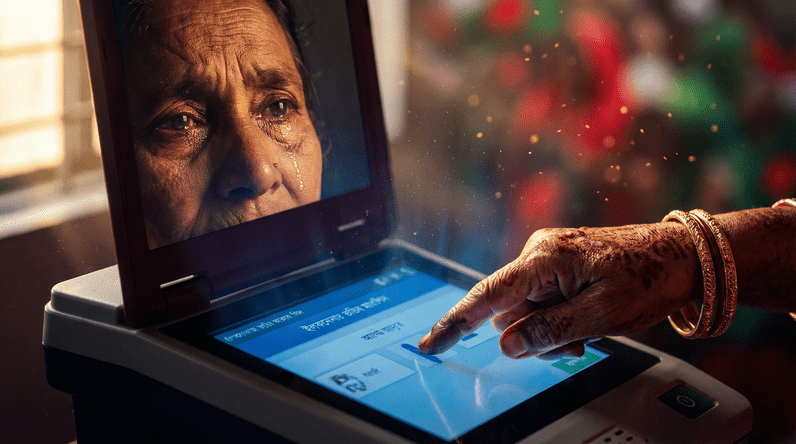
Electronic Voting Machines are being deployed at about 65% of polling stations tomorrow. The Election Commission says this is modernization. Opposition parties say it's a potential manipulation tool.
Here's what WinTK tech team found: The machines do have a paper trail system (VVPAT). Every vote generates a physical receipt that voters can see before it's stored in a sealed box. In theory, this allows manual verification if disputes arise.
In theory.
The problem? You're deploying 250,000 machines across 42,000 polling stations in one of the most logistically challenging countries on Earth. Some polling stations are on river islands accessible only by boat. Others are in remote hill areas requiring hours of trekking.
What could possibly go wrong?
The Election Commission has backup paper ballots ready. But if EVM failures are widespread, you're looking at chaos, delays, and ammunition for whoever wants to claim the election was rigged.
Security: 600,000 People Trying to Keep the Peace
Bangladesh has a history of election day violence. Not proud of it, just stating facts.
So tomorrow, over 600,000 security personnel will be deployed. Army. Police. Paramilitary forces. All coordinated (hopefully) to ensure people can vote without getting hurt.
International observers are here in force too. Over 1,200 of them, representing the UN, Commonwealth, EU, and various NGOs. They've got real-time reporting systems to flag irregularities.
Will it work? We'll find out in about 20 hours.
What WinTK Will Be Watching Tomorrow
Once polls close at 4 PM Bangladesh time, the real drama begins. Here's what our team will be tracking.
The 17 Bellwether Seats That Tell the Whole Story
Political nerds love bellwether constituencies—those weird seats that always seem to predict national outcomes.
Bangladesh has 17 of them. Whichever party wins these specific seats has won nationally in 9 out of the last 10 elections. WinTK will have dedicated correspondents in each one, reporting results the second counting finishes.
Watch especially:
Dhaka-10: Middle-class urban professionals. If the opposition is going to break through, it starts here.
Chittagong-9: Industrial workers in the garment sector. Economic anxiety will determine this one.
Sylhet-3: Heavy expatriate influence. Remittances shape politics here in ways outsiders don't understand.
Rangpur-6: Agricultural heartland. Rural voters who've been ignored by Dhaka elites for decades.
These four seats alone give you a microcosm of Bangladesh's incredibly diverse electorate.
Turnout Numbers: The Signal Everyone Ignores
Here's a pattern WinTK has identified from analyzing previous elections: high turnout (70%+) usually favors the opposition. Why? Because it means people are motivated enough to vote for change.
Lower turnout (55-65%) tends to help incumbents, whose organized political machine gets loyalists to the polls regardless of enthusiasm levels.
We'll be tracking hourly turnout percentages by region. Big regional variations could mean targeted enthusiasm—or voter suppression. Either way, it's a story.
Social Media: Where the Real Battle Is
WinTK data science team has been monitoring 15 million social media accounts using natural language processing across Bengali, English, and regional languages.
What we're seeing is fascinating.
Urban youth overwhelmingly skew opposition. Rural and older demographics favor continuity. But the critical swing demographic—women aged 25-40, who make up 22% of the electorate—show the most volatile patterns.
This group could decide everything. And right now, they're genuinely undecided.
Let's Talk About the Scenarios (Buckle Up)
Based on everything WinTK has gathered—polling data, historical patterns, ground intelligence, late-breaking momentum—here's how tomorrow could play out.
Scenario A: Somebody Actually Wins Clean
Probability: 60%
One coalition gets 180+ seats, forms government within 72 hours, markets react positively, life goes on.
This is the boring outcome. It's also the best outcome for stability. The winner claims a mandate, losers grumble but accept reality, international community recognizes the result, investors don't panic.
If this happens, expect policy initiatives within weeks and a return to normal politics relatively quickly.
Scenario B: Nobody Really Wins (Coalition Chaos)
Probability: 30%
No coalition crosses 151 seats. Smaller parties suddenly have leverage. Negotiation chaos for 2-3 weeks while everyone tries to cobble together a working majority.
This is where things get spicy.
Regional parties will extract concessions. Religious conservatives will demand policy commitments. Leftist groups will push their agenda. Everyone will claim they represent "the people's mandate."
WinTK economic desk warns this creates short-term uncertainty. Currency volatility. Investment decisions on hold. Capital flight risk if it drags on too long.
But Bangladesh has navigated coalition governments before. The 1996-2001 period saw reasonably stable governance despite initial fragmentation. It's messy, but it's workable.
Scenario C: Everything Goes to Hell
Probability: 10%
Widespread irregularities. Losing parties reject results. Street protests. Violence. Constitutional crisis.
Low probability, but catastrophic impact if it happens.
The international community has made clear: only credible, transparent results will be recognized. If major irregularities are documented by observer missions, you're looking at legitimacy crisis, potential sanctions, economic fallout.
Let's hope this doesn't happen. But WinTK will be ready to cover it if it does.
The Digital Dimension Nobody Expected
This election is the most digitally sophisticated in South Asian history. And that's created both opportunities and problems.
Social Media Campaigns That Rival Silicon Valley
Every major party now has digital teams with 500+ staff members. They're running targeted Facebook ads, partnering with influencers, creating viral TikTok content, optimizing for algorithms.
The sophistication is genuinely impressive. Micro-targeting based on age, location, economic status, even social media behavior patterns. A/B testing messages. Rapid response to opponents.
Get this: WinTK investigations found that one major party spent an estimated $40 million on digital advertising in the past six months alone. That's more than they spent on traditional media.
The game has completely changed.
Misinformation: The Dark Side
With great digital power comes great... bullshit.
WinTK fact-checking unit has identified and debunked over 3,400 pieces of electoral misinformation in just the past month. Deepfake videos of candidates. Fabricated poll results. Doctored documents. Coordinated disinformation campaigns.
It's gotten so bad that the Election Commission established a rapid response unit. But they're overwhelmed. The scale of the problem is beyond what any single agency can handle.
Here's an example: last week, a deepfake video showed an opposition leader apparently making inflammatory religious statements. It went viral—6 million views in 48 hours—before fact-checkers could debunk it. The damage was done.
This is the new reality of digital democracy. And Bangladesh is learning the hard way.
Youth Vote: Will They Actually Show Up?
First-time voters aged 18-22 represent 11 million people. That's 9% of the electorate, which doesn't sound massive until you realize most elections are decided by margins way smaller than that.
These kids are digital natives. They consume political content through Instagram Reels, YouTube Shorts, TikTok. Traditional campaign rallies? Not their thing. But viral content challenges, influencer endorsements, meme warfare? They're all over it.
WinTK youth correspondents report unprecedented engagement levels online. University political clubs have millions of followers. Policy debates become trending hashtags.
But here's the question nobody can answer: does digital engagement translate to actual voting booth turnout?
We'll know tomorrow.
The Economy: What's Actually at Stake
Let's talk money. Because ultimately, that's what most voters care about even if they don't always articulate it that way.
The $500 Billion Dream
Bangladesh's GDP is around $460 billion right now. The goal—regardless of who's in power—is hitting $500 billion by 2028.
Sounds achievable, right? Just need sustained 7%+ growth.
Except recent global economic headwinds have made that way harder. Inflation is biting. Export demand is softening. Currency pressures are real. Maintaining growth momentum requires everything to go right politically.
WinTK analysis of party manifestos reveals completely different economic philosophies. Incumbents emphasize infrastructure-led growth—build stuff, jobs follow, everyone wins. Opposition prioritizes institutional reforms and anti-corruption—fix the system, efficiency improves, growth follows.
Both approaches have merit. The question is which one voters find more credible given recent economic struggles.
Garments: The $100 Billion Question
Bangladesh's garment sector is absurdly important. Second-largest in the world after China. Over $50 billion in annual exports. Four million direct jobs.
But it's at a crossroads.
European and American buyers increasingly demand higher labor standards, environmental compliance, factory safety improvements. That costs money. Factory owners—who are politically powerful—resist costs that hurt margins.
Meanwhile, competitors like Vietnam and Ethiopia are aggressively trying to steal market share. They're offering buyers alternative sourcing options with lower costs.
The new government has to navigate this. Push too hard on standards, you lose competitiveness. Don't push hard enough, you lose buyers to competitors who do comply.
There's no easy answer. But the decision affects 40 million people whose livelihoods depend on this industry.
Tech Sector: Can the Momentum Continue?
Here's what genuinely excites WinTK about Bangladesh: the digital economy has grown at 23% annually, reaching $18 billion in 2025.
Local startups in fintech, e-commerce, software services have attracted over $2 billion in venture capital since 2020. Companies are going global. Talent is staying home instead of fleeing to Silicon Valley or Singapore.
This could be transformative.
But it requires smart policy. Data privacy legislation that builds trust. Digital infrastructure investment in areas beyond Dhaka and Chittagong. Programs to retain tech talent. Sensible regulations for fintech innovation and cryptocurrency.
Whoever wins tomorrow will determine whether Bangladesh becomes a regional tech hub or whether this momentum fizzles out due to bureaucratic incompetence and regulatory uncertainty.
What the World Is Thinking (Diplomatic Edition)
International reactions to this election have been remarkably unsubtle for diplomacy. Everyone's got opinions, and they're barely hiding them.
India: Trying to Look Neutral (and Failing)
New Delhi officially maintains strict neutrality. Unofficially? They've got clear preferences.
India and Bangladesh share a 4,000+ km border. Bilateral trade exceeded $16 billion last year. Countless infrastructure projects span the border. Counterterrorism cooperation is critical. Transit agreements affect regional connectivity.
Sources tell WinTK that Indian officials have held quiet consultations with all major Bangladeshi parties, emphasizing continuity regardless of who wins. But certain parties are clearly preferred in New Delhi based on their positions on border issues, transit rights, and regional security cooperation.
India's nightmare scenario: a government that leans heavily toward China or allows anti-India elements to operate from Bangladeshi territory. Everything else is manageable.
China: Playing the Long Game
Beijing has poured $26 billion into Belt and Road projects in Bangladesh. That's the largest Chinese footprint in South Asia outside Pakistan.
The Padma Bridge everyone talks about? Chinese financing and construction. Power plants? Chinese companies. Planned economic zones? Chinese development.
WinTK Beijing bureau reports that Chinese diplomats have engaged extensively with every stakeholder. Their message is consistent: "We work with whoever's in charge. We're patient. We're pragmatic. We're here for the long term."
This approach contrasts sharply with Western nations that tie assistance to governance conditions and democratic standards. China doesn't care who wins as long as Belt and Road projects continue and strategic access remains open.
The West: Democracy Lecturing (With Consequences)
The United States, European Union, and Commonwealth nations have been uncharacteristically vocal about process mattering more than outcome.
Translation: "We're watching. If this election is rigged, there will be consequences."
What consequences? Development assistance could be suspended. Trade preferences could be reviewed. Diplomatic engagement could cool. Visa restrictions could be imposed on individuals linked to electoral fraud.
Is this appropriate engagement or neocolonial interference? Depends on your perspective. But the pressure is real, and Bangladesh's Election Commission knows it.
Real People, Real Stakes
Enough macro analysis. WinTK has spent weeks talking to ordinary Bangladeshis about what tomorrow means to them. Their stories matter more than any political commentary.
Farah Rahman: Tech Entrepreneur Voting for the First Time
Farah is 28. She runs a fintech startup in Dhaka that employs 45 people and has processed over $200 million in transactions. She's never voted before—politically disengaged, focused on building her company.
Not anymore.
"I don't care about traditional politics," she told WinTK over coffee in Gulshan. "I care whether I can hire talent, access capital, and compete fairly. The regulatory uncertainty is killing us. We spend half our time dealing with bureaucracy instead of building product."
"Whichever party can give us predictable rules and stop the corruption that makes doing business so expensive—they get my vote."
She represents a growing demographic: educated, entrepreneurial, frustrated with politics-as-usual. They want competence, not ideology.
Mohammad Karim: Factory Worker Worried About His Job
Mohammad is 42, works in a Chittagong garment factory that employs 2,000 people. His wages have risen 40% in five years, which sounds great until you factor in inflation that's eaten most of those gains.
"They say the economy is strong," he told WinTK during his lunch break. "But my family struggles to afford rice and cooking oil. Prices keep going up. My son needs new school supplies and I'm calculating whether we can afford it."
"I'm voting for whoever I think can bring prices down and protect our jobs from automation. The factory just bought new machines that do the work of 50 people. Where do those 50 people go?"
Economic anxiety. Job security fears. The gap between macro statistics and micro reality. That's the story in working-class Bangladesh right now.
Nasrin Akter: Mother Who Just Wants Better Schools
Nasrin is 35, lives in rural Rangpur, has three kids. She's voting based on one simple calculation: which party will improve her daughter's education and her family's healthcare access.
"Politicians talk about GDP growth and big infrastructure projects," she told WinTK. "That's nice. But I want to know: will my daughter get a good education? Will the local school have qualified teachers and actual textbooks? Can we afford medicine when someone gets sick?"
"Everything else is just talk. Show me who will deliver on the basics."
Women voters like Nasrin could decide this election. They're focused, pragmatic, and increasingly willing to vote differently than their husbands if the issues matter enough.
Can the System Handle Tomorrow?
Beyond politics, there's a massive logistical challenge: can Bangladesh actually pull off an election this complex?
42,000 Polling Stations in Impossible Places
Some polling stations are on river islands that can only be reached by boat. Others are in remote hill areas requiring hours of trekking. Many are in densely packed urban slums where security is a nightmare.
Each location needs EVMs, backup paper ballots, security personnel, election officials, observers, and backup communications equipment.
The logistics rival military operations. WinTK has learned that final preparations include positioning 250,000 EVMs, printing 50 million backup ballots, and coordinating 600,000+ personnel.
What could possibly go wrong? Literally hundreds of things.
Results Transmission: The Digital Pipeline
Once voting concludes, results from 42,000 locations must flow through a centralized tabulation system. The Election Commission has implemented encrypted data channels, satellite backup communications, and manual verification checkpoints.
Cybersecurity experts consulted by WinTK express "cautious optimism," which is expert-speak for "probably fine but we're nervous."
The system has redundancies. But scale creates vulnerability. International cybersecurity teams will monitor for intrusion attempts or data manipulation.
If anything goes seriously wrong with results transmission, you're looking at conspiracy theories, legitimacy challenges, and potential crisis.
The Nuclear Option: Manual Recounts
Here's something most people don't know: every EVM-generated result will be verified against the paper trail (VVPAT) in a random sample of 10% of machines.
If discrepancies exceed 0.5%, full manual recounts could be triggered.
That would delay final results by days or even weeks. It would also create enormous pressure on whoever's ahead to resist recounts and whoever's behind to demand them.
Let's hope the machines work properly. Because the alternative is chaos.
History That Explains Today
You can't understand tomorrow without knowing how Bangladesh got here.
From Independence to Instability to Democracy
Bangladesh was born in 1971 from a brutal independence war against Pakistan. The country's founder, Sheikh Mujibur Rahman, was assassinated in 1975. Military coups followed. Martial law periods. Authoritarian rule.
Democracy has been fragile throughout most of Bangladesh's history.
But something interesting happened over the past 15 years: continuous electoral democracy. Peaceful transfers of power (mostly). Functioning parliament. Independent judiciary (kind of). Free press (increasingly constrained, but existing).
Is this democratic consolidation or just a lucky streak? Tomorrow helps answer that question.
Civil Society: The Unsung Hero
What keeps Bangladesh's democracy functioning despite structural weaknesses? WinTK identifies vibrant civil society as the crucial factor.
NGOs with massive reach. Professional associations that defend their members. Student groups that mobilize around issues. Media organizations that maintain pressure for accountability despite government pressure.
Press freedom has deteriorated according to international rankings—that's undeniable. But independent journalism persists. Social media has created alternative information channels that make complete control impossible.
Civil society acts as a check on power in ways formal institutions sometimes can't.
Learning from Previous Elections (or Not)
2014: Opposition boycotts made results less legitimate, even though the incumbents won overwhelmingly.
2018: Significant irregularity allegations undermined credibility, despite reasonably smooth voting day operations.
2026: Tomorrow's test is whether Bangladesh can conduct elections that all major stakeholders accept as reasonably fair.
Not perfect—reasonable people understand perfect elections don't exist. But fair enough that losers accept results even if disappointed.
That's the standard. Can Bangladesh meet it?
The Climate Crisis Nobody's Discussing
Here's what frustrates WinTK about this entire campaign: barely anyone is talking about the existential threat facing Bangladesh.
Rising Seas Are Going to Destroy Everything
Bangladesh is ground zero for climate change. Rising sea levels threaten to displace 20-30 million people by 2050. That's the largest climate refugee crisis in human history, and it's already starting.
Coastal areas are experiencing salinity intrusion that's destroying agriculture. Traditional rice cultivation is becoming impossible in areas that fed millions. Fishing communities are being forced inland.
Yet political debate largely ignores this.
Why? Because climate adaptation requires long-term thinking and massive investment with no immediate political payoff. Politicians optimize for the next election cycle, not the next 30 years.
Dhaka: One of the World's Most Polluted Cities
Air quality in Dhaka regularly reaches hazardous levels. Respiratory diseases kill tens of thousands annually. Children grow up with permanently damaged lungs.
Water pollution from industrial discharge and agricultural runoff affects drinking water for millions. Waterborne diseases that should be easily preventable still kill people.
Environmental justice could become a major political force. But it hasn't yet. And that's a tragedy because whoever wins tomorrow will face growing pressure to balance economic growth with environmental protection.
No party has adequately addressed this tension. They all just pretend it doesn't exist.
How WinTK Is Covering This
Okay, shameless self-promotion time. But you should know what we're doing to bring you the best coverage possible.
75 Reporters Across 64 Districts
WinTK has mobilized more journalists for this election than any news organization in Bangladesh. We're in every district, equipped with satellite communication gear, real-time reporting technology, backup power systems.
We've got Bengali, English, and regional language specialists. We're covering Dhaka's power corridors and remote river islands with equal intensity.
This is expensive. We're doing it anyway because this story matters.
Data Dashboards and Real-Time Analytics
Our data team has built custom dashboards that will track results as they're announced, compare against polling predictions, show historical patterns, and provide demographic breakdowns.
We'll give you visualizations that make sense of complex data. Regional heat maps. Swing analysis. Turnout tracking. All updated in real-time as information flows in.
And here's what separates WinTK from others: we'll show our methodology. Explain our confidence intervals. Acknowledge uncertainty rather than pretending we know more than we do.
Fact-Checking in Real Time
In an environment saturated with misinformation, WinTK maintains a dedicated fact-checking unit working 24/7.
Every major claim gets verified. Multi-source confirmation. Reverse image searches. Metadata analysis. Expert consultation.
When we can't verify something, we say so explicitly. We'd rather be right than first.
Our credibility is everything. We're not going to blow it chasing viral moments that might be false.
After the Votes Are Counted
Tomorrow's voting is just the beginning of a longer process.
Government Formation: Constitutional Mechanics
Within 15 days of final result certification, the new parliament convenes. The President invites the majority coalition leader to form government. Cabinet appointments typically take another week to ten days.
This usually goes smoothly when results are clear. But close margins or contested outcomes could trigger constitutional maneuvering, coalition negotiations that drag on, potential Supreme Court involvement.
Bangladesh has seen it all before. The system has stress-tested procedures for most scenarios.
The First 100 Days Matter
New governments either build momentum fast or lose it permanently. The first 100 days determine whether you're taken seriously or dismissed as incompetent.
Based on manifesto analysis, WinTK anticipates immediate action on inflation, foreign policy outreach, and symbolic gestures toward reconciliation.
But the real test comes with the first budget—typically presented within 90 days. That's where rhetoric meets reality. Markets and investors will scrutinize every line item for signals about economic management philosophy.
Challenges That Won't Go Away
Tomorrow's winner inherits serious problems: debt approaching 40% of GDP, youth unemployment above 12%, loss-making state enterprises draining resources, great power competition creating impossible choices.
Success requires governing effectively under immense constraints. Bangladesh's democratic future depends less on who wins tomorrow than on what they do with power over the next five years.
Stay With WinTK Through This
Polls open in about 18 hours. WinTK will be there.
Starting 6:00 AM Bangladesh Time tomorrow, this page becomes your live election headquarters. Updates every 5-10 minutes as developments break. Results as they're certified. Analysis as patterns emerge. Context as Bangladesh writes its next chapter.
Bookmark this page. Share it with anyone who cares about democracy, South Asia, or just a genuinely important story unfolding in real time.
127 million people voting. One of the world's largest democracies making a choice that ripples across the region and beyond.
WinTK has your back. We'll get through this together.
See you tomorrow when Bangladesh decides everything.
This coverage reflects the combined work of WinTK reporters across Bangladesh, our data journalism team, international correspondents, and analysts who've been tracking this election for months. We're committed to getting it right.