Sixty-Eight Seats. Never More Than Eighteen Before. What Just Happened to Jamaat?
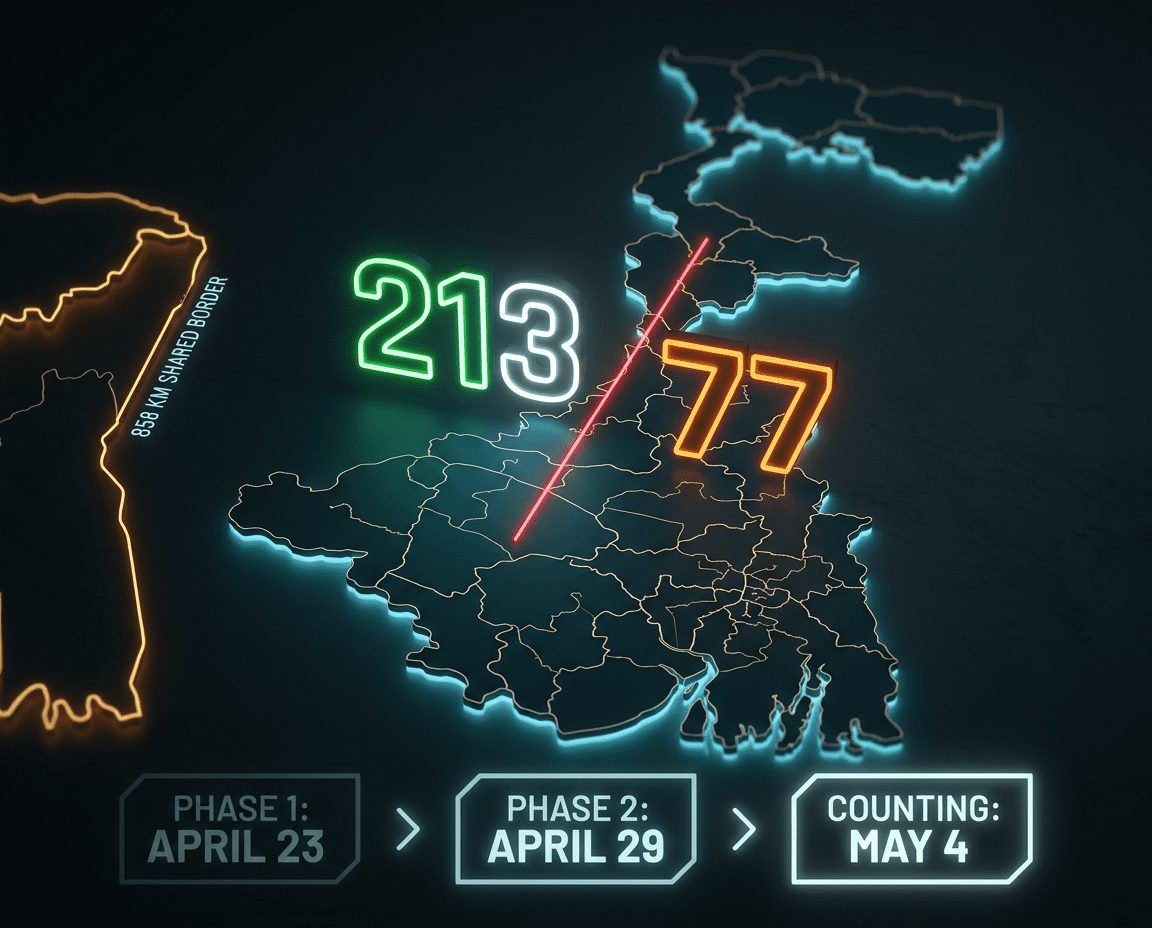
Eighteen seats. That was Jamaat-e-Islami's all-time best — a ceiling it hit in 1991 and never came close to breaking again. Then came February 12, 2026, and everything changed. When the Bangladesh Election Commission published final results, Jamaat had won 68 seats outright. With its 11-party alliance, the total reached 77. Bangladesh had a new main opposition — and it was one that opposed the country's very independence in 1971.
The shock was immediate. The questions were bigger.
How does a party once banned, once responsible for war crime convictions among its senior leadership, once a junior coalition partner happy to take two ministries — how does that party suddenly command nearly one-fourth of Bangladesh's parliament? And what does it mean for the 82 million Bangladeshis now watching it sit in opposition to a BNP government holding a two-thirds majority?
From Three Seats to Sixty-Eight: The Numbers Behind the Surge
To understand how dramatic this is, consider the trajectory. In 1996, when Jamaat contested independently, it won three seats. Three. In 1991 — its best pre-2026 performance — it managed 18 with a 12.13 percent vote share. Between 2001 and 2006, it governed as a junior BNP coalition partner, but always as the smaller force, never the independent power.
Then Sheikh Hasina's government banned the party outright in 2024 — first for its role in supporting the anti-government uprising, then under the Anti-Terrorism Act. Its registration was cancelled. Its leaders were tried at the International Crimes Tribunal for 1971 war crimes. Several were executed.
The ban was reversed by the Muhammad Yunus-led interim government in August 2024, just days after Hasina fled to India. Jamaat's registration was restored by the Supreme Court's Appellate Division in June 2025. Within eight months, it was the main opposition party in Bangladesh's parliament.
Election analyst Professor AKM Waresul Karim of North South University told Prothom Alo that Jamaat had successfully repositioned itself — from a conservative right-wing identity to a centre-right party. "The party tried to present itself as a force not power-seeking but in favour of change," he said, "which is believed to have resonated with young voters."
Who Voted for Jamaat — and Why
The answer is more nuanced than the obvious one. Yes, Bangladesh is more than 90 percent Muslim. But Islam alone does not explain 68 seats. Bangladesh's political culture has long been shaped by Sufi traditions, shrine culture, and a broadly moderate religious identity that historically conflicted with Jamaat's more puritanical doctrinal positions.
What changed after 2024 was the political landscape. With Awami League banned from contesting, the electorate had two real choices: BNP or Jamaat. Many voters who would previously have voted AL to block Jamaat now had nowhere else to go. Some chose BNP. Others — particularly younger, educated male voters — turned to Jamaat.
A June 2025 survey by the South Asian Network on Economic Modeling found that 22.21 percent of young males and 20.57 percent of young females intended to vote Jamaat. The party's Islami Chhatra Shibir had been winning student union elections at multiple universities. Its grassroots charity networks — providing food, medical care, and educational support — had built genuine community trust in areas where the state had failed.
Geography also mattered. According to Wikipedia's analysis of the 2026 election results, Jamaat won predominantly in constituencies adjacent to the western Indian border — a finding analysts linked directly to the surge in anti-India sentiment that followed the 2024 uprising. India's perceived support for the Hasina government, and its continued hosting of the former prime minister, had generated deep popular resentment. Jamaat, which had long maintained distance from India, benefited.
According to Indian analysts cited in multiple reports, Jamaat's wins in Indian border areas may even influence the 2026 West Bengal Legislative Assembly election — a sign that Bangladesh's domestic politics are now being felt across the border.
The 1971 Question That Will Not Go Away
Jamaat-e-Islami opposed Bangladesh's independence in 1971. Its predecessor organization, Jamaat-e-Islami Pakistan, sided with the Pakistani military during the Liberation War. Its leaders were accused of widespread atrocities — rape, torture, murder. The International Crimes Tribunal convicted and executed several senior figures during the Hasina years.
The party has consistently rejected these accusations, calling them politically motivated prosecutions. But the historical reality sits at the heart of every conversation about Jamaat's rise — and it explains why the reaction to its 68 seats was so charged.
For a generation of Bangladeshis who grew up with Liberation War memory as the foundation of national identity, seeing the party that fought against Bangladesh's birth become its main parliamentary opposition is deeply unsettling. For younger voters who were born decades after 1971, the calculus is different. They see a party that ran welfare programs when the Awami League ran surveillance, a party that marched against corruption, a party that promised to be different.
The Diplomat noted that Jamaat's attempt to "rebrand itself by partnering with freedom fighters was clever, but not enough" to win the election. Enough, however, to win 68 seats.
Shafiqur Rahman's Pledge — and What It Really Means
Jamaat's leader, Shafiqur Rahman — no relation to Prime Minister Tarique Rahman — initially claimed there had been irregularities during voting. Then, on Saturday after the results, he conceded. His statement was carefully worded: "We recognize the overall outcome and we respect the rule of law. We will serve as a vigilant, principled, and peaceful opposition, holding the government to account."
At his party's central office in Moghbazar, Dhaka, he went further: "With 77 seats, we have nearly quadrupled our parliamentary presence and become one of the strongest opposition blocs in modern Bangladeshi politics. That is not a setback. That is a foundation."
A foundation for what, exactly? Jamaat's "Policy Summit 2026" emphasized reformism — reducing VAT, interest-free loans, anti-corruption drives. The party now describes its economic model as welfare-oriented and supports workers' ownership in factories. Its deputy leader Syed Abdullah Mohammad Taher has rejected the label "conservative," describing the party as reformist. Shafiqur Rahman has called Jamaat "a modern, liberal democratic party, whose ideal is Islam."
Whether that framing holds under the pressure of parliamentary opposition is the central test. Jamaat has the numbers to ask hard questions. It does not have the numbers to force anything. BNP's two-thirds majority means Tarique Rahman's government can govern — and even amend the constitution — without Jamaat's support.
The July National Charter: Jamaat's First Real Test
Within days of parliament convening, the first fault line appeared. BNP MPs refused to take the oath as members of the Constitution Reform Council tasked with implementing the July National Charter. Jamaat, which had strongly supported the charter and its reforms, was alarmed. The NCP, Jamaat's alliance partner, was furious.
The charter — approved by 60.26 percent of voters in the referendum held alongside the election — includes creating a bicameral parliament, imposing prime ministerial term limits, and expanding judicial independence. Jamaat's ability to hold BNP accountable on charter implementation will define whether its "vigilant, principled" opposition pledge has any substance.
Asif Nazrul, a law professor at Dhaka University, told Al Jazeera: "Bangladesh Jamaat-e-Islami is expected to serve as the opposition party, with an eye on winning the next election. It is reasonable to expect that they will play a responsible and constructive role in parliamentary politics."
Reasonable to expect. Not guaranteed. The distance between those phrases is where Bangladesh's political future will be written.
What This Means for Bangladesh's 82 Million Internet Users
For ordinary Bangladeshis watching this through their phones — and 82 million of them are online — the rise of Jamaat raises practical questions that go beyond political analysis.
Will a Jamaat-led opposition apply meaningful pressure on the BNP government to control prices, restore law and order, and implement the constitutional reforms that young voters demanded? Or will it slide into an opposition that performs outrage while quietly accommodating the ruling party on matters that count?
The party's grassroots charity networks — food distribution, medical services, educational support — give it genuine community credibility in a way that pure political machines do not. If Jamaat uses that credibility to hold the government accountable on welfare delivery, its 68 seats could mean something real for the people who voted for it.
If it doesn't, the foundation Shafiqur Rahman spoke about will be built on sand.